Showing posts with label Pastoral Resources. Show all posts

Monday, February 6, 2012

Worship across the Racial Divide: A Response from Three Practitioners

My new book on the dynamics of worship and music in diverse congregations has been out for just a few short weeks, but thanks to Art Lucero the first reviews are now in.

Last week, three Christian music leaders, Josh Davis, Nikki Lerner, and Jeff McCourt, took time to write their own reactions to the book. I am so pleased with how carefully they read the book and the responses they gave:

Josh Davis wrote, "Marti clearly states that no one knows 'what manner of worship is best for stimulating and accelerating racial and ethnic diversity in churches.' Absolutely. There is no one-size-fits-all method or approach to multicultural worship."

Nikki Lerner wrote, "I could not agree more with his conclusions at the end of this book: As I continued to pursue my research, I came to understand that it is not the acoustics of musical style but rather the visible presence of diversity—a racialized ritual inclusion—that stimulates integration of different racial and ethnic groups into their churches [pg. 198]."

Jeff McCourt wrote, "Honestly, I argued with Dr. Marti most of the way through the book but was beginning to feel an openness to his perspective due to the thoroughness of his research..."

Each of them wrote much more, and they're worth reading for yourself. I also provided a brief response that you can see at the bottom of the page.

Saturday, December 5, 2009

Smartphone Religion at the Duke Divinity Call & Response Blog

Christmas season is in full gear at the Marti house -- finishing up my classes, the kids homework projects before the end of the year, community activities here in Davidson.

In the midst of it all, I've been able to take Jason Byasee's invitation to again contribute last week to the Faith & Leadership Blog at Duke Divinity.


My latest post on The Wi-Fi Church of the Future (and the Present)
is tagged under Innovation | Liturgy | Technology ):

Worldwide iPhone sales by quarter in an svg fo...Image via Wikipedia

"The past two years have seen a rapid acceleration in the adoption of portable computing by the average person. This will inevitably prompt changes by church leaders."
It's prompted a good online exchange.

I'll encourage you to read the whole post on your own. But more than the post itself are the responses that follow it.

The Executive Director of Leadership Education at Duke Divinity first describes his "knee jerk" reaction against churches leaning on such technology. Another believes "the app" already exists. And yet another comment brings concern for the poor and their access to wi-fi technology and information.

I appreciate the dialogue. I'm learning all the time, and the comments are helpful.

Overall what this exchange suggests to me is that we've arrived at an interesting moment in the relationship between technology and church.

Assorted smartphones. From left to right, top ...Image via Wikipedia

The American culture has swallowed the use of smartphones almost whole -- after all, analysts can readily predict how many iPhones will be found under the Christmas tree this year.

But church leaders remain nervous about learning new techniques to harness the use of these advanced devices to their ministries.

Smartphones are not the future; they are already here.

So the failure lies not in ministry budgets (people have their own phones), it lies in the imagination of leaders to use these devices to advance their ministry.

Friday, November 13, 2009

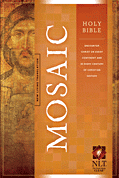
Mosaic Bible - The Branding of Devotional Christianity

I agreed to write a "review" of the new Mosaic Bible, a new formatting of the Protestant Scriptures published this Fall by Tyndale Publishers. The publisher provided me a deluxe, imitation leather version. Joining Tyndale's campaign afforded an opportunity for me to look take a closer look at some of the sociological aspects of Bible marketing today.

Walk into any local bookstore, and you will find dozens of choices for bibles today. The production and distribution of market-savvy bibles may surprise some, but it is one of the most interesting developments in modern Christianity.

Crafting Editions of The Word of God

This Gutenberg Bible is displayed by the Unite...Image via Wikipedia

We can look back and see how the printing press certainly enabled a more ambitious structuring of the Protestant scriptures. The Geneva Bible first printed in 1560 was the first Bible to add numbered verses to make referencing passages easier. In addition, every chapter included extensive marginal notes and references making the Geneva Bible the first English "Study Bible." Between Between 1560 and 1644 at least 144 editions of this Bible were published.

Yet the initial effort to craft these bibles was considerable. It took scores of hours to typeset new bibles, and innovative systems of notations, illustrations, and footnotes created enormous difficulties. Take a glance through any edition of the Thompson Chain Reference Bible to gain an appreciation for the tremendous hours of work required to craft these books as ultimate "Bible Study Tools" intended to take personal reading of the scripture to unprecedented layering of hermeneutic possibilities.

Furthermore, the structuring of "notes" became the occasion to self-consciously promote whole theological systems. Consider the successive editions of the Scofield Reference Bible for its quite specific (and to many people peculiar) discussion of world history, the relationship between Israel and Christianity, and anticipations of eschatological happenings.

Now, the rise of digital typeset and new print techniques (including the ability to print color pages cheaply) have greatly expanded the possibilities for bible formats. Production houses have become increasingly creative in the formation of new types of bibles. While the "text" of the bible (the translation formats) may often be the same, the formatting, illustrations, and notations accompanying the text are what make a new product.

Bibles Proclaim a Brand of Faith

Moreover, bibles are not only intended to provide exhaustive notations but also reorientation toward the faith. In other words, while it may initially seem that "a bible is a bible is a bible," it is important to note that the crafting of a bible is equivalent to forming a strategic presentation of the Christian faith. In short, any carefully designed bible proclaims a brand of faith.

Enter Holy Bible: Mosaic NLT.

The Mosaic Bible strives to make a book primarily meant for meditation and prayer. It claims to be "a new genre of Bible—a weekly meditation Bible." In comparison with the large, white bible that occupied the living room table of my home growing up, the Mosaic Bible is portable and durable. But more than its portability, what makes the bible intentionally geared to personal reflection is that nearly the first half of the whole book is a series of weekly "installments," a set of scripture readings, prayers, reflections, and empty lines (for writing) accompanied by religious artwork. The weeks are aligned with church seasons. (For those who don't know which season it is, a website can be consulted; this is the 26th week of Pentecost ("Righteous Judgment"), pg m314.

The readings and prayers are intended to be diverse, affirming Christianity as a historic and global religion. There are readings from ancient to contemporary authors from every continent and every century. Of course, these excerpts are all highly orthodox and contain the presentation of Christian concepts and virtues to those generally accepted by more conservative Protestant Christians.

There is also a notable striving to affirm of the use of art in religious devotion. Full-color artwork, hymns, and poems are included.

The New Living Translation provides the base scriptural text, a newer, freer English version that allows for contemporary and colloquial speech constructed by a team of (mostly Evangelical) biblical scholars.

So, what is the branding of Christianity that comes through this particular bible?

I would suggest several dominant themes:
  • A bible can be aesthetically pleasing, yet should still evoke a pious consideration of the "sacredness" of the book as traditionally understood.
  • The bible is to be a personal, devotional tool such that the notations in "your" bible will not be the same as those in "my" bible.
  • However, the bible is not meant to be read "individualistically," but in the context of a broader community of believers through history.
  • The bible is to be read regularly and systematically.
  • The bible is most profitably read accompanied by prayer and focused reflection on themes.
  • Although structured devotions are useful, individuals should take corporate themes as launchpoints for personal reflections and commitments.
  • Bible study tools including cross-references, dictionary, maps, and concordances, are now "assumed" as essential in personal bibles.
  • The use of contemporary translations means that there is a recognition that the spiritual value of the bible is not found in traditional words or phrasing but rather in the meaning of those words to the extent they can be accurately conveyed.
  • And the aggressive marketing of a bible is appropriate in that the goal is not self-promotion as much as the distribution of a tool that gets people to read the scriptures for themselves.
My participation in the "blog tour" of the Mosaic Bible certainly indicates that bible publishers are attempting to work with a crowded marketplace. There are already many bibles on the market; the attempt to craft a message to highlight the uniqueness and devotional utility of any new bible presents a considerable challenge. To these ends, Tyndale has a dedicated website, a blog, a twitter account, and a listing of other blog reviews available.

Finally, as part of the marketing blitz for the product, Tyndale is giving away a few copies of this new book. If you are still reading this and are interested in one, the first person to email me with a request will receive a certificate from Tyndale that can be redeemed for your own personal copy.

Monday, October 26, 2009

Church “Tradition” Previous Era’s Cultural Accommodation


Thanks to Jason Byassee, Executive Director of Leadership Education at Duke Divinity, a new post on their Call & Response blog describes my take on tradition and innovation in church life.


In a post titled 'Our "Tradition" is Often a Previous Era's Cultural Accomodation," I try to give church leaders a perspective that will open them to reconsidering not only the new religious movements which they often hate, but also their own religious traditions which they so very much cherish.

The
post says:
When new forms of religious vibrancy clearly manifest social change, critics are often quick to attribute their successes to crass appeals to popular tastes.

Here’s an example. I describe in my book “Hollywood Faith” how Oasis Christian Center, an evangelical church in Hollywood, California, grew from five hundred to over two thousand people from 2001 to 2003. Incorporation of entertainment, fun, relevance, and practicality in the promotion of spiritual vitality yielded this spectacular growth.

It is worth asking whether the growth and excitement evident at Oasis is due simply to placating a consumer-driven, popular culture. Is Oasis a secularized “church”? Is religion being compromised?

My main point is to urge recognition that no religious tradition exists which was not forged through a historical processes of accommodation and acculturation.

Working the delicate tension between relevance and ritual, between cultural resonance and cultural transformation, is a perpetual challenge for church leaders everywhere. I want to encourage church leaders to think more carefully about negotiating this tension in recognition that their cherished "tradition" are historical forms that represent cultural adaptations to a prior era.

Friday, September 11, 2009

My Experience Twittering Religion

Quick Post: In the past month, I've noticed a lot on the use of media in congregations. It also happens to be a very blog-friendly topic -- visual media items can be seen, reviewed, and downloaded by readers with the links provided.

Now that I've experienced a conference where I fully immersed myself in living the "twittering stream of religion," I want to again bring up the use of Twitter in religious gatherings.

What started my thinking for today is coming across another "Twitter and Church" discussion. The website Church Marketing Sucks posted a set of links to their recent entries on the use of Twitter (the micro-blogging service) you can explore:

Image representing Twitter as depicted in Crun...Image via CrunchBase

But the extent of Twitter is far more than church services.

More broadly, posts like this lead me to conclude that churches, denominations, seminaries, and para-church organizations have moved American religion decisively toward mainstreaming social media.

My experience with this at the Moltmann Conversation organized by Emergent Village is the first time I decided to dive into this Twitter stream full-force.

Conferences like the Moltmann Conversation I joined at Chicago and the earlier Earl Lectures conference at Berkeley encourage attenders to "tweet" through the sessions. Wi-Fi is available in the auditorium, and extra electrical "plugs"are spread throughout the room. This allows laptops and other portable devices like smartphones to sustain power. I used the "twubs" service found at "http://twubs.com/moltmann" and the "#" hashtag "#moltmann" available through my twitter feed.

The collective "tweets" are available to participants and displayed on a large, public screen at the front of the auditorium. Between my laptop, my phone and the screen up front, I was able to access tweets continuously. This added another dimension to capturing the mood and messages of the conference by letting participants reverberate quotes, observations, questions, insights, and online resources through a continuous live stream.

In my experience, Twitter primarily echoes significant statements made on the platform. I found the 250+ audience in Chicago to be aggressive listeners. When they hear a good statement, they capture it and reel it in with the zeal of a fly fisherman. Fellow "tweeters" will snatch that sentence -- keeping it to 140 characters -- and "tweet" it to the rest of the group. The more times the statement is posted, and the more it is RT'ed (return posted by others), the more collectively important the sentence appears to be. As the conference goes on, I read and follow others thoughts as we revisit significant statements, drawing them out of the steady flow of talk happening out front.

This forces the conference to take on an aphoristic quality. Sharp, witty statements are accentuated; paragraphs of thoughts are assumed. It's less a summary, and more an attempt to help hearers remember what happened.

In addition, people post short remarks and questions. Some will add a link that sends others to online ideas and sources. This gives a privileged view of the "mind" of other participants. What are they asking? What are they critiquing? What do they highlight? What do they ignore?

Also, some at the conference took a few pictures. Using the service "Twitpic", you can capture the view of the conference as taken by one of the participants. Here's a picture twittered from the Moltmann Conversation. Using all tweets together, we have the potential of creating a type of textual and visual archive for the event.

Because the Twitter feed is accessible to anyone with an internet connection, people unable to physically attend are able to vicariously experience some aspect of the conference by also catching the tweet-flow. While it is not a summary of the conference, those not there still derive at least some small benefit and an unusual privilege of overhearing some of the best "lines" from a very long conversation.

Finally, it's hard to ignore that "tweeting" conferences is a fascinating form of participatory marketing. Conference organizers know that while actively twittering adds value to participants and observers, it is also a benefit to the organizers to "spread the word" and broadcast the happenings of the conference in multiple directions through social networks. Thus, the power of social media to promote this and future events is realized in a distinctive way.

My experience at the conference helped me appreciate the extent to which organizers are deliberately adding "tweeting" to their events. So Twitter is interesting and important not only for worship and liturgy but also for the expansive experience of religion and collective experience.

I left considering this question: could the use of Twitter become as "normal" to Christianity as the use of hymnals?

Tuesday, September 8, 2009

Instant Cool: Explaining the Diffusion of "Contemporary" Church Culture

Church Marketing Sucks, a website concerned with the use of contemporary marketing techniques by church leaders, recently provided a list of great media resources for churches freely available online. Through sites like these, we have a privileged window into American religion. Why? Because understanding the circulation of these media materials gives us an alternative means for understanding the widespread diffusion of "contemporary" church culture.

The Fields Church - Newspaper AdImage by mufan96 via Flickr

We know contemporary churches use rented facilities. Not just movie theaters and high school auditoriums--churches are using bars and coffeehouses, community centers and warehouses, even lake shores and parking lots. How do these church leaders focus spiritual attention in these architecturally challenging sites?

Well, what's happening is that even churches who do not have specially-designed or "megachurch" aesthetics are adopting sharp media imagery to promote an exciting "vibe" that directs devotional attention and speaks to quality (and money) even when the church is just starting out.

Take a look through the free resource sites listed by Church Marketing Sucks below. Each of these congregational ministries have longtime experience producing entire suites of visual materials that compliment and accentuate message series:Clicking and exploring these sites, you get a sense of what non-high liturgy, "contemporary" churches are bringing into their services.

(For church-researcher types, these materials provide fodder for understanding seeker churches, new paradigm churches, and emerging adult spirituality.)

But, I'm writing this post to make a particular point: The availability of these materials points out an aspect of the modern diffusion of church culture. Here's what I see.

The internet is allowing more easy accessibility to media resources. Churches which have produced these materials (and are frequently asked by scores of other church leaders who literally salivate over obtaining such things) are seeing the extension of their local church ministry as giving away these resources--at zero cost.

See, churches that produce these materials are well aware of the money and time invested in the creation of media materials that have an inherent disposability to them. They'll never be used again in their church (since churches don't "repeat" sermon series). So they are happy to have them used by others and see their investment put to good use by others.

In other words, providing media resources to other churches (after they have been used in the base church) is understood to be part of the missional outreach of the congregation.Graphic materials are viewed as tools (modern, necessary, missionary tools) that can be easily adapted by like-minded ministries who are perceived to be essentially partnering with them to spread a message they already believe should be widely promoted.

Because these media items are used in many different churches across the nation (perhaps the anglophone world), and because church attenders are highly unlikely to know the materials they see were originally used somewhere else, there is an unacknowledged yet powerful diffusion of Christian visual culture -- at last a type of Christian culture.

And because we have not studied this, I speculate that the diffusion of style, ambiance, and ethos of religion embedded within these media materials is reinforcing particular boundaries of similarity and identity.

In the research literature, this is a type of "institutional isomorphism." But I won't go into all that now. It's enough to say that researchers DiMaggio and Powell* defined imitating or "Mimetic Processes" as coming from similar external conditions. In particular:

Uncertainty encourages imitation.

What does this mean for how "contemporary" church culture is widely reproduced?

Let's look at how this works. Using DiMaggio and Powell's framework, predictors of similarity (or "isomorphism") are based on premises like this:

Principle 1: The greater the centralization of resource supply, the more it will change to resemble the organizations it is dependent upon.

Application
1: There are only a few churches willing to give away these media materials, so the dependency on these few churches raises their influence as models for how to "do church."

Principle 2: The more uncertainty, the more an organization will model it's structure after successful firms.

Application
2: The means to growing new (and struggling) churches is highly uncertain, so leaders look to the successes of other, usually much larger and media-rich, churches.

Principle 3: The more ambiguous the goals, the more an organization will mimic a successful one to establish legitimacy.

Application
3:
A mission statement like "Reaching our community with the gospel" is quite ambiguous, so church leaders quickly become alerted to widely accepted models of ministry and absorb their media practices.
These are not exhaustive, and certainly the principles are not directed soley toward understanding the use of media. Nevertheless, these principles provide a quick peek into the dynamics of isomorphism that can be applied.

Other important aspects are how organizational models can be diffused is through employee migration, which in the case of churches would include the movement of clergy, lay leaders, as well as members between churches. Larger churches with well-institutionalized media ministries more quickly diffuse their media-intelligent people in comparison with smaller churches which are not likely to have as extensive of media practices.

Also, organizational models are spread by consulting firms, which in the case of leaders is usually accomplished through church leader conferences. Highlighting and discussing the use of media is a common aspect of "contemporary" church conferences.

I've come a long way in this post, something I thought I'd shoot off much more quickly than I did. Here's my main point.

In short, I've come to think that the accessibility and wide-spread use of church media materials gives us an alternative pathway to grasping how the cultures of "contemporary" churches can be understood. For me, this highlights that the occurrence of "contemporary" churches are not isolated phenomena--and most of us know this.

Further, it also suggests that "contemporary" churches are more tightly networked with each other than we usually think, specifically around assisting one another to reach similar goals with similar methods. Media materials provides a tangible means to enact those networks.

*P. J. DiMaggio & W. Powell, "The iron cage revisited" institutional isomorphism and collective rationality in organizational fields", American Sociological Review, 48 (1983), 147-60.

Saturday, August 29, 2009

Dan Kimball Gives Update on New Network of Entrepreneurial Evangelicals

Thanks to Dan Kimball, we now have a nice update of what's coming through the initiative of a group of missional, innovation-friendly Christians this coming year.

Posting an "insider's view" of the Origins Project on his website, pastor and author Dan Kimball from Vintage Faith Church in Santa Cruz, California, describes a series of new initiatives coming out of a meeting at Eriwn McManus's house with David Gibbons, April Diaz, Margaret Feinberg, Josh Fox, Amena Brown, Eric Bryant, Marc McCartney, and other staff members from NewSong Irvine and Mosiac Los Angeles. (Others like Scot McKnight and Mark Batterson were unable to join.)

If you don't know these names, together they constitute a dynamic collection of evangelicals who write, speak, and perform across the world on matters of mission, relevance, innovation, and church leadership. Dan expresses in his own words the core of this Origins group:
Origins is a network/community being birthed for those who are passionate about Jesus, Humanity and Innovation. So this means it is for anyone who desires to join in on the hopeful mission of people experiencing and knowing the love, and saving grace of Jesus. And using our God-given creativity and innovative thinking in this mission.
There's a lot happening with this very passionate, highly mobilized, and well-networked group. We're getting in on the ground floor through this post. Some highlights include:
Origins festival-event - July 2010: We will be doing an event next summer (most likely in July). It will have a festival-like feel to it with lots of break out groups for connecting, music, art creating, poetry and spoken word creating and inspiration of stories and various sized meetings. Part of the event will be actual serving the community - so it will be about the gospel of Jesus being both proclamation and in deeds.

"Listening" tour - Fall and Spring 2009-2010: We are taking the development of this seriously as we want to be listening to people who have ideas and how they envision Origins to be. It is already happening in the "community" section of the website. But this Fall we will have meetings all across the country where we will be asking questions and listening. Questions like "What would you envision this network to be like?

Regional Groups: part of this will be forming regional groups around the country who can connect for inspiration, discussion and encouragement and learning from one another.

A kick-off book: We discussed some really great ideas for a kick-off book which will hopefully be an inspiring one and a different approach to what a book like this normally would be.
One thing that stands out here is how religious innovation involves a communal network of zealous participants. It is a social movements model invoked by this group that is discontent with staid, "churchy" ways of doing ministry and instead stretching to reframe Christian discipleship as a dynamic, vision-driven, world-involved, and relationally-saturated way of life.

And while the words and actions of this group are involved in a problematic critique with mainstream Christianity, they are spending less time speaking about the enemy of dead religion (as they see it) and more about coordinating their efforts to foster new congregational forms.

Tuesday, August 4, 2009

Innovation, Social Change, and the Emerging Future of American Congregations

Hartford Seminary asked me to lead a 3-day intensive course in January. Here's the catalog description. Scroll down or search this page for more info.

Innovation, Social Change, and the Emerging Future of American Congregations
A Continuing Education Course with Dr. Gerardo Marti
Monday, January 4 – Wednesday, January 6
9 a.m. to 4 p.m.

Social change labelImage by Aleksi Aaltonen via Flickr

Much of the recent conversation on "secularization" among social scientists or "postmodernism" and "the emerging church" among church leaders is an attempt to reflect on social change and its impact on religious structures. This special course takes "change" as a fundamental, yet highly negotiated, dynamic of congregational life. More specifically, the course will continually connect contemporary (post-1960) societal arrangements with adaptation, reaction, innovation, and experimentation in congregational beliefs and practices with implications for church leaders.

By incorporating a historical sensitivity and scholarship rooted in a sociological perspective, the course seeks to develop more textured, more layered, and more sophisticated approaches to the ongoing changes and negotiations that religious congregations always make in relation to the broader social world.

This is an essential leadership program for all pastors and other religious and lay leaders.

Find more info on upcoming events page at Hartford Seminary.

Thursday, July 30, 2009

Peter Rollins - Lacan, Desire, and Religious Language

Quick Post: Peter Rollins is a provocative writer and speaker who views contemporary social theory as a resource for theological reflection rather than as an enemy to Christianity. In a new post, Rollins proves himself a good teacher of theory (insights in bite-sized chunks) and offers another example of his appropriation of modern thinkers many people simply ignore.

Home-content-image


Take this as a highly inadequate introduction to Peter Rollins.

In his books and thoughts, Peter Rollins combines a strain of "postmodern theorists" (oh please forgive me for such an inaccurate term) with the history of Christian theology to reintroduce what he calls "heterodoxy." In this latest post, Jacques Lacan's psychoanalytic views are brought into a discussion of discourse and desire.
...we could not operate in the world if we were constantly expressing the desires hidden within language (something that would be impossible anyway). What is of interest to me is, firstly understanding this structure, secondly exploring how it can help us understand religious discourse, and thirdly to explore how an application of this knowledge can help us instigate real change in the religious landscape.
Check out his post to see how he develops this in a few words.

Rollins always offers a a quick background on theorists, presents a shortcoming in current Christian thought, and then recovers alternative conceptions through a combination of biblical scriptures, church history, and poetic parables to bring forth an interesting view.

His first book, How (Not) to Speak of God, is a short one where the first half consists of a string of such thoughts.

Wednesday, July 8, 2009

Jay Bakker Stikes Again - How Good Theology That Makes You a Jerk Isn’t Good Theology

I enjoyed meeting pastor Jay Bakker earlier this year. Jay told me he only has one message. It's about the grace of God. And I believe him.

Jay Bakker continues to travel and write (he's working on another book) while pastoring Revolution church in New York City. His latest message offers another striking testimony -- a speech (he would rather not call it a sermon) that hits at one of the most pressing divisions within evangelicalism today.

The title: "Good Theology That Makes You a Jerk Isn’t Good Theology."

Jay's point is this -- the measure of Christian "correctness" must not be based on well-formulated theology but how we manifest the character of Jesus.

It's a division between "loving" and "exacting" Christians. Those who love do not expect perfection in any form as a qualification for standing well with God or bonding with other believers. But the more exacting Christians have filters of correctness, standards of thought and behavior, that are expected. Fail to live up to these, and beware - you will be attacked and ostracized.

On a personal level, this talk is thoroughly consistent with who Jay is. Yes, Jay does get some attention for his celebrity (including his fashion sense - see a photo from December '08 Esquire and a Kenneth Cole ad here). But I believe these are shrewd opportunities to draw attention to his message. Jay works from a deep orientation of "grace" - a theological term that can be slippery but which for Jay is deeply personal. His understanding of grace comes from his life experience, springing from a conviction that brought him from a spiritual wanderer to committing to full time ministry.

So, this talk is another sample from Jay. It's a good example of Jay's casual-intense speaking style.

But I also share this with you because it's a good example of the profound divide among evangelicals about the proper approach to Christian spirituality. Two ways of approaching the church and the world creating two forms of fellowship, two forms of devotion, two forms of missional activity.

Saturday, June 27, 2009

Seminar Course in Berkeley - Catalyzing Creative Leadership


The summer is in full gear for me between conferences, writing, interviews, family vacation, and preparation for a summer course to be held at the Pacific School of Religion in Berkeley, California.

City of BerkeleyView of San Francisco Bay from Berkeley. Image via Wikipedia


If you are interested in auditing a stimulating class or looking for a fun way to earn credit for a seminary degree, join us in August in the Bay Area --

Catalyzing Creative Leadership for the Emerging Church

Instructor:
Gerardo Marti, PhD
Date and Time: August 3-7, 2009; 8:30 am -12:30 pm
Units: Audit ($330.00)
2 Continuing Education Units ($355.00)
1.5 semester hours (general--$636.00; current PLTS/PSR student--$523.00)

Description: This course explores the relationships between culture and the emerging church and the implications of these relationships for effective spiritual leadership.

Color: Fiber FestivalImage by >>>WonderMike<<< via Flickr

In addition to references to church history and biblical scriptures, the course continually connects societal arrangements with contemporary innovation and experimentation in congregational beliefs and practices.

By incorporating scholarship rooted in a sociological perspective, the course also looks more generally to the ongoing changes and negotiations that the Christian Church always makes in relation to the broader world.

syllabus instructor bio

Registration is at the PSR site.

Tuesday, May 5, 2009

Twittering Religion in America - Part 1

After posting about churches in North Carolina encouraging attenders to tweet during Easter services, now Time has picked up the story on how churches across the country are jumping on the Twitter bandwagon. Here's Part 1 of "Twittering Religion in America."


Image representing Twitter as depicted in Crun...Image via CrunchBase

John Voelz and David McDonald, senior pastors at Westwinds Community Church, a tech-savvy congregation in Jackson, Michigan, spent two weeks educating their congregation about Twitter. Congregants brought in their laptops, iPhones and Blackberrys.

They also pumped up the bandwidth in the auditorium. During services, the church publicly broadcasts tweets that look like this:
"Nice shirt JVo"

"So glad they are doing Lenny Kravitz"

"I have a hard time recognizing God in the middle of everything"

"The more I press in to Him, the more He presses me out to be useful"

"sometimes healing is painful"

It may seem odd to some, but more churches integrate text-messaging into worship, asking people to bring the act of texting into their relationship with God."

Other churches in the "quirky minority" using Twitter include Seattle's Mars Hill, New York City's Trinity Church, and Next Level Church outside Charlotte.

view us Image by Shira Golding via Flickr


Will it catch on? I don't know. The issue of the use of twitter should probably be seen as part of the general discussion on church and technology.  I'll try to write more about this later....

But as to the use of Twitter, Pastor Voelz reports getting at least 5 emails a week from people asking about how to launch twitter in thier church. They ask, "How did you rig the screen resolution so people could read the tweets?" "What was members' reaction?" And, not surprisingly: "Got any tips to persuade church leadership this is way cool?"

Not everyone is convinced Twitter is a spiritually "good" thing.

One worry about bringing Twitter into church services is how it might alter the experience of worship. 

The Time article writes, "The trick is to not let the chatter overshadow the need for quiet reflection that spirituality requires." Of course, this relates to an assumption that "quiet reflection" is a bottom-line necessity for "spirituality." The 140 character "chatter" of Twitter does not qualify for deep spritual activity for most people.

Texting on a keyboard phoneImage via Wikipedia

Shallow spirituality is not a concern for Robbie McLaughlin who is an attender at Next Level Church.   His experience is interesting to note. 

Although Twitter is not a formal part of the services,
"The graphic designer twittered the Sunday after Easter Sunday and he intends to do it again and again, caught up in the way it has transformed the way he worships.

He likes the way it helps him see what God is doing in other people's lives during the service.

(And there's another benefit too: no more misplaced musings jotted down on that day's program. "With Twitter," he points out, "your notes are there forever.")
So, we might exercise caution in suggesting twittering is not compatible with a deeper spirituality.

I'll post Part 2 of "Twittering Religion in America" this week.

Monday, April 20, 2009

Charles Finney and His Calculated Ministry

Finished reading Charles Finney's memoirs published in 1876 last night. Much of the book focuses on his plea for innovation for the sake of evangelism.

On a recent trip to California, I stopped in a religious store that sells a largely unsorted collection of used books. I was looking for treasure, and I found it.

Portrait of an unnamed balding manCharles G. Finney. Image via Wikipedia


On the floor and at the end of a row of "overflow" books that would not fit on an already overstuffed bookshelf I found an unassuming green book, yellowed with age and frayed at the spine. The square-ish little bundle had a simple title: CHARLES G. FINNEY - and that was enough for me.

The 477 page book, complete with a portrait of the famous evangelist, turned out to be a first edition of his autobiography, a book published by Oberlin College (a school built almost entirely on his reputation, fundraising, and booksales) after his death in consideration of the great importance of his life.

The book is a fascinating read. For me, the value of the book is to see Finney's own view of his theological convictions and his methods in his approach to gaining converts. Finney is the original seeker-sensitive preacher.

Toward the end of the book, Finney writes,

laughter curesImage by Nate KS via Flickr

"In religion as in every thing else, good sense and sound discretion will, from time to time, judiciously adapt means to ends.

The measures needed will be naturally suggested to those who witness the state of things, and if prayerfully and cautiously used, let great freedom be given to the influences of the Holy Spirit in all hearts."

[emphasis mine.]
His call for "great freedom" comes as a striking, summary statement after reading the many, many stories of conversion and revival. In short, the book is a plea to earnest Christians for innovation in the service of evangelism.

Finney often uses terms like "calculation," "means," and "measures" throughout the book that indicate his conscious consideration of methods to provoke conviction and move people to make public commitment toward the gospel.

Indeed, for Finney the lack of revival in any place pointed to a lack of consideration of proper methods. On page 155, he writes, "The great failure of the ministry and of the church, in promoting religion, consisted, in great measure, in the want of a suitable adaptation of means to that end." And on page 154 he writes, "There must be an adaptation of means to the end to be secured," namely conversion.

The means-end discussion is constant through the book, both in its successes and in its failures.

JapanSMP_1212Finney "invented" the altar call. Image by openg via Flickr


Here's one of his most important methods -- many of you may remember that Finney essentially invented the "altar call," the practice of preachers summoning attenders to move to the front of the service as a sign of their dedication to Jesus and meeting others there who will talk and pray with them, giving them spiritual assurance.

The book tells stories regarding his first use and continual experimentation with altar calls and the use of "the anxious seat" to provoke people to commitment.

Finney's practice was to arrive in town and spend much time living there, even two or six months at a stretch, getting to know people and speaking to them as directly and as plainly as possible.

Although he was criticized by both members and ministers for the failure to use a more religious oratory style, Finney strenuously argued that he would rather be understood than thought merely eloquent.

On page 94 he writes,

Extreme EvangelismImage by Dave Siberia via Flickr

"My habit has always been to study the Gospel, and the best application of it, all the time. I do not confine myself to hours and days of writing my sermons; but my mind is always pondering the truths of the Gospel, and the best ways of using them. I go among the people and learn their wants. Then, in the light of the Holy Spirit, I take a subject that I think will meet their present necessities. I think intensely on it, and pray much over the subject on Sabbath morning, for example, and get my mind full of it, and then go and pour it out ot the people."
Finney's preaching was more like a conversation. "How completely they were in the dark in regard to the results of that method of addressing people!" he wrote. "The used to complain that I let down the dignity of the pulpit" and "that I talked to the people in a colloquial manner."

Finney usually spoke extemporaneously, speaking from a brief outline, in order to talk to the assembly with the greatest freshness and spontaneity possible. "Indeed, people have often said to me: 'Why, you do not preach. You talk to the people.'" This is one of the ways his "preaching" was set apart from the well-prepared, written-out, and read-aloud sermons of his contemporaries.

He later summarized his ministry, saying,
"Wherever I went, the word of God took immediate effect; and it seemed only necessary to present the law of God, and the claims of Christ, in such relations and proportions as were calculated to secure the conversion of men, and they would be converted by scores."

Holy SpiritFinney practiced and continually called for deep prayer for revival, and always attributed the work to the Holy Spirit. Image by Sacred Destinations via Flickr

Finney "called" people to public affirmation of faith in the context of an understanding of their local cultures and common concerns at home and at work.

But don't think that Finney believed conversion was merely an outcome of human manipulation -- far from it. Finney spends much of the book (and writings in other books) talking about the centrality of prayer for revival. And Finney attributes nothing to his self, rather to the efficacious working of the Gospel when properly presented.

It is the work of the Holy Spirit according to Finney. The difference between himself and most of his contemporaries is that they failed to properly understand the working of the Spirit and failed to call individuals to take responsibilities for their personal, active response to the Gospel.

Saturday, April 18, 2009

Revival and Relevance in the Sticks (towns 75k or less...)

Interesting new conference -- "The Sticks" -- takes a southern and mid-western sensibility to initiating contemporary, mission-driven ministry to the small towns of the United States.


With a website complete with videos of t-shirt and wireless-mike wearing pastors, The Sticks conference is designed to inspire smaller town pastors to go for innovative ministry styled on the successful models of larger churches around the country.


The conference is an interesting example of the extent of influence from successful, evangelical megachurches in America, the pervasive use of technology in American religion, and the continued concern for attracting young adults in church ministry. Here you will find a mission-driven form of accommodation, acculturation, and experimentation in response to social change.

Stimulating ambition for churches outside Metro areas, The Sticks makes leadership philosophy and a reflection of contemporary practices accessible to smaller towns. Its stated mission --
Do you live out in the sticks? [small cities and towns of 75K or less]

Divernon IL - First Baptist Church (10 of 14)Image by myoldpostcards via Flickr


Do you want to make a big impact?
Tired of small towns being left out of the conversation?

Have you bought into the lies...
'we can't do that' or 'we don't have the funds to pull that off'?

the sticks is a gathering where revival meets relevance. It is a gathering to inspire and equip pastors in small to medium towns to make a big impact for the Kingdom!

Break out sessions over two days in three different sites work through youth ministry, outrreach, the use of social networking sites, multi-site ministry, and leadership developments.

The speakers are native to each area, successful pastors who have grown vibrant ministries in these areas like Perry Noble, founding and senior pastor of NewSpring Church in Anderson and Greenville, South Carolina.

Monday, April 13, 2009

A Week in Berkeley - Course in Creative Leadership

I've just accepted an invitation to return to the Pacific School of Religion, a seminary affiliated with the Graduate Theological Union which happens to be the largest and most diverse partnership of seminaries and graduate schools in America. I will teach a one-week intensive course on leadership.

Color: Fiber FestivalGothic inspired architecture on PSR's campus - Image by >>>WonderMike<<< via Flickr


I am happily returning to Berkeley the first week of August 2009. The course details are below, and more detail is available on PSR's summer session webpage.

Catalyzing Creative Leadership for the Emerging Church
Instructor: Gerardo Marti, PhD
Date and Time: August 3-7, 2009; 8:30 am -12:30 pm
Course School Ownership: PSR

Units: Audit ($330.00)
2 Continuing Education Units ($355.00)
1.5 Semester Hours (General - $636.00; Current PLTS/PSR Student - $523.00)

Description:

This course explores the relationships between culture and the emerging church and the implications of these relationships for effective spiritual leadership.

In addition to references to church history and biblical scriptures, the course continually connects societal arrangements with contemporary innovation and experimentation in congregational beliefs and practices.

By incorporating scholarship rooted in a sociological perspective, the course also looks more generally to the ongoing changes and negotiations that the Christian Church always makes in relation to the broader social world.

Photographed by Doug Dolde along the Big Sur c...Northern Coast of California - Image via Thinkin

Trust me, this will be an enjoyable week together, so if you can make it over to Berkeley -- a wonderful city during a beautiful part of the year in California's fantastic Bay Area -- please join us!

Saturday, March 28, 2009

H. Richard Niebuhr's Christ & Culture - Only a Beginning

After yet another stimulating conversation with my friend and colleague Doug Ottati (Doug's written several books), I once again picked up my copy of H. Richard Niebuhr's Christ and Culture to think about how theology affects one's understanding of culture and social change.

Cover of Cover via Amazon

My 50th anniversary edition of this influential book contains several additions compared to the Harper Torchbook paperback I started to read back in 1992. That one was a crumbling used book with an olive-green cover, yellowed pages, and tiny print. I didn't finish it. I didn't get it.

With this new edition, the editors include an introductory chapter written by Niebuhr that not only summarizes the 5 typologies that characterize orientations to the connection between "the gospel" and "the world" but also spends a profitable moment describing what typologies are and how they should be used. This brief essay provides a smooth transition into the text.

Also, James Gustafson's introductory preface nails home the importance of seeing how typologies function (something sociologists have wrested with from Max Weber's work) and the misreadings that can happen by misunderstanding their application. Martin Marty's brief introduction is also helpful.

So, I am again reading through the book. As you can see, there are several "prefatory" materials, so you can understand how after 2 days I am finally getting to page 1!

QuestionsImage by Oberazzi via Flickr

This morning I don't claim that Niebuhr has the answer to all the questions regarding an approach to understanding the broader questions on the relationships between religion and culture. The phrasing of it in this way is certainly not Niebuhr's objective, and perhaps that is not even the best way to encounter this text. Yet the influence of Niebuhr's work makes it an appropriate place of exploration.

The main point I get out of my reading (let me remind you, this is all pre-page 1) is Niebuhr's outstanding observation that --
"[the use of] typology...denies the assumption that there is a single Christian ethics or a single Christian ethical principle. It assumes, on the contrary, that there are multiple principles and a large number of creative individual concretions of the Christian life."
That statement alone is worth the price of the book.

Reading listImage by jakebouma via Flickr

Any look at church history -- or just the simple act of looking at a row of Christian books at any bookstore, library, or any pastor's or professor's shelf -- demonstrates "multiple principles" and "a large number of creative individual concretions of the Christian life."

Certainly, any actual observation of members in any local congregation would do the same.

By establishing a base of comparison, we can now look at the implications and differentiation of orientations in terms of definitions of culture, approaches to social change, rhetorical strategies for describing changes, decoding discourses and "jeremiads" of all sorts, and generally helping us think a whole lot better about the religious self in the world.

And generating better thinking about the self and the world is what I think Niebuhr wanted most from this book.