Showing posts with label music. Show all posts
Monday, June 25, 2012
5 Stars for "Worship across the Racial Divide" from Christianity Today
Christianity Today has chosen to review my newest book Worship across the Racial Divide: Religious Music and the Multiracial Congregation. In addition to the enthusiastic review from Michael Emerson, a leading scholar of race and religion, the CT editors gave the book a full 5 stars.
The review (and comments from readers) can be found here.
Tuesday, April 10, 2012
Author Reading: Worship across the Racial Divide ~ Ch 3
Continuing a series of readings from my new book "Worship across the Racial Divide: Religious Music and the Multiracial Congregation" published with Oxford University Press. These feature short previews of each chapter and introduce you to some of the insights from the book.
From Part 1 "Confronting Popular Notions of Race and Worship", here's the beginning of Chapter 3 on African Americans as the Icon of "True Worship" in diverse churches.
The reading from the beginning of the book, Chapter 1, is here. Chapter 2 is here.
From Part 1 "Confronting Popular Notions of Race and Worship", here's the beginning of Chapter 3 on African Americans as the Icon of "True Worship" in diverse churches.
The reading from the beginning of the book, Chapter 1, is here. Chapter 2 is here.
Thursday, March 29, 2012
Author Reading: Worship across the Racial Divide ~ Ch 2
I'm continuing a series of readings from my new book "Worship across the Racial Divide: Religious Music and the Multiracial Congregation." These feature short previews of each chapter and introduce you to some of the insights from the book.
From Part 1 "Confronting Popular Notions of Race and Worship", here's the beginning of Chapter 2.
The reading from the beginning of the book, Chapter 1, is here.
Enjoy!
From Part 1 "Confronting Popular Notions of Race and Worship", here's the beginning of Chapter 2.
The reading from the beginning of the book, Chapter 1, is here.
Enjoy!
Friday, January 6, 2012
Book Launch: Worship across the Racial Divide
Last year was great -- this year looks to be even better! The new year begins with the launch of my newest book, Worship across the Racial Divide (Oxford University Press).
A few highlights in January:
- For now, the Kindle version of Worship across the Racial Divide is on sale, reduced to just $9.99. Download your copy here!
- I'll be doing a video interview with Eric Bryant on January 11th. To sign up, you can either email Eric directly at eric.bryant@gatewaychurch.com with "Gerardo Interview" in the subject or simply visit us here at 4pm Wed., 1/11.
- On Tuesday January 17th, I will be a guest on NPR's Charlotte Talks radio show with Mike Collins. Joining me will be Naeem Fazal of Mosaic Church and Howard Brown of Christ Central Church. You can listen online, or catch the show later.
- Thanks to a kind invitation from the Department of Sociology at Baylor University, on Thursday January 26th, I will be giving a public lecture with a presentation on some key findings from my research. Come say hello!
- Planning for Spring and Summer 2012 will continue including visits to Indiana University and University of California, Los Angeles. Hope to meet up with more people this coming year.
Thursday, October 13, 2011
Cover - Worship across the Racial Divide (Jan 2012) Oxford University Press
Oxford just shared with me the image for the cover of my forthcoming book, due out January 2012.
![]() |
| Oxford University Press (January 2012) |
Saturday, August 13, 2011
Worship across the Racial Divide: Order Your Exam Copy Now!
Colleagues,
My new book Worship across the Racial Divide is now listed at the Oxford University Press site. At the right side is a blue link to "Request Examination Copy" ~

I invite all instructors, college professors, seminary professors, and periodical reviewers to click on that link and request their copy today!
Best,
Gerardo
Monday, August 8, 2011
Finish and Rest - Taking a Breath in August
The summer has been consuming, so the past couple of weeks have been a combination of finishing final edits on my book with Oxford University Press, taking care of loose-ends, and then taking a moment to breathe. Besides spending time with my family, I've been taking a leisurely look through a stack of Bibles I've collected around the house.
Since coming back from Michigan, by far the most important thing I've worked on is completing the final set of revisions for my book, Worship across the Racial Divide, coming out early 2012 with Oxford University Press. These are the "copyedited" files from Oxford that are worked through before being sent to the typesetter for producing the "proof sheets."
What's critical about the copyedited files is that this becomes the LAST CHANCE to make any substantive changes in the document. And I ended up making quite a few.
The last stages of writing a book manuscript for me is a combination of relief and panic. Relief that this is a critical stage before having an actual printed book in hand, a copy that I will send to my parents, and a copy I will carry around with me to show anyone who'll listen (at the gym, the grocery store, the gas station... you get the picture). But -- Panic that this is the final push before sending off to press, a final opportunity to craft what I'm going to say.
So the past two weeks have been an effort to further weave together the core narrative, accentuating key points, highlighting the main contribution. New thoughts, new arguments keep coming up as I re-read the book, like the relationship of musical taste to church music. I keep finding insights that relate to my book. For example, I read an interesting article saying that as the level of education increases, "musical tolerance" also increases. Yet the same research also shows that genres whose fans have the least education (gospel, country, rap, heavy metal) are most rejected by these “musically tolerant” people.
In contrast to such “taste-based” findings, I find situational dynamics in multiracial churches encourage all members (regardless of race, regardless of education) to strongly favor gospel music. The musical tastes members bring to their churches are not nearly as important as the situational dynamics of race/music/worship within their church. Individual musical taste is subdued in relation to value for highlighting notions of race-based diversity in multiracial churches. Even more, a person's overall musical preference is subdued in relation to desire for people to connect with others in apart from specific genre(s) of church music.
Also on re-reading the book, the most surprising thread of argument is how important the notion of African American musicality is. All people have profound notions of how "black people" relate to music. It is an incredibly persistent theme.
African Americans bear the weight of diversity in multiracial churches in so many ways, even when few or no blacks attend the church. I can tell you that Chapter 3 on African Americans singing gospel music as the icon of "true worship" will be worth the price of the whole book. Add Chapter 7 on the importance of "gospel choirs" for multiracial worship, and I think it will be an interesting, surprising set of insights. I hope you all enjoy it!
Besides working through the copyedits for my book, I've seen a few movies, caught up on sleep, went swimming and bowling with my family. There's always quite a bit of mail (physical) and email to catch up on, and some new writing projects I'm working through. Plenty to do.
Perhaps most surprisingly, I found myself reviewing a dozen or so Bibles I have around the house. Perhaps finishing my own "tome" has got me thinking about others lying around the house....
Some of the Bibles are new (New Oxford Annotated NRSV 4th Edition, MacArthur Study NASB Updated, NIV 2011) but most are quite old (Newberry Reference Bible Portable Edition 1893, Original Scofield 1917 edition, Revised Scofield 1967 edition, Dickson's New Analytical Indexed 1950, Dake's Annotated 1963 alongside the 2006 revised version). These various study editions, nearly all in the King James Version, represent aggressive attempts to systematize the scriptures, lending helps and reference points before, after, and throughout the text.
In a time before computers, the work of notation and typesetting in these "study bibles" would have been fantastically demanding. It is hard for us to imagine the amount of time and passion that went into the construction of these books. We may be too casual in seeing how these "mini-libraries" seem widely available today. Yet, I find that holding these books in my hand and working through the 1000+ pages of notations, I am overwhelmed with the amount of thinking and striving for coherence and accuracy represented in these works.
Given the 400th anniversary of the King James Version, it seems relevant that most of my looking through bibles has involved this version. I have a replica of the first edition of the KJV published this year by Oxford (a truly giant book) and one of the most interesting things about it is how much "study" material is included in this book. Modern translations have not been soley about "text," but nearly always about helping ordinary people make sense of the text, with generous help from translators and editors.
For me, the most intriguing places to look in these bibles is Genesis and Exodus, then Matthew and Revelation. Here are the places where the notes go crazy, with long footnotes, bulging cross-references, and fascinating sub-headings. I'm just today going through the building of the Tabernacle and the equipping of the High Priest (Exodus 23-28). Fascinating in any one of these bibles; supremely interesting when comparing several of them.
I'll round out the summer with attending the American Sociological Association Meetings, and the Association for the Sociology of Religion Meetings, both held in Las Vegas toward the end of August. If you're there, maybe I'll see you at the buffet line!
Since coming back from Michigan, by far the most important thing I've worked on is completing the final set of revisions for my book, Worship across the Racial Divide, coming out early 2012 with Oxford University Press. These are the "copyedited" files from Oxford that are worked through before being sent to the typesetter for producing the "proof sheets."
What's critical about the copyedited files is that this becomes the LAST CHANCE to make any substantive changes in the document. And I ended up making quite a few.
| Making Last Changes to Manuscript before Printing? |
So the past two weeks have been an effort to further weave together the core narrative, accentuating key points, highlighting the main contribution. New thoughts, new arguments keep coming up as I re-read the book, like the relationship of musical taste to church music. I keep finding insights that relate to my book. For example, I read an interesting article saying that as the level of education increases, "musical tolerance" also increases. Yet the same research also shows that genres whose fans have the least education (gospel, country, rap, heavy metal) are most rejected by these “musically tolerant” people.
In contrast to such “taste-based” findings, I find situational dynamics in multiracial churches encourage all members (regardless of race, regardless of education) to strongly favor gospel music. The musical tastes members bring to their churches are not nearly as important as the situational dynamics of race/music/worship within their church. Individual musical taste is subdued in relation to value for highlighting notions of race-based diversity in multiracial churches. Even more, a person's overall musical preference is subdued in relation to desire for people to connect with others in apart from specific genre(s) of church music.
Also on re-reading the book, the most surprising thread of argument is how important the notion of African American musicality is. All people have profound notions of how "black people" relate to music. It is an incredibly persistent theme.
African Americans bear the weight of diversity in multiracial churches in so many ways, even when few or no blacks attend the church. I can tell you that Chapter 3 on African Americans singing gospel music as the icon of "true worship" will be worth the price of the whole book. Add Chapter 7 on the importance of "gospel choirs" for multiracial worship, and I think it will be an interesting, surprising set of insights. I hope you all enjoy it!
Besides working through the copyedits for my book, I've seen a few movies, caught up on sleep, went swimming and bowling with my family. There's always quite a bit of mail (physical) and email to catch up on, and some new writing projects I'm working through. Plenty to do.
| The Marvel of the "Study Bible" |
Some of the Bibles are new (New Oxford Annotated NRSV 4th Edition, MacArthur Study NASB Updated, NIV 2011) but most are quite old (Newberry Reference Bible Portable Edition 1893, Original Scofield 1917 edition, Revised Scofield 1967 edition, Dickson's New Analytical Indexed 1950, Dake's Annotated 1963 alongside the 2006 revised version). These various study editions, nearly all in the King James Version, represent aggressive attempts to systematize the scriptures, lending helps and reference points before, after, and throughout the text.
In a time before computers, the work of notation and typesetting in these "study bibles" would have been fantastically demanding. It is hard for us to imagine the amount of time and passion that went into the construction of these books. We may be too casual in seeing how these "mini-libraries" seem widely available today. Yet, I find that holding these books in my hand and working through the 1000+ pages of notations, I am overwhelmed with the amount of thinking and striving for coherence and accuracy represented in these works.
Given the 400th anniversary of the King James Version, it seems relevant that most of my looking through bibles has involved this version. I have a replica of the first edition of the KJV published this year by Oxford (a truly giant book) and one of the most interesting things about it is how much "study" material is included in this book. Modern translations have not been soley about "text," but nearly always about helping ordinary people make sense of the text, with generous help from translators and editors.
For me, the most intriguing places to look in these bibles is Genesis and Exodus, then Matthew and Revelation. Here are the places where the notes go crazy, with long footnotes, bulging cross-references, and fascinating sub-headings. I'm just today going through the building of the Tabernacle and the equipping of the High Priest (Exodus 23-28). Fascinating in any one of these bibles; supremely interesting when comparing several of them.
I'll round out the summer with attending the American Sociological Association Meetings, and the Association for the Sociology of Religion Meetings, both held in Las Vegas toward the end of August. If you're there, maybe I'll see you at the buffet line!
Tuesday, March 1, 2011
Submitted to Press - New Book "Worship Across the Racial Divide: Notions of Race and the Practices of Religious Music in Multiracial Churches"
[Insert fireworks and happy dance about here.]
Worship Across the Racial Divide examines how music and worship "work" in successfully diverse congregations.
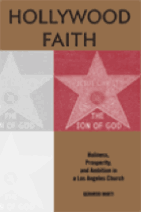
Research for this book began in 2005 as I was completing my ethnography on Oasis, a black-white congregation ministering to workers in the Entertainment Industry and released as Hollywood Faith (Rutgers University Press). With over a dozen churches, 170+ interviews, and reams of background information from scholars and practitioners, I am pleased with the result. Assuming all goes smoothly, I expect the book to be available in 2012.
This book goes into detail on what happens in the worship and music experience of diverse congregations. I decided to focus on this because worship and music are believed to provide "strategic" moments for churches to stimulate racial and ethnic diversity.
Inevitably, what may seem like a simple idea ("Let's bring in some multicultural music...") inevitably involves a complex of tricky notions of representation, ethnic difference, racial authenticity, and the always pragmatic considerations of church leaders who need to be ready for church services on a week to week basis.
I would have liked to say much more about African American and Latino notions of "their music" and how this developed in the history of music and race in the United States. No space, no time!
I also found the literature on worship and race utterly fascinating. In reading documents from the mid-1800s, I saw how notions of African Americans as inherently religious (which is tied to their presumed "emotionality") continues to affect even the most informal discussion on racial worship. Black people worship differently -- so it is said. And the fact that church leaders and attenders BELIEVE blacks worship differently invokes the construction of sacred scenes which demand that blacks PERFORM worship differently. Some of this talk can sound like a lot of sociological mumbo-jumbo. But my observations and interviews reveal a fascinating dichotomy between blacks as they are expected to act when they are in the pews of diverse congregations and how they are expected to act when they are on the platform.
The interviews and stories from these congregations are striking. The book includes page after page of pastors, worship directors, and attenders talking about their experiences of worship, their views on diversity, and their connections of race and music in church. The ironies and unexpected insights continued to surprise me even in the final weeks of adding material and revising the manuscript.
The final draft of the book still weighs in at 100,000 words when you add footnotes and all. I think it is far too short. The amount of thinking left to do on worship, race, music, diversity, etc., is a rich arena of study. I'm glad I stumbled into it. So, whatever shortcomings may be in the book, it is so interesting and so important, I expect many others will pick up threads and make their own distinctive contribution.
Thursday, February 5, 2009
Johnny Cash as Icon of American Paradox
New book on Johnny Cash that plays on the ironic contradictions of this American icon.
Here's a great new book,
Johnny Cash and the Paradox of American Identity
From the publisher:
Johnny Cash and the Paradox of American IdentityFrom the publisher:
Throughout his career, Johnny Cash has been depicted - and has depicted himself - as a walking contradiction: social protestor and establishment patriot, drugged wildman and devout Christian crusader, rebel outlaw hillbilly thug and elder statesman. Leigh H. Edwards explores the allure of this paradoxical image and its cultural significance.
She argues that Cash embodies irresolvable contradictions of American identity that reflect foundational issues in the American experience, such as the tensions between freedom and patriotism, individual rights and nationalism, the sacred and the profane.
She illustrates how this model of ambivalence is a vital paradigm for American popular music, and for American identity in general.
This book looks great, partly because Johnny Cash is inherently interesting and partly because this gives us an occasion to look at the messiness of what we often find to be "cool" in American culture.
And definitions of "cool" really matter in American religion.
To the extent that preachers, advocates, and evangelists face the pressure to gain the attention of people in culture, they find ways to co-opt that which is already seen as attractive in the culture. This in turn influences what is absorbed as images and icons used in sermons, announcements, and plays on media.
So, we can usually spot what seems "cool" in culture and even predict that it will be re-framed in religious contexts. What we don't often do is see how that "cool" is constructed.
One more thing...
I appreciate that the book description acknowledges that Johnny Cash is a contemporary example of the paradox between the "sacred" and the "profane." These categories are used by thinkers like Mircea Eliade in his book The Sacred and The Profane
and Emile Durkheim in Elementary Forms of Religious Life
.
What's interesting to me is how often contemporary religion mixes the "sacred" and the "profane" for the advancement of "sacred" imperatives. A thoughtful reading of this book could provide insight into how this dynamic plays out between religion and popular culture today.
I appreciate that the book description acknowledges that Johnny Cash is a contemporary example of the paradox between the "sacred" and the "profane." These categories are used by thinkers like Mircea Eliade in his book The Sacred and The Profane
What's interesting to me is how often contemporary religion mixes the "sacred" and the "profane" for the advancement of "sacred" imperatives. A thoughtful reading of this book could provide insight into how this dynamic plays out between religion and popular culture today.
Labels:
books,
culture,
Evangelism,
media studies,
music,
new research,
popular culture,
religion,
Society and Culture,
sociology
Tuesday, January 27, 2009
Suburban Evangelicals and Christian Pop Culture
Christian Pop in the Suburbs
Historian Eileen Luhr has written on how religion, family, and media came together to reshape politics.
Witnessing Suburbia: Conservatives and Christian Youth Culture
The book is described as a new "cultural analysis" on how national politics moved decidedly "right" in the Reagan-Bush era. She writes, "this study explores Christian conservatives' shifting attitudes toward youth culture to provide insight into how religious conservatives attempted to reenter public conversations about culture at the end of the twentieth century."
From what I gather in the publisher's description and preview, Luhr brings us the story of how Christian parents and concerned ministers became "activists" in the 1980s for protecting their youth. She focuses much of the work on music -- as rock-and-roll became saturated in American life, evangelicals reconsidered their approach to culture and introduced new innovations.
Overall, she privileges the ability of evangelicals to infiltrate American suburbs and adopt consumer themes. She shows how conservative evangelical involvement with meda had wide political implications.
Concern for Youth Leads to Political Shifts
What makes this book important is how it connecting these developments to the political surge of the Religious Right.
Reading the first chapter, I see how she captures a moment in evangelical culture in the early 1980s when record-burning and exposing Satan's hidden lyrics through backward masking moved conservative families to reject the rock-and-roll culture and the sex, drugs, and wild living that went with it. This set up a context for crafting a new Christian pop culture.
She says the creation of a new approach to "popular" (read "mass media") culture was part of a "modernization" project. And I think she's right. She describes the shift from Old Right to New Right:
Evangelicals' cultural interventions reflected a critical shift in conservative religious affinities from Old Right to New Right as evangelicals developed "modern" middle-class suburban sensibilities and consumer habits.
In both old and new mindsets, the family provided a critical building block of Christian society, and believers worried that a secular worldview encroached on familial authority. Proponents of both views feared that popular culture had replaced parents and church as the primary source of children's socialization.
Strict fundamentalists avoided contamination of the Christian worldview by swearing off secular culture—at least in name.
Conversely, suburbanized evangelicals...cautiously accepted television and music into the domestic circle but attempted to maintain careful adult guidance over message and interpretation.
As far as I can tell, playing out this transition is the theme of the book.
Understanding this piece of history a bit more closely, we come to understand yet another aspect of how modernity re-shaped evangelicalism in various ways. This contributes another piece of the puzzle to marking the rise of megachurches, the incorporation of entertainment, the shift in dress codes, the bringing in of movies and top 40 music into "contemporary" services, and a whole host of other developments thousands of church-goers consider quite "normal" today.
And it gives us another opportunity to reflect on religion and culture.
Check It Out
There's more in the book. Here are the core chapters (and Chapter 1 is now available online):
1. Home Improvement: Christian Cultural Criticism and the Defense of "Traditional" Authority
2. Rebel with a Cross: The Creation of a Christian Youth Culture
3. Metal Missionaries to the Nation: Christian Heavy Metal Music, 1984-1994
4. "An MTV Approach to Evangelism": The Cultural Politics of Suburban Revivalism
Saturday, January 24, 2009
Bob Dylan's Jesus Years
"You gotta serve somebody," sang Bob Dylan in the 1979 album Slow Train Coming that publicly announced his conversion to Christianity. Love it or hate it, the evangelicals I knew in Southern California were ecstatic to claim Dylan as their "brother in Christ."
I heard Bob Dylan live in concert when he came to the Davidson College campus -- a great show with only one disappointment. All of us had been imitating Dylan's distinctive way of talking, joking and playing around, in anticipation of hearing the legend himself speak. Two hours later, the concert ended -- and he didn't say even one word the whole time!
Anyways, here's a chance to give yourself a well-after-Christmas treat. Two documentaries on Bob Dylan's Jesus Years are out, the first documentary,
Inside Bob Dylan's Jesus Years: Busy Being Born... Again!

is a film that documents the years Jesus was most prominent in the artists songs. It's a biography with lots of commentary, one that plays on the shock felt through the music world by Dylan's Christian music. His conversion was unexpected, the reactions mixed, and the continuing relevance uncertain.
From the description:

The film offers "an insider's view of Bob Dylan's "Born Again" transformation, and its effect on his life and music."
There's a trailer and full website. Also, here's a quick review of the film.

I also found another documentary,
Bob Dylan: 1978-1989 - Both Ends of the Rainbow
From the description:
Reviews the years from late-1978 to the release of 1989's Oh Mercy - an album that was seen by many as a huge return to form.
Both DVD's cover Dylan's overtly Christian years. Many question whether Dylan abandoned the faith, or if it's just a more subtle aspect of his life today.
What do you think?
I heard Bob Dylan live in concert when he came to the Davidson College campus -- a great show with only one disappointment. All of us had been imitating Dylan's distinctive way of talking, joking and playing around, in anticipation of hearing the legend himself speak. Two hours later, the concert ended -- and he didn't say even one word the whole time!
Anyways, here's a chance to give yourself a well-after-Christmas treat. Two documentaries on Bob Dylan's Jesus Years are out, the first documentary,
Inside Bob Dylan's Jesus Years: Busy Being Born... Again!
is a film that documents the years Jesus was most prominent in the artists songs. It's a biography with lots of commentary, one that plays on the shock felt through the music world by Dylan's Christian music. His conversion was unexpected, the reactions mixed, and the continuing relevance uncertain.
From the description:

In late 1978, Bob Dylan fell into the Arms of the Lord through the Vineyard Christian Fellowship Church. In his first-ever interview, Dylan's Bible class teacher, Pastor Bill Dwyer, details Bob Dylan's embrace of Jesus Christ and Christianity. Dylan then made three Gospel albums, winning a Grammy for Gotta Serve Somebody. However, Dylan's radical new direction alienated fans and enraged critics as he preached apocalyptic messages from the Book of Revelation.
The film offers "an insider's view of Bob Dylan's "Born Again" transformation, and its effect on his life and music."
There's a trailer and full website. Also, here's a quick review of the film.

I also found another documentary,
Bob Dylan: 1978-1989 - Both Ends of the Rainbow
From the description:
Reviews the years from late-1978 to the release of 1989's Oh Mercy - an album that was seen by many as a huge return to form.
Both DVD's cover Dylan's overtly Christian years. Many question whether Dylan abandoned the faith, or if it's just a more subtle aspect of his life today.
What do you think?
Labels:
Bob Dylan,
Christianity,
conversion,
documentaries,
Jesus,
music,
popular culture,
religion,
video
Subscribe to:
Posts (Atom)