Showing posts with label Southern California. Show all posts

Sunday, December 13, 2009

Hollywood Faith: Holiness, Prosperity, and Ambition in a Los Angeles Church - Book Review

Many thanks to Kathleen Hladky at Florida State University (her recent article) who provided a review of my book Hollywood Faith for the H-Pentecostalism thread of Humanities and Social Sciences (H-Net) Reviews Online, a powerful consortium of scholars attempting to provide timely updates of new research.

In the review, she concludes:
Throughout Hollywood Faith, Marti contributes to the study of Pentecostalism and contemporary Christianity by drawing attention to topics too often overlooked by scholars of religion: the relationship between religion and work, multiracial Christian congregations, and the Word of Faith movement.
Overall, her reading of my book shows great sensitivity to the layered themes on religion, economics, and race found there.

You can read the full review here.

Friday, August 7, 2009

Religious Historian Ed Blum Brings New Jersey Sensitivity to Reading Hollywood Faith

Over at the Religion in American History blog, historian Edward J. Blum, author of WEB Du Bois: American Prophet, brings a suburban New Jersey sensitivity to reading my book Hollywood Faith.

Professor Blum writes,

Cover of Cover via Amazon

Growing up in suburban New Jersey – where making money, just saying “no” to drugs, and interrupting people as a way to show you care were the cultural norms and the entertainment industry was something way out there – I never thought too much about religion and film.

I tried to avoid movies with too much swearing or nudity (except for the time a youth group friend compelled me to see
Natural Born Killers, which I still haven’t recovered from; yes, Kevin Pepper, you scarred me for life). Southern California is a different animal. If you aren’t in a band or trying to land your Screen Actors’ Guild card, you can’t be very important. The entire culture confuses me.

Thank goodness for Gerardo Marti. An incredible interpreter of congregational life...

Blum is a gifted historian who brings a wealth of understanding to the intersection of race and religion, especially in the African American experience,

WASHINGTON - APRIL 28:  Invited guests stand a...Image by Getty Images via Daylife

I think Marti is at his best analyzing how Oasis appeals to aspirants in the entertainment industry in ways similar to how historically black churches have appealed to embattled African Americans who often experienced economic problems, setbacks, and frustration more often than whites.

Marti suggests, I think brilliantly, that Oasis bridges the gap between older black congregations that looked to “advance the dignity and rights of African Americans as a racial group” and the newer black churches that emphasize “individual upward mobility.”

Blum's expertise makes his assessment of my discussion of the Black Church sooooo very much appreciated.

Read his full post is over at the Religion in American History blog.

Tuesday, June 2, 2009

Journal for the Scientific Study of Religion Reviews Hollywood Faith

It's been about eight months since my book Hollywood Faithhas been out, and that means the academic reviews are only just beginning to appear.  

Today I am grateful to professor Kathleen Jenkins, sociologist at The College of William and Mary, whose articulate review of my book is available in this month's Journal for the Scientific Study of Religion.  Jenkins authored her own fascinating book Awesome Families: The Promise of Healing Relationships in the International Churches of Christ.  

Here are snippets from her review. 

Book Review of Hollywood Faith
From Journal for the Scientific Study of Religion June 2009 

Hollywood Faith is an engaging ethnography that makes multiple contributions to the sociology of contemporary U.S. religion. 

Oasis is the epitome of what scholars have recently named "new paradigm" churches, especially in its creative use of contemporary culture. 

Drawing from current studies in work and occupations, Marti locates the majority of Oasis members as creative workers whose occupations leave their employment contingent and often exploitative. 

Members are offered a new purpose and fresh identity; through worship and church relationships, individuals come to believe that they are not alone as they engage in self promotion. Instead, personal fame takes a back seat to a common Christian moral purpose. 

We feel the power of collective worship, music especially, as rejuvenating ritual. 

Hollywood Faith...is provocative in suggesting how contemporary religious organizations might help members negotiate and manage uncertain and exploitative labor markets. 

Additionally, the chapters on Hollywood and evangelicalism will certainly be of importance to anyone interested in media and religion. 

Finally, the careful attention to congregational dynamics and how they support a multiracial congregation make this a valuable addition to literature on religion, race, and ethnicity.
 
-- Kathleen E. Jenkins, The College of William and Mary


Wednesday, March 25, 2009

Book Review of Hollywood Faith

The first published book review of  Hollywood Faith: Holiness, Prosperity, and Ambition in a Los Angeles Churchhas just been published.

From CHOICE Reviews April 2009:
Marti (Davidson College) follows up his 2005 book on multiethnic congregations in Los Angeles (A Mosaic of Believers, CH, Jan'06, 43-2867) with this study of the contrast between Christianity and the often-perceived amorality of the media industry in Hollywood. Oasis Christian Center provides the setting for this study in contrasts. 
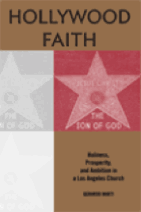
Symbolically housed in an old movie theater with an ersatz Hollywood star on the sidewalk in front of the building dedicated to "Jesus Christ, the Son of God," Oasis unexpectedly combines two streams of members--a diverse collection of people seeking solace from the stress and frustrations of careers in the increasingly fragmented and transitory world of the film industry, and a substantial African American group of worshipers. 
Marti uses Oasis as a starting point to review Hollywood's social archaeology, tracing its early history as a quiet, decidedly religious haven to its transformation into Tinseltown and beyond. He finds an explanation for the combination of movie people and African Americans at Oasis in their shared lives of ongoing marginality, stress, and uncertainty in US society. 
Addressing the perspectives of students of religion, media and the film industry, and ethnic differences, the book speaks to all three subjects, combining them in a novel, interesting fashion. 
Summing Up: Highly recommended. All levels/libraries. 
-- E. Carlson, Florida State University

Saturday, March 21, 2009

Aimee Semple McPherson and the Development of American Religion

On Monday, March 23rd, PBS will air Sister Aimee, a provocative documentary on the life of the astounding American evangelist.

If you don't know Sister Aimee, now is the time. The show is based on a wonderful book, Aimee Semple McPherson and the Resurrection of Christian America, by religious historian Matthew Avery Sutton.

Aimee Semple McPherson is so important, it is hard to summarize all she accomplished in the scope of modern Christianity. Among them is the incorporation of drama into church services, the promotion of media (she founded KFSG in Los Angeles), and the negotiation of women's religious roles.

The PBS website to accompany the documentary is full of fantastic materials:
- a gallery of pictures of Sister Aimee (my favorite is her "Gospel Car" driven across country doing revivals in 1918)

- a brief biography of her life (she founded the Four Square Gospel denomination)

- resources for teachers on history, religion, culture, and the connection between religion and racism and feminism

Angelus Temple in Echo Park. Notice the radio ...Angelus Temple and KFSG Radio Towers. Image via Wikipedia


- a list of websites and books (besides Sutton's book, I also really enjoyed Sister Aimee: The Life of Aimee Semple McPherson by Mark Epstein)

- pictures and history of The Angelus Temple, important moment in church architecture that pre-dates Willow Creek by over half a century, and the current home of the Dream Center

- the full transcript of the documentary


Be sure to set your DVRs.

Thursday, March 19, 2009

A Mosaic of Believers - Big Sale, Free Shipping

As part of an "Intellectual Stimulus Package Sale," A Mosaic of Believers is currently on sale, and free shipping is available.

"Engagingly and accessibly written, this excellent book deserves wide readership among everyone interested in US religion, ethnicity, organizations and urban culture." —Choice


Indiana University Press is hosting free ground shipping in the U.S. with code WWEZXX at checkout.

Mosaic in southern California is one of the largest and most innovative multiethnic congregations in America. Gerardo Marti shows us how this unusual church has achieved multiethnicity, not by targeting ethnic groups, but by providing multiple havens of inclusion that play down ethnic differences. He reveals a congregation aiming to reconstruct evangelical theology, personal identity, member involvement, and church governance to create an institution with greater relevance to the social reality of a new generation.

Thursday, February 26, 2009

Idea Camp is Live Streaming Video Starting Thurs Nite

Diagram of Streaming MulticastImage via Wikipedia

Quick post:  

The innovative incubator "Idea Camp" for church leaders happening in my native Orange County, California, is streaming live video tonight and tomorrow.  Check it out for an online, front-row seat to this "unconference"  --

http://theideacamp.ning.com/

http://www.theideacamplive.com/

You might need to register yourself into the site first.

Friday, January 9, 2009

Church Innovators Meet for Idea Camp

Innovative church networks continue to emerge. Here's a new one built on the concept of an "unconference."


Innovation in Irvine

Several Church leaders from Southern California are participating in an upcoming event called,
Southern CaliforniaImage via Wikipedia
The Idea Camp

Promoted as "a free hybrid conference for idea-makers to share, network, and implement ideas." It will be held at New Song Irvine, a church pastored by David Gibbons.

From their website:
We are gathering some of the most innovative and creative leaders from around the country (this means YOU!) to share ideas, intentionally network, and move collaboratively into idea-making. Whether your passion is church leadership, non-profit work, social entrepreneurialism, technology, media, creativity, culture making, church planting, spiritual formation, compassionate justice, etc., this is the conference for YOU.

The focus of this conference will be on the participants (yes, You!) and not on keynote speakers. We function under the belief that the crowd is always smarter and wiser than any one speaker. In fact, you are invited to create and refine some of the major components of the conference prior to the gathering itself via our web interface. You are welcome to suggest specific topics for our workshops (called Idea Sessions), leave comments, ask questions, share case scenarios for discussion, and even volunteer yourself to facilitate one of our Idea Sessions.

Planning the Unconference

The event is planned as an "unconference" -- an interesting new form of self-organizing, self-regulating, self-referential group interaction. Many of the church leaders I talk to are tired of being tied to their chairs listening to keynote speakers and hassled by a barrage of product-booths before and after events. This new form provides an intriguing opportunity to maximize networking while negotiating the amount of input each person wishes to give.

Taking their cues from the high-tech arena, an unconference allows a high level of interaction and self-organization. An article from Jonathan Follett in Digital Web magazine describes unconferences as "self-organizing forums,"

The unconference format is based on the premise that in any professional gathering, the people in the audience—not just those selected to speak on stage—have interesting thoughts, insights, and expertise to share. Everyone who attends an unconference, such as those put together by organizations like BarCamp or BrainJams, is required to participate in some way: to present, to speak on a panel, to show off a project, or just to ask a lot of questions.

As an event, the character of the unconference falls somewhere between that of a bazaar and that of an intellectual salon. It is, to borrow a phrase, a free “marketplace of ideas.” There are no themes or tracks to guide you, as in a typical conference; the whole event is centered on what might be called the discussion group.

The ad hoc nature and the low cost of this forum (they’re usually free, compared to the hundreds of dollars needed to attend some industry gatherings) make the unconference accessible to many.

Another brief article on unconferences can be found here.


A Who's Who of Innovation-Friendly Evangelicals

The structure of an "unconference" is built around respected facilitators. They become the key, the glue, for sustaining a thread of dialogue focused on the theme at hand.

The long list of facilitators for this event include a who's who of local church leaders and innovation-friendly evangelicals. The names and (for most of them) websites are:

Brad Abare (http://www.thinkpersonality.com and http://www.churchmarketingsucks.com)
Shah Afshar (http://www.shahshankedredemption.blogspot.com)
Greg Atkinson (http://www.gregatkinson.com)Map of major Southern California area codesImage via Wikipedia
Dawn Nicole Baldwin (http://www.aspireone.com)
Eric Bryant (http://www.ericbryant.org and http://www.mosaic.org)
Spencer Burke (http://theooze.com)
Chris Cannon (http://www.kingsharbor.org)
Dawn Carter (http://www.decarter.wordpress.com)
Eugene Cho (http://www.eugenecho.wordpress.com)
DJ Chuang (http://www.djchuang.com and http://digital.leadnet.org)
Mike Foster (http://www.ethur.org and http://www.deadlyviper.org)
Dave Gibbons (http://www.davegibbons.tv)
Keith Kall (http://www.worldvision.org)
Todd Hiestand (http://toddhiestand.com)
Penny Hunter
Zach Hunter
Charles Lee (http://www.charlestlee.com)
James Pearson (http://www.jamestravels.com)
David Ruis (http://www.davidruis.com)
Matt Russell (http://www.myvcc.org/uturn)
Greg Russinger (http://www.just4one.org)
Jeff Shinabarger (http://www.jeffshinabarger.com)
Cynthia Ware (http://www.thedigitalsanctuary.org and http://digital.leadnet.org)
Tony Wood (http://www.generatelife.com)
Robert Yang (http://www.kindlejoy.com)
Henry Zonio (http://www.elementalcm.com)

Overall, events like this are becoming more common and are contributing to a re-distribution and re-framing of congregational philosophies. New networks become institutionalized, and new initiatives can be birthed from unanticipated collaborations.

What do you think?