Showing posts with label religious right. Show all posts

Thursday, July 23, 2009

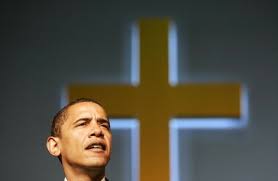
Is Obama the Antichrist? Well, Of Course He Is...

The American Religion Historian Matthew Avery Sutton wields a sharp pen. His book connecting American politics and the ministry of Aimee Semple McPherson is fascinating and important. Now in a post on Religion Dispatches this week, Matt takes aim at evangelicals and their relationship to President Obama, especially in their all-too-frequent obsession over decoding biblical prophecy. While Matt may not slay the beast, I think he hits pretty close to the heart.

(Thanks again to Paul Harvey for his posting at the Religion and American History blog.
)

Historian Matt Sutton doesn't hold back. He combines careful scholarship with sharp opinion. As a writer, we might say Matt has a "point of view." Even more, Matt is a scholar willing to tell people what he really thinks. Uncommon for an untenured professor.

In this post, Matt shows how it is inevitable that Obama's serene "Angel of Light" manner will be interpreted as yet another indication of the coming Antichrist.

Matt points out that "the vast majority of American evangelicals interpret the most obscure books of the Bible (Daniel, Ezekiel, and Revelation) in a very narrow and particular way. They believe that when these three books are read in conjunction with one another and overlaid with a few of Jesus’ statements, a hidden 'plan of the ages' emerges." And he's right. This is a holdover from the grip of dispensationalism (found in places like Scofield's Study Bible, bestselling Christian books both scholarly and popular, and frequent Sunday sermons) that has held evangelicals for most of the 20th Century.

He continues, "During the last 100 years, evangelicals have witnessed more and more evidence of these prophecies being fulfilled..." and shows how the Antichrist was predicted in the rise of leaders and various policies that emerged in this eventful time.
"So what does this mean for the Obama administration? Nothing very promising. Despite the president’s desire to find common ground with evangelicals, he is unlikely to be able to penetrate the apocalyptic fears that have characterized the evangelical movement since the Great Depression."
The flexibility of biblical interpretation and the considerable history of connecting the actions of political leaders with violent acts and natural disasters of all kinds leads these beleivers to connecting the dots of Obama's life to the determinative flow of spiritual history.

6: bible nerdImage by jamelah via Flickr

In other words, if you look for the Antichrist, you will find him.

Matt throws up his hands and concludes:
So what can we do? Pray for the rapture. If evangelicals vanish, the rest of us might finally get better medical care, a healthier environment, a more just international community, and full civil rights for gays and lesbians. But short of this miracle, we can at least begin to understand that before Obama is able to penetrate the evangelical heart, evangelicals themselves will need to do some serious soul-searching. Rick Warren and Joel Osteen’s shallow, positive-thinking, feel-good sermonizing is not going to help them do this. Instead, it is up to the younger evangelicals to engage in serious intellectual debate and a rigorous rethinking of the theology at the root of their politics. Anything less and the doomsayers will turn fears of Obama-as-Antichrist into big business. But hell, maybe that’s just the spark the economy needs.
Here Matt tips his hand on his own politics. Nevertheless, I think Matt is right that the old-school, end-times prophetic orientation of evangelicals will keep them from ever seeing politicians who fail to live up to a conservative social agenda as being less than an agent of prophecy, accelerating the apocalyptic consummation of history.

And he raises an important question. What are the resources available for re-thinking the theology at the root of evangelical politics? Is there something that needs to be recovered from the past, perhaps Walter Rauchenbush? Reinhold Niebuhr? Is there something to be found more recently in Martin Luther King, Jr.? Or is Jim Wallis and the Sojourner's group a fruitful direction?

Tuesday, May 19, 2009

How Religious Right Shaped Lesbian and Gay Activism

A new book presents ironic and surprising conclusions about mobilization, opposition, and tolerance of homosexuality in America.

How the Religious Right Shaped Lesbian and Gay Activism (Social Movements, Protest and Contention)
by Tina Fetner

From CHOICE Reviews:
Fetner shows how each ramping up of activism on one side led to a mobilization on the other.

While the lesbian and gay movement has remained miniscule compared to enormous religious Right organizations, each side has tried to match the form and tactics of the opposing organizations.

Both sides have made their case to their own followers that they are a threatened minority, while making the case to the public that the other side is a threat to cherished national values.

The two sides are not quite balanced, however. The greater size and influence of the religious Right means that it usually sets the agenda, to which lesbian and gay organizations react.

Ironically, Fetner suggests, the religious Right's great efforts opposing homosexual practice may have brought the whole question to the attention of the public, who are now more tolerant of lesbians and gays than they were a generation ago.

Monday, February 9, 2009

Video Profile of Influential Pastor Mark Driscoll and Mars Hill Seattle

Mark Driscoll, a contemporary pastor recently profiled in The New York Times, was interviewed on Nightline. 


I wrote last month about Pastor Mark Driscoll of Mars Hill, Seattle, as an example of one brand of contemporary evangelicalism.  Driscoll was recently a highlighted speaker last week at Leadership Network's Innovation 3 Gathering.  

For those interested in things like what Driscoll looks like and the ambience of his church, here's a brief video on his ministry. 


Friday, January 30, 2009

The End of Evangelicalism?

Quick post - When I read this small piece from David Sessions this morning, I felt like I was walking into the middle of a conversation. And I stayed because it's an interesting conversation, you know what I mean?

David Sessions is a writer in New York who wrote an extended comment on the fate of evangelicalism in the near future. It comes on the heels of near-apocalyptic comments from Michael Spencer. Spencer wrote,

I believe that we are on the verge- within 10 years- of a major collapse of evangelical Christianity; a collapse that will follow the deterioration of the mainline Protestant world and that will fundamentally alter the religious and cultural environment in the West.

Whew - strong words. And there's even more. This guy's got a lot on his mind.

In turn, David Sessions measured response is worth reading. If nothing else, he knows evangelicalism is not going to change radically in such a short time, there are more complicated developments than most people want to consider, and the variation within evangelicalism continues to be colored by its own history.


Tuesday, January 27, 2009

Suburban Evangelicals and Christian Pop Culture

A bold, new history on modern evangelicalism titled Witnessing Suburbia came through my email today. Here's a quick look.

Christian Pop in the Suburbs

Historian Eileen Luhr has written on how religion, family, and media came together to reshape politics.

Witnessing Suburbia: Conservatives and Christian Youth Culture

The book is described as a new "cultural analysis" on how national politics moved decidedly "right" in the Reagan-Bush era. She writes, "this study explores Christian conservatives' shifting attitudes toward youth culture to provide insight into how religious conservatives attempted to reenter public conversations about culture at the end of the twentieth century."

From what I gather in the publisher's description and preview, Luhr brings us the story of how Christian parents and concerned ministers became "activists" in the 1980s for protecting their youth. She focuses much of the work on music -- as rock-and-roll became saturated in American life, evangelicals reconsidered their approach to culture and introduced new innovations.

Overall, she privileges the ability of evangelicals to infiltrate American suburbs and adopt consumer themes. She shows how conservative evangelical involvement with meda had wide political implications.


Concern for Youth Leads to Political Shifts

In the book, Luhr writes "how conservative Christians linked youth culture and social problems and how they aggressively sought to reestablish 'youth' as a category of innocence in need of adult protection during the late-twentieth-century culture wars." She writes about the rise of pop music that included Christian heavy metal (remember Stryper?) and Christian rock festivals.

What makes this book important is how it connecting these developments to the political surge of the Religious Right.

Reading the first chapter, I see how she captures a moment in evangelical culture in the early 1980s when record-burning and exposing Satan's hidden lyrics through backward masking moved conservative families to reject the rock-and-roll culture and the sex, drugs, and wild living that went with it. This set up a context for crafting a new Christian pop culture.

She says the creation of a new approach to "popular" (read "mass media") culture was part of a "modernization" project. And I think she's right. She describes the shift from Old Right to New Right:
Evangelicals' cultural interventions reflected a critical shift in conservative religious affinities from Old Right to New Right as evangelicals developed "modern" middle-class suburban sensibilities and consumer habits.

In both old and new mindsets, the family provided a critical building block of Christian society, and believers worried that a secular worldview encroached on familial authority. Proponents of both views feared that popular culture had replaced parents and church as the primary source of children's socialization.

Strict fundamentalists avoided contamination of the Christian worldview by swearing off secular culture—at least in name.

Conversely, suburbanized evangelicals...cautiously accepted television and music into the domestic circle but attempted to maintain careful adult guidance over message and interpretation.

As far as I can tell, playing out this transition is the theme of the book.

Understanding this piece of history a bit more closely, we come to understand yet another aspect of how modernity re-shaped evangelicalism in various ways. This contributes another piece of the puzzle to marking the rise of megachurches, the incorporation of entertainment, the shift in dress codes, the bringing in of movies and top 40 music into "contemporary" services, and a whole host of other developments thousands of church-goers consider quite "normal" today.

And it gives us another opportunity to reflect on religion and culture.


Check It Out

There's more in the book. Here are the core chapters (and Chapter 1 is now available online):

1. Home Improvement: Christian Cultural Criticism and the Defense of "Traditional" Authority
2. Rebel with a Cross: The Creation of a Christian Youth Culture
3. Metal Missionaries to the Nation: Christian Heavy Metal Music, 1984-1994
4. "An MTV Approach to Evangelism": The Cultural Politics of Suburban Revivalism

Sunday, January 4, 2009

Evangelicals "Fear" Obama's Administration?


Here's an interesting article that plays on the dichotomy of Religious Right with Antagonistic Left. Although this particular article at the end moves away from a narrow characterization, this story has been re-played in other national newspapers to bring out the "hype" of "fearful evangelicals."

From the article:
Obama has endorsed faith-based initiatives and conversation about the role of religion in public life. Despite the objection of gay rights activists, he plans to have Rev. Rick Warren, a popular evangelical minister, deliver the invocation at his inauguration.

But conservative evangelicals, who had a great deal of access to the Bush administration and influenced its policies on abortion and other issues, worry that Obama's commitment to listen to the concerns of evangelicals comes with caveats on issues such as same-sex marriage and hiring gays and lesbians.

More moderate evangelicals say conservatives' concerns are premature and unwarranted. David Gushee, professor of Christian ethics at Mercer University and president of Evangelicals for Human Rights, said Obama's record and appointments have less to do with the concerns than his affiliation with the d-word.

No, not the devil—Democrats.
You can read the full article here.

What do you think?