Showing posts with label intellectual history. Show all posts

Monday, June 29, 2009

The Crisis of Islamic Civilization

Like everyone else, I am far more interested in the development and workings of Islam since the morning of 9/11 but frustrated in my efforts to achieve a larger, more comprehensive grasp of the past and future of the Muslim world. As part of that effort, today I discovered the work of Ali A. Allawi.

This morning I read a short article from Allawi in The Chronicle Review (part of The Chronicle of Higher Education). In "Islamic Civilization in Peril," Allawi introduces his "insiders" understanding of the crisis facing Islamic peoples across the world.

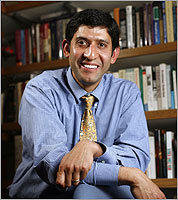
Allawi, a senior visiting fellow at Princeton University, has just been named one of the first two Gebran G. Tueni human-rights fellows at the Carr Center for Human Rights Policy at the John F. Kennedy School of Government at Harvard University. I believe these thoughts are tantalizing pieces from his fuller work, The Crisis of Islamic Civilization, was published by Yale University Press in March, which came out in March of this year.

Allawi writes:
The crisis in Islamic civilization arises in part from the fact that Muslims have been unable to chart their own path into contemporary life. Islam as a religion — or even as a remnant of a civilization — has never fully surrendered to the demands of a desacralized world. Those who rule over Muslims may behave atrociously, continuing a venerable tradition of misrule, violence, and corruption that has long plagued the Muslim world, but tantalizing thoughts of "what might be" still reverberate among the masses — and even among some of the elite.

Islam's encounter with the West and the ascendant forces of modernity have made deep inroads into the outer world of Islam and, equally important, into the minds of Muslims. Some may deny it and fight numerous rear-guard actions, but this reality cannot be effaced until Muslims confront another harsh fact: All civilizations have an inner and outer aspect, an inner world of beliefs, ideas, and values that inform the outer aspects of institutions, laws, government, and culture. But the inner dimensions of Islam no longer have the significance or power to shape the outer world in which most Muslims live. Most Muslims — knowingly or not — have lost sight of the centrality of sacredness to their historic civilization. The Muslim world has effectively become desacralized, and that has changed how Muslims think, believe, and behave. Islam's outer expressions — laws, institutions, governing structures, economic and cultural principles — have been in constant retreat.

The insatiable pursuit of ever-rising standards of living, coupled with an almost fetishistic belief in science and technology, is a nearly universal condition. The West has accepted secularization as an inevitable consequence of increasing wealth and power. That same recipe is now being offered to Muslims. Liberal reformers in the Muslim world, and their allies beyond, are in effect calling for a Christianization of Islam: concede the public arena to secularism and acknowledge that the break between Islam's sacred interior world and the profane external world is definitive and legitimate. The reformers, advocates of Muslim liberal democracy, are at least honest in that they forthrightly call for the wholesale adoption of the institutions and processes of modernity. But their vision of Islamic civilization is empty — a vague spirituality wafting over a society with a shallow cultural distinctiveness, one that has effectively merged with the dominant order.

The radical Islamists, on the other hand, and even the rank and file of so-called "rationalist" Muslims who insist that Islam has all the elements of Western-style humanism already embedded in it, suffer from a different conceit — namely that a happy compromise can be fashioned between Islam and modernity simply by running modern ideas through the filter of the Shariah: What is acceptable will be embraced, and what is not will be rejected. That approach, which has been entertained for more than a century, has produced neither material progress nor the foundations of a revivified Islamic civilization. The fundamental conundrum facing both rationalists and radicals is that the forces of modernity are the product of a different and ascendant civilizational order. Those forces can be internalized successfully only if they are refashioned, and then transcended, in a uniquely Islamic framework.

Such a framework must be rooted explicitly in the Islamic virtues of justice, moderation, the respectful accommodation of other cultures and religions, and the rejection of oppression and gross inequalities. Those immutable principles are spelled out in the Koran. They are milestones for the believers' pathways to God. They should guide an ethical rereading of the Shariah that will not only revitalize Islam's outer world, but also bring Islam closer to providing a new, constructive, and potentially appealing response to the growing problems facing humanity — including environmental degradation, the coarsening of public life, economic inequity among nations and peoples, and overconsumption. The Shariah has traditionally been pitted against modern practices and values, with the implication that it should give way to the prevailing ethos. Or the Shariah has been seen in entirely static terms, a blueprint for reviving some golden age of Islam. The latter is the approach of fundamentalist Muslims.

But an Islam reimagined along the lines sketched above can go beyond the travesty that is "Islamic banking" and produce institutions and enterprises that emphasize risk-sharing and cooperative finance. It can push for technological innovations that focus on conservation. In the hard sciences, Islam can privilege research that seeks to reveal the unseen substructures that underlie the physical world — what the great theoretical physicist David Bohm called the "implicate order," which has not been investigated with the necessary energy because it counters the prevailing methods of scientific inquiry. Islam can open up entirely new vistas to find unity and wholeness in the natural world.

Muslims cannot simply partake of the technological fruits of modern civilization while simultaneously rejecting or questioning its premises. That makes them nothing more than inert consumers of the effort and creativity of others — even if they continue to smugly assert the superiority of their spiritual ways. That is the ultimate fallacy of the Islamists. Alternatively, Muslims might choose to package the products of Western civilization in ways that are culturally or politically acceptable to their own societies. They can even participate in the dominant civilizational order and risk fatally undermining whatever remains of Muslims' basic identity and autonomy. That appears to be the path of the Gulf states, which have exuberantly embraced a frantic hypermodernity that is scantily garbed in Islamic idioms. This path also appeals to the Westernized professional classes who view their Islam as little more than a cultural ornament.

To see more of Allawi's analysis, check out his new book. I found a preview available through Google Books online --


Sunday, June 28, 2009

Historian Questions America's Voluntary Tradition

Thanks to Religion in American History blog, I caught an interesting interview with Historian Johann N. Neem on the relationship between religion and the emergence of democratic ideals of the American Republic.

Are joining and volunteering a "natural outgrowth" of the American Revolution?

According to Neem, "Freedom of association is in a sense the embodiment of a failure of a certain kind of revolutionary hope."

And church leaders were part of the process of discouraging orienting with the interests of the state.

Naeem says, "Increasingly church
leaders said less we need an alliance with the state, in fact that is a handicap. What we need is to convert people and then mobilize those people.

"Some of the most mobilized Americans in the 1820s and 1830s were Evangelicals coming out of these churches."


For more, add Neem's new book Creating a Nation of Joiners: Democracy and Civil Society in Early National Massachusetts to your summer reading list.

Tuesday, June 9, 2009

19th Century Evangelicals, Religious "Nones," and Anybody Can Talk about Religion: Religion and American Culture Conference

On Saturday afternoon, the conversation began with reflections on American Religion as it relates to Politics, Secularization, and the Public Square...

Cover of Cover via Amazon

Daniel Walker Howe, from the department of history at UCLA and Oxford University (and recent Pulitzer prize winning writer of What Hath God Wrought: The Transformation of America, 1815-1848 (Oxford History of the United States) provided a historical overview of the reversals among Evangelicals and the way in which they are related to the Republican party.

Howe reminded the group that Evangelicalism was a dominant, organized, and transformative influence in American society in the early 19th century.

Yes, Higher criticism and the intellectual winning over of Darwinism in the early 20th Century effectively split American Protestantism between those that accommodated these approaches and those that rejected them. But until that time, Evangelicals affiliated with the state, supported strong government to provide education and strong structure and tariff protection as well as temperance legislation against liquor.

For Howe, the repeal of prohibition in the early 20th Century turned Evangelicals against the state. That’s when Evangelicalism became “conservative.”

Mark Silk from the department of religion at Trinity College came out strongly against interdisciplinarity, yet spent much of his time talking about the religious narrative of “religious nones.” He speculates that the research that found a doubling of the proportion of “nones” in American society gained so much attention because it runs counter to our new understanding of the post-9/11 world which has raised the level of religious awareness and discourse to extremely high levels.

Indianapolis City MarketIndianapolis City Market nicolernorman Flickr

At the end of our conversation this survey research there remained an outstanding question: What is the meaning of religions “nones”?

Answer: Hmmm, well... there's a great deal of ambiguity. Silk says there is much more research desperately needed to tease out the implications of this emergent, yet unclear, category of analysis.

Winnifred Fallers Sullivan, a very interesting and very articulate professor from the University at Buffalo Law School, spoke persuasively about the difficulty of being a “scholar” of religion.

“It’s not that there is no religion in the academy,” she said, “but that it is everywhere, and that we have no control of how religion is discussed.”

As a legal scholar, she consistently finds that the fact she has a religious studies degree doesn’t matter, it does not lend any particular weight to her opinions. All Americans talk about religion. Anybody can talk about religion. The most important aspect of this for scholars is that it is difficult to help the general public appreciate that there is need for a level of expertise to talk about religion today.

She asserts that it’s not that the study of religion is not important to people, but rather that the study of religion requires training.

Wednesday, April 22, 2009

Finney's Altar Call and the Quest for Efficient Evangelism

I just can't seem to get Finney out of my mind. One more post...

After lingering with Charles Finney's memoirs for the past week, it finally struck me that Finney's use of altar calls contrasts markedly from his own, personal process of conversion. It's not until you read his memoirs that you realize that his public ministry of evangelism is quite different from his private experience of conversion. But after reading through his whole book, I think I understand how the altar call connects to his own life experience.

Mary Magdalene, in a dramatic 19th-century pop...Image via Wikipedia


Finney mentions summoning attenders to make a public commitment early in his preaching ministry. But it is not until he talked about "the anxious seat" well into his memoirs that I understood what the alter call was intended to accomplish.

The very beginning of his memoirs is devoted to how he found his own commitment to Jesus. In particular, as Finney wrestled with his own salvation he found himself unable to pray. He could not find the ability to give himself over to God. He went in and out of his house, talked with others, and went walking the streets, roaming and anxious, and still found that he could not find contentment for his own soul.

He eventually looked over to the woods, a quiet stretch of land up a hill and away from other people. It was there that he went in private -- apart from the company of others.

There in the woods, Finney finally prayed out his confession and commitment, releasing himself, discovering a sweetness reconciling to God in prayer, and finding joy and rest for himself. When he committed to Christ, he committed to preaching the gospel of Christ.

As Finney began to preach, he was struck by the response to the messages. He tells story after story throughout his memoirs of people who agonized over their salvation and were overcome with anxiety over their spiritual state. Attenders moaned during church services. People regularly fell out of their pews and onto the floor. Both men and women fainted in the fellowship.

The consternation and disturbance hits all social classes and all professions both in America and in England. Beyond church services, Finney regularly made house visits (often late at night and often at great inconvenience) to counsel and pray over individuals moved near the point of insanity over their spiritual destiny.

I think Finney empathized with these struggles. He recalled his own turmoil before committing to Christ.

As a pastor, he wanted to save people from such pain.

anxiousImage by Martino's doodles via Flickr


See, Finney was convinced that an individual who clearly understands the gospel and their responsibility to respond to it will experience emotional distress. From his experience and observation, the gospel provokes an emotional agitation, a deep disturbance that persists until the person makes a personal and proper response to God.

It is therefore out of a pastoral concern for the crisis experienced by near-converts that Finney crystallized his notion of "the anxious seat." Individuals who understand the gospel begin to occupy the anxious seat; they experience a type of physical agony that mere rest will not take away. The seat becomes a place of torture -- the unmoving agent stuck sitting amidst the stirring of their own conviction.

sin& salvationImage by wheat_in_your_hair via Flickr


For Finney, the altar call delivers people from their anxiety. It takes them out of a passive state to an active one. By inviting attenders to respond to the message, the preacher delivers convicted persons from their anxiety and toward spiritual ease in the elation of obtaining salvation through their active repentance. The preacher and volunteers steer each person out of their anxiety by giving them assurance of their salvation by pointing to their standing and coming forward as a physical mark of their commitment to Jesus.

In the end, while Finney's own conversion was private it emerged from a state of utter distress. Finney hoped to ease people from such emotional pain by directing them to a standardized response that moves them productively -- even efficiently -- toward salvation and emotional comfort.

Yes, altar calls are efficient means toward salvation, allowing more converts to find their way into Christian fellowship than if they pursued it without direction privately. But for Finney the use of alter calls emerges not for the sake of efficiency alone, but rather a pastoral concern to deliver people from spiritual agony toward spiritual elation. In this sense, finding salvation is simultaneously a means to find healing.

Monday, April 20, 2009

Charles Finney and His Calculated Ministry

Finished reading Charles Finney's memoirs published in 1876 last night. Much of the book focuses on his plea for innovation for the sake of evangelism.

On a recent trip to California, I stopped in a religious store that sells a largely unsorted collection of used books. I was looking for treasure, and I found it.

Portrait of an unnamed balding manCharles G. Finney. Image via Wikipedia


On the floor and at the end of a row of "overflow" books that would not fit on an already overstuffed bookshelf I found an unassuming green book, yellowed with age and frayed at the spine. The square-ish little bundle had a simple title: CHARLES G. FINNEY - and that was enough for me.

The 477 page book, complete with a portrait of the famous evangelist, turned out to be a first edition of his autobiography, a book published by Oberlin College (a school built almost entirely on his reputation, fundraising, and booksales) after his death in consideration of the great importance of his life.

The book is a fascinating read. For me, the value of the book is to see Finney's own view of his theological convictions and his methods in his approach to gaining converts. Finney is the original seeker-sensitive preacher.

Toward the end of the book, Finney writes,

laughter curesImage by Nate KS via Flickr

"In religion as in every thing else, good sense and sound discretion will, from time to time, judiciously adapt means to ends.

The measures needed will be naturally suggested to those who witness the state of things, and if prayerfully and cautiously used, let great freedom be given to the influences of the Holy Spirit in all hearts."

[emphasis mine.]
His call for "great freedom" comes as a striking, summary statement after reading the many, many stories of conversion and revival. In short, the book is a plea to earnest Christians for innovation in the service of evangelism.

Finney often uses terms like "calculation," "means," and "measures" throughout the book that indicate his conscious consideration of methods to provoke conviction and move people to make public commitment toward the gospel.

Indeed, for Finney the lack of revival in any place pointed to a lack of consideration of proper methods. On page 155, he writes, "The great failure of the ministry and of the church, in promoting religion, consisted, in great measure, in the want of a suitable adaptation of means to that end." And on page 154 he writes, "There must be an adaptation of means to the end to be secured," namely conversion.

The means-end discussion is constant through the book, both in its successes and in its failures.

JapanSMP_1212Finney "invented" the altar call. Image by openg via Flickr


Here's one of his most important methods -- many of you may remember that Finney essentially invented the "altar call," the practice of preachers summoning attenders to move to the front of the service as a sign of their dedication to Jesus and meeting others there who will talk and pray with them, giving them spiritual assurance.

The book tells stories regarding his first use and continual experimentation with altar calls and the use of "the anxious seat" to provoke people to commitment.

Finney's practice was to arrive in town and spend much time living there, even two or six months at a stretch, getting to know people and speaking to them as directly and as plainly as possible.

Although he was criticized by both members and ministers for the failure to use a more religious oratory style, Finney strenuously argued that he would rather be understood than thought merely eloquent.

On page 94 he writes,

Extreme EvangelismImage by Dave Siberia via Flickr

"My habit has always been to study the Gospel, and the best application of it, all the time. I do not confine myself to hours and days of writing my sermons; but my mind is always pondering the truths of the Gospel, and the best ways of using them. I go among the people and learn their wants. Then, in the light of the Holy Spirit, I take a subject that I think will meet their present necessities. I think intensely on it, and pray much over the subject on Sabbath morning, for example, and get my mind full of it, and then go and pour it out ot the people."
Finney's preaching was more like a conversation. "How completely they were in the dark in regard to the results of that method of addressing people!" he wrote. "The used to complain that I let down the dignity of the pulpit" and "that I talked to the people in a colloquial manner."

Finney usually spoke extemporaneously, speaking from a brief outline, in order to talk to the assembly with the greatest freshness and spontaneity possible. "Indeed, people have often said to me: 'Why, you do not preach. You talk to the people.'" This is one of the ways his "preaching" was set apart from the well-prepared, written-out, and read-aloud sermons of his contemporaries.

He later summarized his ministry, saying,
"Wherever I went, the word of God took immediate effect; and it seemed only necessary to present the law of God, and the claims of Christ, in such relations and proportions as were calculated to secure the conversion of men, and they would be converted by scores."

Holy SpiritFinney practiced and continually called for deep prayer for revival, and always attributed the work to the Holy Spirit. Image by Sacred Destinations via Flickr

Finney "called" people to public affirmation of faith in the context of an understanding of their local cultures and common concerns at home and at work.

But don't think that Finney believed conversion was merely an outcome of human manipulation -- far from it. Finney spends much of the book (and writings in other books) talking about the centrality of prayer for revival. And Finney attributes nothing to his self, rather to the efficacious working of the Gospel when properly presented.

It is the work of the Holy Spirit according to Finney. The difference between himself and most of his contemporaries is that they failed to properly understand the working of the Spirit and failed to call individuals to take responsibilities for their personal, active response to the Gospel.

Saturday, March 28, 2009

H. Richard Niebuhr's Christ & Culture - Only a Beginning

After yet another stimulating conversation with my friend and colleague Doug Ottati (Doug's written several books), I once again picked up my copy of H. Richard Niebuhr's Christ and Culture to think about how theology affects one's understanding of culture and social change.

Cover of Cover via Amazon

My 50th anniversary edition of this influential book contains several additions compared to the Harper Torchbook paperback I started to read back in 1992. That one was a crumbling used book with an olive-green cover, yellowed pages, and tiny print. I didn't finish it. I didn't get it.

With this new edition, the editors include an introductory chapter written by Niebuhr that not only summarizes the 5 typologies that characterize orientations to the connection between "the gospel" and "the world" but also spends a profitable moment describing what typologies are and how they should be used. This brief essay provides a smooth transition into the text.

Also, James Gustafson's introductory preface nails home the importance of seeing how typologies function (something sociologists have wrested with from Max Weber's work) and the misreadings that can happen by misunderstanding their application. Martin Marty's brief introduction is also helpful.

So, I am again reading through the book. As you can see, there are several "prefatory" materials, so you can understand how after 2 days I am finally getting to page 1!

QuestionsImage by Oberazzi via Flickr

This morning I don't claim that Niebuhr has the answer to all the questions regarding an approach to understanding the broader questions on the relationships between religion and culture. The phrasing of it in this way is certainly not Niebuhr's objective, and perhaps that is not even the best way to encounter this text. Yet the influence of Niebuhr's work makes it an appropriate place of exploration.

The main point I get out of my reading (let me remind you, this is all pre-page 1) is Niebuhr's outstanding observation that --
"[the use of] typology...denies the assumption that there is a single Christian ethics or a single Christian ethical principle. It assumes, on the contrary, that there are multiple principles and a large number of creative individual concretions of the Christian life."
That statement alone is worth the price of the book.

Reading listImage by jakebouma via Flickr

Any look at church history -- or just the simple act of looking at a row of Christian books at any bookstore, library, or any pastor's or professor's shelf -- demonstrates "multiple principles" and "a large number of creative individual concretions of the Christian life."

Certainly, any actual observation of members in any local congregation would do the same.

By establishing a base of comparison, we can now look at the implications and differentiation of orientations in terms of definitions of culture, approaches to social change, rhetorical strategies for describing changes, decoding discourses and "jeremiads" of all sorts, and generally helping us think a whole lot better about the religious self in the world.

And generating better thinking about the self and the world is what I think Niebuhr wanted most from this book.

Saturday, February 7, 2009

Missionary Jews

A new book looks at how mid-20th Century Jews sought to present themselves in ways that generated understanding and support.


I have a general interest in any form of "missionary" activity, and here's a new book looks at a form of missional activity in the conscious self-presentation of Jews in America in the past century.

Speaking of Jews: Rabbis, Intellectuals, and the Creation of an American Public Identity


From the Introduction (available online):

Over the course of Jewish history, Jews often thought of themselves as living among strangers. Through stories, rituals, laws, and folkways, Jews sought to understand their relationship to non-Jews. In the modern era, in a more sustained fashion than any other historical period, explaining—or presenting—Jewishness to non-Jews became a political necessity and an act of Jewish survival.

For some Jews, the task bred ideological fervor, a sense that Jewishness was enacted only when Jews were busy addressing themselves to the non-Jewish world. Even for those who were not so fervid, few Jews could navigate modernity without considering how to talk about being Jewish to non-Jews.

This book is about some of the ways in which American Jews explained themselves to non-Jews and how the meaning of Jewishness became inseparable from their explanations.

In the United States, Jewish leaders—rabbis and intellectuals—sought to generate a public language of Jewishness, one that carried authority and was disseminated into an American public sphere. Speaking of Jews is a history of how these leaders talked about Jewishness in public from immediately after World War I through the civil rights era.

Photo by Gila Brand.Image via Wikipedia


As the most widely recognized spokespeople of American Jews, countless rabbis devoted themselves to creating an American language of Jewishness. Taking to the roads, the airwaves, the printing presses, university classrooms, and pulpits across the country, rabbis engaged in the central and as yet unexamined project of presenting Jewishness to the United States. Their task, as they saw it, was as much about defining a collective identity as it was about crafting an ideology about the relationship between Jews and non-Jews and the role that Jews could play in a non-Jewish society. At different times and in different contexts, rabbis claimed that Jews' religious ideals, their history, or their distinctive behaviors allowed the United States to forge ahead with its democratic experiment. When properly conceived, a public language of Jewishness, instead of marking Jews as outside of or peripheral to American life, enabled Jewish leaders to define Jews as indispensable to the United States.

The book combines questions of history and identity among an important religious-ethnic group in the face of questions of diversity and legitimacy in the United States. My impression? Informative and fascinating.

You can find more on Speaking of Jews at the University of California Press website.

Friday, January 16, 2009

De-conversion and Evangelical Disenchantment - A New Book

On the theme of "de-conversion," I found an interesting book by Harvard Professor David Hempton thanks to the Books and Culture newsletter. The reviewer, writes, "Hempton argues compellingly that evangelicalism needs to learn from the complaints of its "conscientious objectors and wounded lovers."


Since reading Christine Vyrnon's story of de-conversion on her blog, I've started noticing other de-conversion stories. In particular, in my post on the online atheist support group I mentioned that the only book I had found was Versions of Deconversion: Autobiography and the Loss of Faith by John D. Barbour back in 1999.

Well, I was wrong. Thanks to Tim Larson's review in Books & Culture, there's a brand-new book out by the respected Harvard professor David Hempton:

Evangelical Disenchantment: Nine Portraits of Faith and Doubt
by David Hempton


Hempton wrote the book Methodism: Empire of the Spirit which received outstanding reviews. Now, this new book features a series of mini-biographies to isolate common reasons for leaving the faith.

Quick excerpts from Tim Larson's review:

Hempton argues compellingly that evangelicalism needs to learn from the complaints of its "conscientious objectors and wounded lovers." His selections all offer the perspective of those who had a precise faith drain away and were left with only, at best, a vaguer spirituality.

The nine studies are

  • the Victorian novelist, George Eliot;
  • the reformer and brother of John Henry Newman, Francis W. Newman;
  • the abolitionist Theodore Dwight Weld;
  • three American advocates for women, Sarah Grimké, Elizabeth Cady Stanton, and Frances Willard;
  • the Dutch painter Vincent van Gogh;
  • the English man of letters Edmund Gosse; and
  • the African American writer James Baldwin.

Hempton observes that these people were often frustrated idealists. If I may augment this argument, it is also noticeable that many of them once championed an unusually strict or rigid form of evangelicalism.

Larson provides an insightful review, challenging certain points while appreciating the sensitive scholar's effort to put an intriguing dynamic into perspective.

You can read the full review here.

Thursday, January 1, 2009

History that's Easy on the Brain - On the French Revolution

The Days of the French Revolution

I enjoy history and am always looking for good books. The French Revolution is core to the development of the modern world and yet most of it rests in the background of my own understanding. I know there are various interpretations of the events and their significance, but as a starting point I found this recently re-released book, seems like one of the more approachable histories out there. I'm adding it to my Amazon wish list.


From the publisher:

"Works from Les Misérables by Victor Hugo to Citizens: A Chronicle of the French Revolution by Simon Schama have been inspired by the French Revolution. Now available for the first time in years, The Days of the French Revolution brings to life the events that changed the future of Western civilization. As compelling as any fiction thriller, this real-life drama moves from the storming of the Bastille to the doomed court of Louis XVI, the salon of Madame Roland, and even the boudoir of Marie Antoinette. Hibbert recounts the events that swirled around Napoleon, Mirabeau, Danton, Marat, and Robespierre with eyewitness accounts and his "usual grace and flair for divulging interesting detail" (Booklist).

Thursday, December 25, 2008

Deep meets Deep - Barzun on William James


A Stroll with William James

Reading William James can be satisfying; reading Barzun on James is paradigm-shifting. Here is an interpreter who pulls together not only what makes James important but the critical points of modern approaches to understanding the self and the world. Chatty and a bit rambling, the book still provides an expansive picture of contemporary forms of thinking through the lens William James.

A Stroll with William James has the potential of bringing people from the 19th c. to the 21st c.-- if they are willing to set aside what they think they already know about how the world works.

WEB DuBois and Religion - A Rich and Important Portrait


W. E. B. Du Bois, American Prophet (Politics and Culture in Modern America)

Ed Blum is a gracious person and excellent historian of American religion whose book is interesting and important. W.E.B. Du Bois, American Prophet
provides more than an examination of the religious keywords within the massive corpus of Du Bois' output. It proposes that a religious ontology for racial reconciliation might be gleaned from this survey.

From the review: "Blum creates 'one of America's most profound religious thinkers,' a Du Bois whom Blum calls 'the nation's holy seer' and one of American history's 'brightest religious stars.' Within the writings of a man deemed irreligious by some, Blum finds "multiple religious selves": reformer, apostate, prophet, agnostic, and priest.


Read the full review here.