Historian and friend Paul Harvey posted at the Religion and American History blog a nice little interview with me about my book Worship across the Racial Divide.
Between Tuesday and Wednesday, it will be divided into a set of two posts.
The exchange includes a brief reflection on the relationship between the disciplines of history and sociology. Even more, these brief exchanges provide a glimpse into the core arguments of the book.
Showing posts with label blogs. Show all posts
Showing posts with label blogs. Show all posts
Wednesday, March 28, 2012


Tuesday, July 27, 2010
Silly Bandz - Stretching the Relevance of Spirituality
Thanks to an ongoing invitation from Jason Byasee at the Duke Divinity Call & Response Blog, I just posted a fun article on a recent experience visiting a church here in North Carolina. As my friend John Schmalzbauer commented on my facebook page, "Another interesting episode in the story of Christianity and material culture!"

You can jump to the rest of the article here & comment at the Duke Divinity Blog hosted by Leadership Education at Duke University.

Anyone who is a parent or works around kids has seen children go crazy over Silly Bandz, a broad array of colorful rubber bands shaped like cars, animals, and superheroes, and worn in big bunches on forearms. I was introduced to these back in April when my kids begged me to drive them over to the local drug store in search of a new shipment. It's not just the little ones who are into it. From toddlers to teens, the kids collect and trade Silly Bandz to express their identity and proudly flash a new form of status in the latest hierarchy of "cool."
So, when I visited a church recently I recognized the rubbery trinkets being passed out by greeters at the door. Actually, my kids saw them before I did - "Dad! Dad! They're giving out Silly Bandz!" Smiling volunteers enthusiastically gave away armloads of these pretty toys to excited kids as they came into the service that day.
As you might guess, the ambiance of this church is casual, the worship music is loud, and the "preaching" conversational. The pastor proudly showed off his own Silly Bandz at the beginning of the service before moving on.
But it was after the service when I saw these trinkets work their magic as kids, parents, other church members, and church staff were animatedly talking about their Silly Bandz, trading amongst each other, and telling stories connecting the shape of these bands to the shape of their lives. Strangers made friends, and adults found constructive ways to talk with children. A band shaped like an electric guitar prompted a person to talk about their love of music. Another shaped as an outline of the continental United States got people talking about their summer travels. And ones shaped like a cross were proudly traded around tables in the foyer amidst conversation about Jesus.
...
You can jump to the rest of the article here & comment at the Duke Divinity Blog hosted by Leadership Education at Duke University.
Saturday, December 5, 2009
Smartphone Religion at the Duke Divinity Call & Response Blog
Christmas season is in full gear at the Marti house -- finishing up my classes, the kids homework projects before the end of the year, community activities here in Davidson.
In the midst of it all, I've been able to take Jason Byasee's invitation to again contribute last week to the Faith & Leadership Blog at Duke Divinity.

My latest post on The Wi-Fi Church of the Future (and the Present) is tagged under Innovation | Liturgy | Technology ):
In the midst of it all, I've been able to take Jason Byasee's invitation to again contribute last week to the Faith & Leadership Blog at Duke Divinity.
My latest post on The Wi-Fi Church of the Future (and the Present) is tagged under Innovation | Liturgy | Technology ):
"The past two years have seen a rapid acceleration in the adoption of portable computing by the average person. This will inevitably prompt changes by church leaders."
Image via Wikipedia

It's prompted a good online exchange.
I'll encourage you to read the whole post on your own. But more than the post itself are the responses that follow it.
I'll encourage you to read the whole post on your own. But more than the post itself are the responses that follow it.
The Executive Director of Leadership Education at Duke Divinity first describes his "knee jerk" reaction against churches leaning on such technology. Another believes "the app" already exists. And yet another comment brings concern for the poor and their access to wi-fi technology and information.
I appreciate the dialogue. I'm learning all the time, and the comments are helpful.
Overall what this exchange suggests to me is that we've arrived at an interesting moment in the relationship between technology and church.
But church leaders remain nervous about learning new techniques to harness the use of these advanced devices to their ministries.
Smartphones are not the future; they are already here.
So the failure lies not in ministry budgets (people have their own phones), it lies in the imagination of leaders to use these devices to advance their ministry.
Overall what this exchange suggests to me is that we've arrived at an interesting moment in the relationship between technology and church.

But church leaders remain nervous about learning new techniques to harness the use of these advanced devices to their ministries.
Smartphones are not the future; they are already here.
So the failure lies not in ministry budgets (people have their own phones), it lies in the imagination of leaders to use these devices to advance their ministry.
Friday, November 13, 2009
Mosaic Bible - The Branding of Devotional Christianity
I agreed to write a "review" of the new Mosaic Bible, a new formatting of the Protestant Scriptures published this Fall by Tyndale Publishers. The publisher provided me a deluxe, imitation leather version. Joining Tyndale's campaign afforded an opportunity for me to look take a closer look at some of the sociological aspects of Bible marketing today.
Walk into any local bookstore, and you will find dozens of choices for bibles today. The production and distribution of market-savvy bibles may surprise some, but it is one of the most interesting developments in modern Christianity.
Crafting Editions of The Word of God
Yet the initial effort to craft these bibles was considerable. It took scores of hours to typeset new bibles, and innovative systems of notations, illustrations, and footnotes created enormous difficulties. Take a glance through any edition of the Thompson Chain Reference Bible to gain an appreciation for the tremendous hours of work required to craft these books as ultimate "Bible Study Tools" intended to take personal reading of the scripture to unprecedented layering of hermeneutic possibilities.
Furthermore, the structuring of "notes" became the occasion to self-consciously promote whole theological systems. Consider the successive editions of the Scofield Reference Bible for its quite specific (and to many people peculiar) discussion of world history, the relationship between Israel and Christianity, and anticipations of eschatological happenings.
Now, the rise of digital typeset and new print techniques (including the ability to print color pages cheaply) have greatly expanded the possibilities for bible formats. Production houses have become increasingly creative in the formation of new types of bibles. While the "text" of the bible (the translation formats) may often be the same, the formatting, illustrations, and notations accompanying the text are what make a new product.
Bibles Proclaim a Brand of Faith
Moreover, bibles are not only intended to provide exhaustive notations but also reorientation toward the faith. In other words, while it may initially seem that "a bible is a bible is a bible," it is important to note that the crafting of a bible is equivalent to forming a strategic presentation of the Christian faith. In short, any carefully designed bible proclaims a brand of faith.
Enter Holy Bible: Mosaic NLT.
The Mosaic Bible strives to make a book primarily meant for meditation and prayer. It claims to be "a new genre of Bible—a weekly meditation Bible." In comparison with the large, white bible that occupied the living room table of my home growing up, the Mosaic Bible is portable and durable. But more than its portability, what makes the bible intentionally geared to personal reflection is that nearly the first half of the whole book is a series of weekly "installments," a set of scripture readings, prayers, reflections, and empty lines (for writing) accompanied by religious artwork. The weeks are aligned with church seasons. (For those who don't know which season it is, a website can be consulted; this is the 26th week of Pentecost ("Righteous Judgment"), pg m314.
 The readings and prayers are intended to be diverse, affirming Christianity as a historic and global religion. There are readings from ancient to contemporary authors from every continent and every century. Of course, these excerpts are all highly orthodox and contain the presentation of Christian concepts and virtues to those generally accepted by more conservative Protestant Christians.
There is also a notable striving to affirm of the use of art in religious devotion. Full-color artwork, hymns, and poems are included.
 The New Living Translation provides the base scriptural text, a newer, freer English version that allows for contemporary and colloquial speech constructed by a team of (mostly Evangelical) biblical scholars.
So, what is the branding of Christianity that comes through this particular bible?
I would suggest several dominant themes:
 My participation in the "blog tour" of the Mosaic Bible certainly indicates that bible publishers are attempting to work with a crowded marketplace. There are already many bibles on the market; the attempt to craft a message to highlight the uniqueness and devotional utility of any new bible presents a considerable challenge. To these ends, Tyndale has a dedicated website, a blog, a twitter account, and a listing of other blog reviews available.
Finally, as part of the marketing blitz for the product, Tyndale is giving away a few copies of this new book. If you are still reading this and are interested in one, the first person to email me with a request will receive a certificate from Tyndale that can be redeemed for your own personal copy.

Walk into any local bookstore, and you will find dozens of choices for bibles today. The production and distribution of market-savvy bibles may surprise some, but it is one of the most interesting developments in modern Christianity.
Crafting Editions of The Word of God

Yet the initial effort to craft these bibles was considerable. It took scores of hours to typeset new bibles, and innovative systems of notations, illustrations, and footnotes created enormous difficulties. Take a glance through any edition of the Thompson Chain Reference Bible to gain an appreciation for the tremendous hours of work required to craft these books as ultimate "Bible Study Tools" intended to take personal reading of the scripture to unprecedented layering of hermeneutic possibilities.
Furthermore, the structuring of "notes" became the occasion to self-consciously promote whole theological systems. Consider the successive editions of the Scofield Reference Bible for its quite specific (and to many people peculiar) discussion of world history, the relationship between Israel and Christianity, and anticipations of eschatological happenings.
Now, the rise of digital typeset and new print techniques (including the ability to print color pages cheaply) have greatly expanded the possibilities for bible formats. Production houses have become increasingly creative in the formation of new types of bibles. While the "text" of the bible (the translation formats) may often be the same, the formatting, illustrations, and notations accompanying the text are what make a new product.
Bibles Proclaim a Brand of Faith
Moreover, bibles are not only intended to provide exhaustive notations but also reorientation toward the faith. In other words, while it may initially seem that "a bible is a bible is a bible," it is important to note that the crafting of a bible is equivalent to forming a strategic presentation of the Christian faith. In short, any carefully designed bible proclaims a brand of faith.
Enter Holy Bible: Mosaic NLT.

The Mosaic Bible strives to make a book primarily meant for meditation and prayer. It claims to be "a new genre of Bible—a weekly meditation Bible." In comparison with the large, white bible that occupied the living room table of my home growing up, the Mosaic Bible is portable and durable. But more than its portability, what makes the bible intentionally geared to personal reflection is that nearly the first half of the whole book is a series of weekly "installments," a set of scripture readings, prayers, reflections, and empty lines (for writing) accompanied by religious artwork. The weeks are aligned with church seasons. (For those who don't know which season it is, a website can be consulted; this is the 26th week of Pentecost ("Righteous Judgment"), pg m314.
 The readings and prayers are intended to be diverse, affirming Christianity as a historic and global religion. There are readings from ancient to contemporary authors from every continent and every century. Of course, these excerpts are all highly orthodox and contain the presentation of Christian concepts and virtues to those generally accepted by more conservative Protestant Christians.
There is also a notable striving to affirm of the use of art in religious devotion. Full-color artwork, hymns, and poems are included.
 The New Living Translation provides the base scriptural text, a newer, freer English version that allows for contemporary and colloquial speech constructed by a team of (mostly Evangelical) biblical scholars.
So, what is the branding of Christianity that comes through this particular bible?
I would suggest several dominant themes:
- A bible can be aesthetically pleasing, yet should still evoke a pious consideration of the "sacredness" of the book as traditionally understood.
- The bible is to be a personal, devotional tool such that the notations in "your" bible will not be the same as those in "my" bible.
- However, the bible is not meant to be read "individualistically," but in the context of a broader community of believers through history.
- The bible is to be read regularly and systematically.
- The bible is most profitably read accompanied by prayer and focused reflection on themes.
- Although structured devotions are useful, individuals should take corporate themes as launchpoints for personal reflections and commitments.
- Bible study tools including cross-references, dictionary, maps, and concordances, are now "assumed" as essential in personal bibles.
- The use of contemporary translations means that there is a recognition that the spiritual value of the bible is not found in traditional words or phrasing but rather in the meaning of those words to the extent they can be accurately conveyed.
- And the aggressive marketing of a bible is appropriate in that the goal is not self-promotion as much as the distribution of a tool that gets people to read the scriptures for themselves.
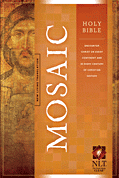 My participation in the "blog tour" of the Mosaic Bible certainly indicates that bible publishers are attempting to work with a crowded marketplace. There are already many bibles on the market; the attempt to craft a message to highlight the uniqueness and devotional utility of any new bible presents a considerable challenge. To these ends, Tyndale has a dedicated website, a blog, a twitter account, and a listing of other blog reviews available.
Finally, as part of the marketing blitz for the product, Tyndale is giving away a few copies of this new book. If you are still reading this and are interested in one, the first person to email me with a request will receive a certificate from Tyndale that can be redeemed for your own personal copy.
Monday, October 26, 2009
Church “Tradition” Previous Era’s Cultural Accommodation
Thanks to Jason Byassee, Executive Director of Leadership Education at Duke Divinity, a new post on their Call & Response blog describes my take on tradition and innovation in church life.
In a post titled 'Our "Tradition" is Often a Previous Era's Cultural Accomodation," I try to give church leaders a perspective that will open them to reconsidering not only the new religious movements which they often hate, but also their own religious traditions which they so very much cherish.
The post says:
The post says:
When new forms of religious vibrancy clearly manifest social change, critics are often quick to attribute their successes to crass appeals to popular tastes.
Here’s an example. I describe in my book “Hollywood Faith” how Oasis Christian Center, an evangelical church in Hollywood, California, grew from five hundred to over two thousand people from 2001 to 2003. Incorporation of entertainment, fun, relevance, and practicality in the promotion of spiritual vitality yielded this spectacular growth.
It is worth asking whether the growth and excitement evident at Oasis is due simply to placating a consumer-driven, popular culture. Is Oasis a secularized “church”? Is religion being compromised?
My main point is to urge recognition that no religious tradition exists which was not forged through a historical processes of accommodation and acculturation.
Working the delicate tension between relevance and ritual, between cultural resonance and cultural transformation, is a perpetual challenge for church leaders everywhere. I want to encourage church leaders to think more carefully about negotiating this tension in recognition that their cherished "tradition" are historical forms that represent cultural adaptations to a prior era.
Friday, April 3, 2009
What's a Blue Kiwi? Innovation through Social Network Software
Quick post: My interest in innovation and online social networking led me to discovering new software designed to stimulate organizational innovation.

In Europe, blueKiwi 2009 was launched last November with a bold presentation on the interaction between the web and human interaction. Working with sociological principles, the software re-thinks the interconnection of networks and the play of organizational management dynamics.
Too many of us take software design for granted. But the ingenuity of software design aligned with the understanding of human social interaction is coming into its own -- especially as social computing becomes more portable and more readily available.
Now we've all got to be schooled in how to use more than "Microsoft Word" and email. Social networking is becoming just as important as the telephone. And as organizations harness the use of these technological innovations, we will find new ways to communicate, brainstorm, share content, and "group think" in dynamic, yet-not-entirely-forseen ways.
In short, the new wave of project management and committee work will move online.
 According to a post by Jon Husband, "Starting from the vantage point of the Web 2.0-savvy user, they have designed and built blueKiwi to be user-centric whilst responding to the business issues that require the building, distributing and and deploying of business-focused knowledge … the essence of social business computing, in my opinion."
Husband describes blueKiwi as "centered on the building, nourishing and sustaining of business-focused relationships - building useful knowledge and getting things done."
Here is an interesting and, to me, persuasive attempt to foster a stimulating space of content and interaction. And once businesses really get behind the building of such systems, the leaders of science, education and religion will not be far behind.
Husband continues in describing the uniqueness of blueKiwi --
Individuals can be known by the "reputation" they build for being involved in different ecosystems in addition to whatever "profile" they create to identify themselves.

The software is oriented around Metcalfe's Law of Networks "whereby the value of a network is proportional to the square of the number of connected members of the network" even though not everyone agrees on this "law." Nevertheless, the software is based on a belief that "organizations should realize that collaboration in connected networks is the way work will be done all the time in the near future, and so organizations should seek to enroll and engage the entire organization in the use of the collaborative platform."
The software here is already available on iPhone -- which means that the accessibility to working with a "portable knowledge community" from the comfort of your local cafe will surely change the way we "think" in the world.
I'll speculate and say I think we're seeing the future of the "new normal." Another decade and this will be a natural way to share ideas.


In Europe, blueKiwi 2009 was launched last November with a bold presentation on the interaction between the web and human interaction. Working with sociological principles, the software re-thinks the interconnection of networks and the play of organizational management dynamics.
Too many of us take software design for granted. But the ingenuity of software design aligned with the understanding of human social interaction is coming into its own -- especially as social computing becomes more portable and more readily available.
Now we've all got to be schooled in how to use more than "Microsoft Word" and email. Social networking is becoming just as important as the telephone. And as organizations harness the use of these technological innovations, we will find new ways to communicate, brainstorm, share content, and "group think" in dynamic, yet-not-entirely-forseen ways.
In short, the new wave of project management and committee work will move online.
 According to a post by Jon Husband, "Starting from the vantage point of the Web 2.0-savvy user, they have designed and built blueKiwi to be user-centric whilst responding to the business issues that require the building, distributing and and deploying of business-focused knowledge … the essence of social business computing, in my opinion."
Husband describes blueKiwi as "centered on the building, nourishing and sustaining of business-focused relationships - building useful knowledge and getting things done."
[M]ost collaboration systems start from the point of view of technical capabilities and do not make it easy, or overlook, the building and growing of relationships. In the past, users of collaborative platforms had to go about building their business relationships, both internally and externally, outside of the collaboration system / platform. blueKiwi2009 is first and foremost a means of building valuable and value-added relationships in the course of doing one’s work … it can enable, contain and manage all the activity in a business ecosystem.An online "ecosystem" is exactly the right term for describing the vision of these software designers.
Here is an interesting and, to me, persuasive attempt to foster a stimulating space of content and interaction. And once businesses really get behind the building of such systems, the leaders of science, education and religion will not be far behind.
Husband continues in describing the uniqueness of blueKiwi --
[A]ll collaboration platforms offer spaces where people can connect, gather, share and exchange information. Thus far, the mainstream approach has been to offer spaces where people can connect and gather, and then share content … information about issues, problems, and areas of interest, and as people exchange and collaborate, useful knowledge is built.In what Husband calls “natural sociology of knowledge work,” the software allows people to enter and exit any "information ecosystem" they wish. The combining of features we know through Facebook, Twitter, LinkedIn, and blogging -- as well as the archiving of documents and drafts -- allows a constructive yet constantly changing space of idea-generation and product-design. Husband says, "the result after several years of intense design, development and deployment is a collaborative platform that in my opinion more closely mirrors the natural sociology of knowledge work than any other platform about which I know."
bK2009 turns this upside down, or around (you choose). It is designed on the principle that the collaborative space is there for content and its distribution, and the individual user then chooses which groups she or he wishes to engage with. Thus, any individual user can be a member of the groups they have chosen to interact with. And of course it has a Twitter clone as one of its features.
What eventuates is a network of interaction around pertinent content, and thus over time an ecosystem around issues in which engagement is de facto defined by the users’ interest and willingness to engage. This then leads to the ability to watch and quantify the volume of interactions and obtain a better, and visible , understanding of the value that is being created (responsiveness, innovation, deepening understanding and so on).
Individuals can be known by the "reputation" they build for being involved in different ecosystems in addition to whatever "profile" they create to identify themselves.

The software is oriented around Metcalfe's Law of Networks "whereby the value of a network is proportional to the square of the number of connected members of the network" even though not everyone agrees on this "law." Nevertheless, the software is based on a belief that "organizations should realize that collaboration in connected networks is the way work will be done all the time in the near future, and so organizations should seek to enroll and engage the entire organization in the use of the collaborative platform."

The software here is already available on iPhone -- which means that the accessibility to working with a "portable knowledge community" from the comfort of your local cafe will surely change the way we "think" in the world.
I'll speculate and say I think we're seeing the future of the "new normal." Another decade and this will be a natural way to share ideas.
Thursday, March 5, 2009
Cool Evangelicals and Their Critique of Institutionalized Evangelicalism
Thanks to my friend Jim Wellman at the University of Washington, here's a fun little article from Brett McCracken on what he calls "Christian Hipsters."
Armed with an M.A. in media studies from UCLA, Brett McCracken is writing a book on "cool Christianity." Sounds like a great project that strikes me as an interesting insider's perspective on the continued negotiation of culture among Evangelicals.
On his blog, McCracken provides a helpful list to see if you, too, might be a Christian Hipster. Here's a sample:
The article (and other related posts) is a marvelous example of Evangelical deconstruction that is so prevalent among younger "churched" segments.
These acculturated Evangelicals alternately turn inside Evangelicalism and outside to the "secular" culture outside of it, back and forth, assessing and comparing, categorizing and typifying, highlighting the gaps between the derivative culture of Evangelicals in comparison with the more authentic and "lively" culture of the "regular" world outside the church.
(It's worth being reminded that Protestantism is founded on a critique of the institutionalized church.)
This work of poking fun at modern Evangelicalism is about their probing assumptions within the movement. It is one of the things modern Evangelicals do constantly. It happens in both seminary classes and Sunday pot-lucks. Witty and sarcastic, such discussions are great fun for insiders. (Discussions within the "Emerging/Emergent Church Movement" is almost entirely based on such repartee.)
But it's not meant to be only fun. For them, the continuity of the Reformation necessitates continual reflection on their own image. It is part of the work of the church. These and other younger Evangelicals value their identity and fear becoming mere caricatures of themselves. They want to beat others to the punch, and hopefully shift quickly to avoid any stigmatization.
And while they are not the only segment of Christianity to self-critique (nor the only religion), it's their use of broad cultural constructs that is interesting to me. These younger, "hip" Evangelicals tend to homogenize all Evangelicals. They leave themselves as the astute outsiders to the messes they see needing to be cleaned up.
Armed with an M.A. in media studies from UCLA, Brett McCracken is writing a book on "cool Christianity." Sounds like a great project that strikes me as an interesting insider's perspective on the continued negotiation of culture among Evangelicals.
On his blog, McCracken provides a helpful list to see if you, too, might be a Christian Hipster. Here's a sample:

Christian hipsters tend not to like contemporary Christian music (CCM), or Christian films (except ironically), or any non-book item sold at Family Christian Stores.
They prefer “Christ follower” to “Christian” and can’t stand the phrases “soul winning” or “non-denominational,” and they could do without weird and awkward evangelistic methods including (but not limited to): sock puppets, ventriloquism, mimes, sign language, “beach evangelism,” and modern dance.
Christian hipsters like music, movies, and books that are well-respected by their respective artistic communities—Christian or not.
Christian hipsters love thinking and acting Catholic, even if they are thoroughly Protestant.
Christian hipsters love breaking the taboos that used to be taboo for Christians. They love piercings, dressing a little goth, getting lots of tattoos (the Christian Tattoo Association now lists more than 100 member shops), carrying flasks and smoking cloves.
The article (and other related posts) is a marvelous example of Evangelical deconstruction that is so prevalent among younger "churched" segments.
These acculturated Evangelicals alternately turn inside Evangelicalism and outside to the "secular" culture outside of it, back and forth, assessing and comparing, categorizing and typifying, highlighting the gaps between the derivative culture of Evangelicals in comparison with the more authentic and "lively" culture of the "regular" world outside the church.

(It's worth being reminded that Protestantism is founded on a critique of the institutionalized church.)
This work of poking fun at modern Evangelicalism is about their probing assumptions within the movement. It is one of the things modern Evangelicals do constantly. It happens in both seminary classes and Sunday pot-lucks. Witty and sarcastic, such discussions are great fun for insiders. (Discussions within the "Emerging/Emergent Church Movement" is almost entirely based on such repartee.)
But it's not meant to be only fun. For them, the continuity of the Reformation necessitates continual reflection on their own image. It is part of the work of the church. These and other younger Evangelicals value their identity and fear becoming mere caricatures of themselves. They want to beat others to the punch, and hopefully shift quickly to avoid any stigmatization.
And while they are not the only segment of Christianity to self-critique (nor the only religion), it's their use of broad cultural constructs that is interesting to me. These younger, "hip" Evangelicals tend to homogenize all Evangelicals. They leave themselves as the astute outsiders to the messes they see needing to be cleaned up.

And since social networks tend to reinforce themselves, they often seem to see the same things, use the same terms, and define reality in similar ways.
It becomes challenging to break out of their own worldview.
Despite the crude categories and the far-too-sweeping generalizations, these self-conscious discussions are part of a serious effort to think and re-think the enactment of the mission of the church in a shifting culture. And as more of them actively integrate more nuanced analytical tools, they could become even more forceful in their self-critiques and contribute even more valid insights on the variety and nuance of dynamics happening around them.

Friday, January 30, 2009
The End of Evangelicalism?
Quick post - When I read this small piece from David Sessions this morning, I felt like I was walking into the middle of a conversation. And I stayed because it's an interesting conversation, you know what I mean?
David Sessions is a writer in New York who wrote an extended comment on the fate of evangelicalism in the near future. It comes on the heels of near-apocalyptic comments from Michael Spencer. Spencer wrote,
I believe that we are on the verge- within 10 years- of a major collapse of evangelical Christianity; a collapse that will follow the deterioration of the mainline Protestant world and that will fundamentally alter the religious and cultural environment in the West.
Whew - strong words. And there's even more. This guy's got a lot on his mind.
In turn, David Sessions measured response is worth reading. If nothing else, he knows evangelicalism is not going to change radically in such a short time, there are more complicated developments than most people want to consider, and the variation within evangelicalism continues to be colored by its own history.
In turn, David Sessions measured response is worth reading. If nothing else, he knows evangelicalism is not going to change radically in such a short time, there are more complicated developments than most people want to consider, and the variation within evangelicalism continues to be colored by its own history.
Tuesday, January 20, 2009
Blog Interview with Me from "Across the Pond"

One of the leaders in the Mosaic Alliance*, my very kind friend Sam Radford from Sheffield in the UK posted an "author interview" of my research awhile back.
You can read the interview online and take a moment to check out Sam's blog.
. . . . . . . . . . . . . . . . . . . . . . . . . . . . . . . . . . . . . . .
*I'll write more about the Mosaic Alliance, a network of churches and congregational leaders initiated at Mosaic in Los Angeles, in a later post.

Monday, January 12, 2009
Hot-For-Jesus Former Fundie - A Story of Deconversion, Doug Pagitt, and 9/11
Compelling prose and heart-wrenching stories often center on religion. In fiction, I think of Flannery O'Conner. In non-fiction, I listen for personal stories. And I just found one.
A Story of De-Conversion
I clicked on Christine Vyrnon's blog because of its title: HOT-FOR-JESUS FORMER FUNDIE. Humorous and personal, her blog features quirky and ironic pictures of Jesus. Her writing focuses on her own experience of faith.
A note posted last October caught me. It's part of a story of de-conversion, and features one of the most influential member of the Emerging Church Movement - Doug Pagitt and Solomon's Porch. In
she writes,
As she tells more about her path to Solomon's Porch, she writes about the service that night,
Read the blog entry to see what happens next.
Affirming-Rejecting Religiosity

 In non-fiction, I listen for personal stories. And I just found one.
A Story of De-Conversion
I clicked on Christine Vyrnon's blog because of its title: HOT-FOR-JESUS FORMER FUNDIE. Humorous and personal, her blog features quirky and ironic pictures of Jesus. Her writing focuses on her own experience of faith.
A note posted last October caught me. It's part of a story of de-conversion, and features one of the most influential member of the Emerging Church Movement - Doug Pagitt and Solomon's Porch. In
JINXED: Solomon's Porch and My Leap From Faith into the Arms of Yoga
she writes,
The night of 9/11 I attended an impromptu prayer service at my favorite “church”: Solomon’s Porch. Under 12 people showed up. We talked and prayed and consulted scripture. I, who never liked praying out loud, a form of improv on one’s knees, prayed aloud, fervently asking God to keep our nation from resorting to violence in response to violence.
Solomon’s Porch was there when I needed it the most. I was settling into a church, which was a Big Deal for a girl who had seen church politics at its worst...
After careful consideration and prayer, the Spirit moved me to tell my story, something I’d never done before. Though I’d been singing solos in church my whole life, I’d never spoken so publicly about my dedication to Jesus.
The time had come.
Read the blog entry to see what happens next.
Affirming-Rejecting Religiosity
One thing I find compelling in her story is her deep appreciation for Solomon's Porch as a church while adamantly rejecting Christianity. We don't know enough about how this kind of paradoxical religion-affirming/yet-religion-rejecting religiosity.
I think it's part of the "new atheism" in today's world. Not all atheism "hates" all aspects of religion. And as the percentage of atheists in the world is growing (sloooowly), we will move away from simple dichotomies and come to understand the variety of "atheisms" that exist out there.
What do you think?
Thursday, January 8, 2009
Warren-ology - Comparing Rick Warren & Billy Graham
Here's a quick post after reading Mark Silk on the Spiritual Politics blog.
Seems like the discussion among the religious historians comparing Billy Graham and Rick Warren is continuing to heat up. Duke University Professor Grant Wacker just gave a presidential speech concluding the meetings of the American Society of Church History.
Wacker, who wrote the fabulous book Heaven Below: Early Pentecostals and American Culture, is currently writing a highly anticipated biography of Graham (having obtained rare access to his archives), so his ideas are further fueling the fire.  Image via Wikipedia
 , is currently writing a highly anticipated biography of Graham (having obtained rare access to his archives), so his ideas are further fueling the fire.
 Image via Wikipedia
Overall? I think the jury's still out. Graham has had decades of public/political ministry, and Rick Warren's has just started.
Still, there's a lot of colorful commentary out there. Silk offers a quick summary of Graham's ministry, saying,
Graham got to where he got because, over his six decades in American public life, he became more adept at slipping punches than Muhammad Ali in his prime. Many were thrown, from left, right, and center, but Billy danced away from most to become the best known Protestant evangelist and the most iconic American religious leader of all time.How did he do it? In part by force of personality, in part by having perfect pitch for what appealed to his vast middle-class, moderately conservative white Protestant followers, in part by sticking to his message of getting people to decide for Christ, in part by a shrewd determination never to let himself get boxed into an ideological corner.
He quips that Billy Graham's socially progressive views are still decades ahead of today's evangelicals, saying,
One might say that the so-called new evangelical agenda is simply the latter-day Graham agenda.
You can read all of the post, and connections to an earlier discussion is here.
My previous Warren-ology posts are here.
Thursday, December 25, 2008
Book Blog for the Literary Types
ReadySteadyBlog is Mark Thwaite's blog at ReadySteadyBook, blogging about the very best books in literary fiction, poetry, history and philosophy.
Thoughtful and less-noticed books that get you thinkin' a bit. Check it out!
Thoughtful and less-noticed books that get you thinkin' a bit. Check it out!
Subscribe to:
Posts (Atom)