Tuesday, May 25, 2010

Spending Time with My New Friends Derrida, Lacan, and Žižek

Winding up this past semester was one thing, getting through an intense immersion through the works of Jacques Derrida, Jacques Lacan, and Slavoj Žižek is another...

Jacques DerridaDerrida via Wikipedia

Jacques-Marie-Émile Lacan'''Lacan via Wikipedia

Slavoj Žižek (b. 1949) - Slovenian philosopher...Žižek via Wikipedia


I have a long interest in social philosophy and chip away at stacks of books at home and my office every few months. Since March, my work on the line of Hegel-Marx-Freud-Saussure-Heidegger-Derrida-Lacan-Žižek has exploded. I can still rely on my past learning of Marx and Freud, have just enough of Hegel to bumble around, and enough of Heidegger and Saussure to make the leap. But the last line of Derrida, Lacan, and Žižek needed sustained attention for some new queries I'm exploring.

There's no way I'm going to summarize these thinkers. Let's say for the moment that I find Derrida's critique of Husserl's subject to be fundamental and important, introducing a radical opening/gap/crisis of subjectivity that demands attention. Derrida is directing me back to Heidegger, and a new translation of Being and Time is coming out in time for my new resolve to think more carefully about the metaphysics of human subjectivity.

Lacan, on the other hand, reworks Freud in intriguing and productive ways. I'm glad I quickly found that one cannot simply "read" Lacan - he demands much prior preparation. He never explains himself, and his ideas have shifted over time. In the experience of reading him, the translated seminars are one thing (conversational, narrative); the massively compacted ideas in Écrits is another (compact, dense). Still, this remarkable thinker opens ways for understanding the self and human relationships that are still being developed.

Which leads to Žižek. Here we find a creative (almost frenetic) thinker who is both a social critic and a metaphysician. Žižek's Sublime Object of Ideology reveals a Lacanian reading of Hegel (via Marx) that brings forth surprising insights into the nature of guiding "beliefs" or "truths" at a macro-level. The conceptual apparatus is daunting to the uninitiated, so I'm grateful for graduate school and my continued readings in philosophy from Descartes onward to get me through. Nevertheless, Žižek's understanding of ideology has got me pondering a lot of things, and it is this orientation that feeds into his approach to Christianity as found in The Puppet and the Dwarf among other writings. It is this reading that has been attractive within the Emerging Church Movement, and Žižek's popularity is making its way through reconsiderations of Christian theology in books recently published by T&T Clark (see also here and here) and Eerdmans. In contrast, his social critique is quite different from such metaphysical considerations, thus accounting for the difference in the experience of reading The Parallax View and Living in the End Times.

So, I've been busy spending time with my new friends. Back to reading.

Tuesday, April 13, 2010

Tenured and Promoted: Gerardo Marti becomes L Richardson King Associate Professor of Sociology at Davidson College

Last week, Davidson College affirmed my tenure and promotion to Associate Professor.

Long time in the making -- a vote of Davidson College Trustees affirms my "lifetime appointment" as a professor in the Department of Sociology. I continue to hold the L. Richardson King Professorship, and have several new courses in the works for the coming year.

Lots happening here. A few quick items:

I continue to work on a new book project which I hope to complete this fall on music and worship in racially diverse congregations. More on this later.

I have a new article just published in the Sociology of Religion: A Quarterly Review titled

Ego-affirming Evangelicalism: How a Hollywood Church Appropriates Religion for Workers in the Creative Class

I have two new articles to be published in June with the Journal for the Scientific Study of Religion about African American integration into diverse congregations. I'll post when these come online.

I posted a new article at the Duke Divinity Call and Response Blog on a "skirmish" between the Multiracial Church Movement and the Emergent Church Movement.

And I am now the Book Review Editor-Elect for the Sociology of Religion journal. Please send good social scientific books my way.

I am preparing in my role as Program Chair the annual conference for the Association for the Sociology of Religion. The meetings will be held in Atlanta in August, and I hope to let you know of some sessions you may be interested in attending, especially a session titled "Scholars and National Leaders of the Emerging Church Movement" with Doug Pagitt, Tim Hartman, Troy Bronsink, James Bielo, and yours truly.

I continue to serve on the Executive Council for the Society for the Scientific Study of Religion, the Council for the Association for the Sociology of Religion, and the Editorial Board for the Journal for the Scientific Study of Religion.

I recently was elected to serve on the Steering Committee for the Religion and Social Science Section of the American Academy of Religion.

I will be presenting some interesting research at the annual meetings for the Society for the Scientific Study of Religion in October this year. These are great meetings happening in Baltimore, Maryland, this year.

And my book stack continues to grow. Reading a ton of philosophy these days, with a few good reads at the intersection of race/ethnicity, religion, and social change.
I hope you can see why I've not been as regular at posting on the blog these days, but I hope to keep you in touch with interesting things as information becomes available.

Sunday, December 13, 2009

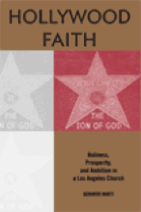
Hollywood Faith: Holiness, Prosperity, and Ambition in a Los Angeles Church - Book Review

Many thanks to Kathleen Hladky at Florida State University (her recent article) who provided a review of my book Hollywood Faith for the H-Pentecostalism thread of Humanities and Social Sciences (H-Net) Reviews Online, a powerful consortium of scholars attempting to provide timely updates of new research.

In the review, she concludes:
Throughout Hollywood Faith, Marti contributes to the study of Pentecostalism and contemporary Christianity by drawing attention to topics too often overlooked by scholars of religion: the relationship between religion and work, multiracial Christian congregations, and the Word of Faith movement.
Overall, her reading of my book shows great sensitivity to the layered themes on religion, economics, and race found there.

You can read the full review here.

Saturday, December 5, 2009

Smartphone Religion at the Duke Divinity Call & Response Blog

Christmas season is in full gear at the Marti house -- finishing up my classes, the kids homework projects before the end of the year, community activities here in Davidson.

In the midst of it all, I've been able to take Jason Byasee's invitation to again contribute last week to the Faith & Leadership Blog at Duke Divinity.


My latest post on The Wi-Fi Church of the Future (and the Present)
is tagged under Innovation | Liturgy | Technology ):

Worldwide iPhone sales by quarter in an svg fo...Image via Wikipedia

"The past two years have seen a rapid acceleration in the adoption of portable computing by the average person. This will inevitably prompt changes by church leaders."
It's prompted a good online exchange.

I'll encourage you to read the whole post on your own. But more than the post itself are the responses that follow it.

The Executive Director of Leadership Education at Duke Divinity first describes his "knee jerk" reaction against churches leaning on such technology. Another believes "the app" already exists. And yet another comment brings concern for the poor and their access to wi-fi technology and information.

I appreciate the dialogue. I'm learning all the time, and the comments are helpful.

Overall what this exchange suggests to me is that we've arrived at an interesting moment in the relationship between technology and church.

Assorted smartphones. From left to right, top ...Image via Wikipedia

The American culture has swallowed the use of smartphones almost whole -- after all, analysts can readily predict how many iPhones will be found under the Christmas tree this year.

But church leaders remain nervous about learning new techniques to harness the use of these advanced devices to their ministries.

Smartphones are not the future; they are already here.

So the failure lies not in ministry budgets (people have their own phones), it lies in the imagination of leaders to use these devices to advance their ministry.

Friday, November 13, 2009

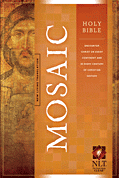
Mosaic Bible - The Branding of Devotional Christianity

I agreed to write a "review" of the new Mosaic Bible, a new formatting of the Protestant Scriptures published this Fall by Tyndale Publishers. The publisher provided me a deluxe, imitation leather version. Joining Tyndale's campaign afforded an opportunity for me to look take a closer look at some of the sociological aspects of Bible marketing today.

Walk into any local bookstore, and you will find dozens of choices for bibles today. The production and distribution of market-savvy bibles may surprise some, but it is one of the most interesting developments in modern Christianity.

Crafting Editions of The Word of God

This Gutenberg Bible is displayed by the Unite...Image via Wikipedia

We can look back and see how the printing press certainly enabled a more ambitious structuring of the Protestant scriptures. The Geneva Bible first printed in 1560 was the first Bible to add numbered verses to make referencing passages easier. In addition, every chapter included extensive marginal notes and references making the Geneva Bible the first English "Study Bible." Between Between 1560 and 1644 at least 144 editions of this Bible were published.

Yet the initial effort to craft these bibles was considerable. It took scores of hours to typeset new bibles, and innovative systems of notations, illustrations, and footnotes created enormous difficulties. Take a glance through any edition of the Thompson Chain Reference Bible to gain an appreciation for the tremendous hours of work required to craft these books as ultimate "Bible Study Tools" intended to take personal reading of the scripture to unprecedented layering of hermeneutic possibilities.

Furthermore, the structuring of "notes" became the occasion to self-consciously promote whole theological systems. Consider the successive editions of the Scofield Reference Bible for its quite specific (and to many people peculiar) discussion of world history, the relationship between Israel and Christianity, and anticipations of eschatological happenings.

Now, the rise of digital typeset and new print techniques (including the ability to print color pages cheaply) have greatly expanded the possibilities for bible formats. Production houses have become increasingly creative in the formation of new types of bibles. While the "text" of the bible (the translation formats) may often be the same, the formatting, illustrations, and notations accompanying the text are what make a new product.

Bibles Proclaim a Brand of Faith

Moreover, bibles are not only intended to provide exhaustive notations but also reorientation toward the faith. In other words, while it may initially seem that "a bible is a bible is a bible," it is important to note that the crafting of a bible is equivalent to forming a strategic presentation of the Christian faith. In short, any carefully designed bible proclaims a brand of faith.

Enter Holy Bible: Mosaic NLT.

The Mosaic Bible strives to make a book primarily meant for meditation and prayer. It claims to be "a new genre of Bible—a weekly meditation Bible." In comparison with the large, white bible that occupied the living room table of my home growing up, the Mosaic Bible is portable and durable. But more than its portability, what makes the bible intentionally geared to personal reflection is that nearly the first half of the whole book is a series of weekly "installments," a set of scripture readings, prayers, reflections, and empty lines (for writing) accompanied by religious artwork. The weeks are aligned with church seasons. (For those who don't know which season it is, a website can be consulted; this is the 26th week of Pentecost ("Righteous Judgment"), pg m314.

The readings and prayers are intended to be diverse, affirming Christianity as a historic and global religion. There are readings from ancient to contemporary authors from every continent and every century. Of course, these excerpts are all highly orthodox and contain the presentation of Christian concepts and virtues to those generally accepted by more conservative Protestant Christians.

There is also a notable striving to affirm of the use of art in religious devotion. Full-color artwork, hymns, and poems are included.

The New Living Translation provides the base scriptural text, a newer, freer English version that allows for contemporary and colloquial speech constructed by a team of (mostly Evangelical) biblical scholars.

So, what is the branding of Christianity that comes through this particular bible?

I would suggest several dominant themes:
  • A bible can be aesthetically pleasing, yet should still evoke a pious consideration of the "sacredness" of the book as traditionally understood.
  • The bible is to be a personal, devotional tool such that the notations in "your" bible will not be the same as those in "my" bible.
  • However, the bible is not meant to be read "individualistically," but in the context of a broader community of believers through history.
  • The bible is to be read regularly and systematically.
  • The bible is most profitably read accompanied by prayer and focused reflection on themes.
  • Although structured devotions are useful, individuals should take corporate themes as launchpoints for personal reflections and commitments.
  • Bible study tools including cross-references, dictionary, maps, and concordances, are now "assumed" as essential in personal bibles.
  • The use of contemporary translations means that there is a recognition that the spiritual value of the bible is not found in traditional words or phrasing but rather in the meaning of those words to the extent they can be accurately conveyed.
  • And the aggressive marketing of a bible is appropriate in that the goal is not self-promotion as much as the distribution of a tool that gets people to read the scriptures for themselves.
My participation in the "blog tour" of the Mosaic Bible certainly indicates that bible publishers are attempting to work with a crowded marketplace. There are already many bibles on the market; the attempt to craft a message to highlight the uniqueness and devotional utility of any new bible presents a considerable challenge. To these ends, Tyndale has a dedicated website, a blog, a twitter account, and a listing of other blog reviews available.

Finally, as part of the marketing blitz for the product, Tyndale is giving away a few copies of this new book. If you are still reading this and are interested in one, the first person to email me with a request will receive a certificate from Tyndale that can be redeemed for your own personal copy.

Monday, October 26, 2009

Church “Tradition” Previous Era’s Cultural Accommodation


Thanks to Jason Byassee, Executive Director of Leadership Education at Duke Divinity, a new post on their Call & Response blog describes my take on tradition and innovation in church life.


In a post titled 'Our "Tradition" is Often a Previous Era's Cultural Accomodation," I try to give church leaders a perspective that will open them to reconsidering not only the new religious movements which they often hate, but also their own religious traditions which they so very much cherish.

The
post says:
When new forms of religious vibrancy clearly manifest social change, critics are often quick to attribute their successes to crass appeals to popular tastes.

Here’s an example. I describe in my book “Hollywood Faith” how Oasis Christian Center, an evangelical church in Hollywood, California, grew from five hundred to over two thousand people from 2001 to 2003. Incorporation of entertainment, fun, relevance, and practicality in the promotion of spiritual vitality yielded this spectacular growth.

It is worth asking whether the growth and excitement evident at Oasis is due simply to placating a consumer-driven, popular culture. Is Oasis a secularized “church”? Is religion being compromised?

My main point is to urge recognition that no religious tradition exists which was not forged through a historical processes of accommodation and acculturation.

Working the delicate tension between relevance and ritual, between cultural resonance and cultural transformation, is a perpetual challenge for church leaders everywhere. I want to encourage church leaders to think more carefully about negotiating this tension in recognition that their cherished "tradition" are historical forms that represent cultural adaptations to a prior era.

Tuesday, October 20, 2009

New Approaches to New Evangelicalism - Special Session in Denver

Here's a shout out for a session I organized for this weekend at SSSR in Denver, Colorado, on contemporary Evangelicalism in the US and abroad.

Jesus SavesImage by Andwar via Flickr


Competition among sessions this year at SSSR is fierce!

So many great sessions in each slot, but you just can't miss the session on New Approaches to New Evangelicalism. Our session brims with brilliance through the work of excellent scholars doing fascinating research. You can count on this being a stimulating time with plenty to chew on.

New Approaches to New Evangelicalism
Westin Tabor Center
Room: Teller

Organizer: Gerardo Marti, Davidson College
One Way Out: Examining the ‘Evangelical Exit Clause’ for Central America
Robert Brenneman, University of Notre Dame (rbrennem@nd.edu)

Exporters of Religion: Evangelicals in Global South Impact Other Countries with the Gospel
Stephen Offutt, Boston University (soffutt@bu.edu)

Reconstructing Social Space at Willow Creek Community Church
Peter Mundey, University of Notre Dame (pmundey@nd.edu)

The Emotional and Aesthetic Dimensions of the Local Church Rock Scene
Kevin McElmurry, University of Missouri (Klm143@mizzou.edu)

Plan on meeting us Saturday October 24 @ 3:45pm-5:15pm.

Sunday, October 18, 2009

Religion Scholars Meet in Denver

Quick Post: I'm getting ready for another meeting of the Society for the Scientific Study of Religion.
Although not everyone likes "scientific" in the name because not everyone accepts the loaded connotations of the word... Nevertheless, SSSR (pronounced "triple-es-arr") is a corporate attempt to talk about religion in "non-confessional terms" and is the most focused gathering of scholars from the social sciences in the United States.

These meetings are great. Really great. Sociologists, anthropologists, psychologists, economists, political scientists, historians, etc., etc., who gather in a focused manner to bring everyone up to date on the most recent, most exciting scholarship, happening on religion all around the world. Not only do I learn a lot, I enjoy the people I've met at these meetings. I've made many friends over the years and expect to make many more.

Take a look at the topics and research being presented over the coming weekend. In one session I'll be presenting research on African Americans as the icon of worship among members of multiracial churches; in another, on how attenders become members, then lay leaders, in the American megachurch.

Monday, October 12, 2009

Sociologists Need to Account for Evangelicals’ Vitality

Thanks to Jason Byassee, executive director of Leadership Education at Duke Divinity, I was asked to contribute a post to the Call & Response Blog. As a sociologist, I'm fascinated by the intersection of religion and social change. Because much of my focus has been on the American context, it's impossible to ignore the vitality of Evangelicalism in the United States.


I've noticed that not everyone is as sanguine about Evangelicalism as I am.

In fact, most sociologists ignore all forms of religious enthusiasm. At Duke Divinity's Call & Response blog, I write:
Spiritual vitality is not a topic normally addressed by sociologists. My discipline historically has more often severely critiqued religion for its oppressive beliefs and practices.

Of course, sociologists are not alone in this: gauged by books and magazines at my local bookstore and conversations with colleagues and neighbors, arguments for the oppressiveness of religion are everywhere. The disappointment and hurt so common among people I know fuels the attention given to the "new atheism" in recent books like Sam Harris’ “Letter to a Christian Nation,” Christopher Hitchens’ “God is Not Great,” and Richard Dawkins’ “The God Delusion.”

But, a few social scientists do pay attention, and I point out that my reading of some recent publications reveals social scientists promoting their own particular religious bias.

The Evening Descends album coverImage via Wikipedia


There is a lot they don't like about Evangelicalism.

They acknowledge the strength of Evangelicalism and the evidence that churches in the "Mainline" are adopting Evangelical tactics. Yet, the very spread of "Evangelicalism" is not seen as success, or less the work of God, but rather evidence of a noxious spread of the frightening demons of shallow individualistic spirituality, right-wing freakishness, and worldly decline.

I say to my colleagues that we need a broader analytical approach that encompasses, rather than ignores, the strength of Evangelicalism --
Social scientists must switch from merely a critique of evangelicalism to a broader analysis of what constitutes the set of dynamics broadly labeled (and vilified) as “Evangelicalism.”

How do we account for the passion, excitement, and (dare I say it?) spiritual vitality evident in at least a portion of evangelical churches?

I'm not alone. Theologian Philip Clayton at the Claremont School of Theology has also aggressively promoted a more open-minded understanding of evangelical vitality. This is a call not to promote Evangelicalism, but rather to avoid merely dismissing it.