Friday, December 26, 2008

Update on My Research - Humanities Research Center, Rice University

I spent this past fall as the Lynette S. Autrey Visiting Professor of Religious Studies through the Humanities Research Center at Rice University.

The HRC regularly publishes a newsletter, and this one includes an update on my work there. Copy and paste into your browser for this PDF file:

http://www.google.com/url?sa=t&source=web&ct=res&cd=237&url=http%3A%2F%2Fhrc.rice.edu%2Ffiles%2FHRCNEWSF08.pdf&ei=g3FVSczXL4-EtgfDmsWkDg&usg=AFQjCNEo8JsaRL_ZffLS_7KjN0omJZ0fkw&sig2=usVaxkXYmCjNFG8-iKHLEg

See page 14!


Moleskine Art

Many of us enjoy our Moleskine notebooks, handy tools with pocket, ribbon, and elastic band to keep our thoughts together.

But others are taking this little book to a whole new level - creating art. Here's one example:

When I see art like this, it reminds me how far my imagination has yet to stretch.

This is only one example. Sketches, paints, portraits, fanciful images, collages, even pop-up books -- the uses for these little sketch books is amazing.

For more images and ideas, check out these links:

http://www.smashingmagazine.com/2008/10/22/moleskine-art-beautiful-examples-and-talented-artists/

http://www.boingboing.net/2008/04/16/public-skineart-mole.html

http://www.boingboing.net/2007/04/17/jim-woodrings-popup-.html

http://octolan.com/moleskine/

http://www.skineart.com/

Bloggingheads: Christian Schism in the Episcopal Church - The New York Times - Video Library

Theology? Or culture war?

A brief dialogue from Christopher Wells, left, of the Living Church Foundation and Father William Franklin of the American Academy in Rome debate the schism in the Episcopal Church.

Thursday, December 25, 2008

Giving Up My Brain to Media - New Book


The Great Brain Suck: And Other American Epiphanies

New book on consequences of American media saturation. Is this book talking to me?

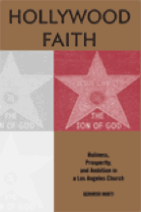
Preview "Hollywood Faith" on Google Books


Hollywood Faith: Holiness, Prosperity, and Ambition in a Los Angeles Church

Check out a preview of my book "Hollywood Faith" available on
Google Books.

Deep meets Deep - Barzun on William James


A Stroll with William James

Reading William James can be satisfying; reading Barzun on James is paradigm-shifting. Here is an interpreter who pulls together not only what makes James important but the critical points of modern approaches to understanding the self and the world. Chatty and a bit rambling, the book still provides an expansive picture of contemporary forms of thinking through the lens William James.

A Stroll with William James has the potential of bringing people from the 19th c. to the 21st c.-- if they are willing to set aside what they think they already know about how the world works.

William Gaddis, Protestantism, and Modern Capitalism

Came across an interesting post on the relation between work and religion in modern society through the novels of William Gaddis. If you haven't read him, Gaddis is a dense, verbose, deeply philosophical writer who combines sensual detail with a textured understanding of his times.

Gaddis books discussed in this article:

The Recognitions (Penguin Classics)

JR (Penguin Twentieth-Century Classics)

Agape Agape (Penguin Classics)

And another book of his to consider:

Carpenter's Gothic (Penguin Twentieth-Century Classics)

Playing Gods - The Game of Divine Domination


I love board games and came across this new game. In a news article, Carl Raschke, professor of religious studies at University of Denver says, "The game's perspective "has no basis in historical reality and doesn't actually represent any religion. It just appeals to people who hate religion to begin with — the hip subculture of militant popular atheists."

Raschke adds, "These people are fanatics, for the most part, themselves. Their thinking is rigid and hostile and not much different from jihadists who don't use their minds or study what they are dealing with. They start from their own dogmatic perspective."

Race - The Theological Problem

Race: A Theological Account

Another interesting book to consider. Carter's claim is that with the legitimation of Christian theology, Christianity became the cultural property of the West, the religious ground of white supremacy and global hegemony. In short, Christianity became white. The racial imagination is thus a particular kind of theological problem.

A little more on the author is here: http://inhabitatiodei.wordpress.com/2007/01/12/j-kameron-carter-on-baptism-christology-and-black-theology/