Showing posts with label politics. Show all posts

Saturday, October 3, 2009

Evangelical Elites - Power in American Culture

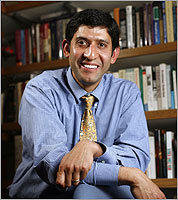
Today I present this extended video lecture from my friend and colleague D. Michael Lindsay given earlier this year at Calvin College. Michael is a sociologist at Rice University and author of the bestselling book Faith in the Halls of Power.

Michael centers his work on the workings of power in American culture.

While completing his research at Princeton University, Michael accomplished an unusual research project. He successfully conducted interviews with more than 350 people of prominence, including two former Presidents of the United States and over two dozen Cabinet secretaries and senior White House staffers; more than 100 presidents, CEOs, and senior executives at large firms (both public and private); two dozen accomplished Hollywood professionals; more than 10 leaders from the world of professional athletics; and more than 100 leaders from the artistic, philanthropic, educational, and nonprofit arenas.

His recent focus on Evangelicals has drawn a great deal of attention, and this lecture titled "Powerful Faith: Evangelicals in American Culture" given to business leaders in Grand Rapids provides a glimpse into his findings.


TJS 20090120 lindsay from Calvin College on Vimeo.

Michael continues to do excellent work and now leads an ongoing multi-year study known as The PLATINUM Study—Public Leaders in America Today and the Inquiry into their Networks, Upbringing, and Motivations.

Thursday, July 23, 2009

Is Obama the Antichrist? Well, Of Course He Is...

The American Religion Historian Matthew Avery Sutton wields a sharp pen. His book connecting American politics and the ministry of Aimee Semple McPherson is fascinating and important. Now in a post on Religion Dispatches this week, Matt takes aim at evangelicals and their relationship to President Obama, especially in their all-too-frequent obsession over decoding biblical prophecy. While Matt may not slay the beast, I think he hits pretty close to the heart.

(Thanks again to Paul Harvey for his posting at the Religion and American History blog.
)

Historian Matt Sutton doesn't hold back. He combines careful scholarship with sharp opinion. As a writer, we might say Matt has a "point of view." Even more, Matt is a scholar willing to tell people what he really thinks. Uncommon for an untenured professor.

In this post, Matt shows how it is inevitable that Obama's serene "Angel of Light" manner will be interpreted as yet another indication of the coming Antichrist.

Matt points out that "the vast majority of American evangelicals interpret the most obscure books of the Bible (Daniel, Ezekiel, and Revelation) in a very narrow and particular way. They believe that when these three books are read in conjunction with one another and overlaid with a few of Jesus’ statements, a hidden 'plan of the ages' emerges." And he's right. This is a holdover from the grip of dispensationalism (found in places like Scofield's Study Bible, bestselling Christian books both scholarly and popular, and frequent Sunday sermons) that has held evangelicals for most of the 20th Century.

He continues, "During the last 100 years, evangelicals have witnessed more and more evidence of these prophecies being fulfilled..." and shows how the Antichrist was predicted in the rise of leaders and various policies that emerged in this eventful time.
"So what does this mean for the Obama administration? Nothing very promising. Despite the president’s desire to find common ground with evangelicals, he is unlikely to be able to penetrate the apocalyptic fears that have characterized the evangelical movement since the Great Depression."
The flexibility of biblical interpretation and the considerable history of connecting the actions of political leaders with violent acts and natural disasters of all kinds leads these beleivers to connecting the dots of Obama's life to the determinative flow of spiritual history.

6: bible nerdImage by jamelah via Flickr

In other words, if you look for the Antichrist, you will find him.

Matt throws up his hands and concludes:
So what can we do? Pray for the rapture. If evangelicals vanish, the rest of us might finally get better medical care, a healthier environment, a more just international community, and full civil rights for gays and lesbians. But short of this miracle, we can at least begin to understand that before Obama is able to penetrate the evangelical heart, evangelicals themselves will need to do some serious soul-searching. Rick Warren and Joel Osteen’s shallow, positive-thinking, feel-good sermonizing is not going to help them do this. Instead, it is up to the younger evangelicals to engage in serious intellectual debate and a rigorous rethinking of the theology at the root of their politics. Anything less and the doomsayers will turn fears of Obama-as-Antichrist into big business. But hell, maybe that’s just the spark the economy needs.
Here Matt tips his hand on his own politics. Nevertheless, I think Matt is right that the old-school, end-times prophetic orientation of evangelicals will keep them from ever seeing politicians who fail to live up to a conservative social agenda as being less than an agent of prophecy, accelerating the apocalyptic consummation of history.

And he raises an important question. What are the resources available for re-thinking the theology at the root of evangelical politics? Is there something that needs to be recovered from the past, perhaps Walter Rauchenbush? Reinhold Niebuhr? Is there something to be found more recently in Martin Luther King, Jr.? Or is Jim Wallis and the Sojourner's group a fruitful direction?

Sunday, June 28, 2009

Historian Questions America's Voluntary Tradition

Thanks to Religion in American History blog, I caught an interesting interview with Historian Johann N. Neem on the relationship between religion and the emergence of democratic ideals of the American Republic.

Are joining and volunteering a "natural outgrowth" of the American Revolution?

According to Neem, "Freedom of association is in a sense the embodiment of a failure of a certain kind of revolutionary hope."

And church leaders were part of the process of discouraging orienting with the interests of the state.

Naeem says, "Increasingly church
leaders said less we need an alliance with the state, in fact that is a handicap. What we need is to convert people and then mobilize those people.

"Some of the most mobilized Americans in the 1820s and 1830s were Evangelicals coming out of these churches."


For more, add Neem's new book Creating a Nation of Joiners: Democracy and Civil Society in Early National Massachusetts to your summer reading list.

Friday, April 17, 2009

Billy Graham and the Rise of the Republican South


Quick post: Nice review of a new book on Billy Graham by historian Steven P. Miller.

The New York Times Book Review includes a nice review of Billy Graham and the Rise of the Republican South, described by the publisher as a book that "considers the critical but underappreciated role of the noted evangelist in the creation of the modern American South."

The book wonderfully weaves politics, religion, and racial relations together around the emerging career of evangelist Billy Graham and the important election of Richard Nixon.

According to the article:

{{w|Billy Graham}}, American religious figure.Image via Wikipedia

Graham’s rise to prominence as an evangelist coincided with the turbulent years between Brown v. Board of Education in 1954 and the landmark civil rights legislation of 1964, and throughout that decade he wrote and sermonized in favor of racial harmony, staged desegregated rallies in balkanized cities, and counseled obedience to court rulings and legislation that many of his fellow Southerners were determined to resist. As a voice for both Christian conservatism and racial progress, he served as a bridge between the Old South and the New, and as a model for a region struggling to shed its worst baggage without losing its identity.

That’s one story. But there’s another story as well, one that paints Graham as a coward and an apologist for racial backlash. He supported desegregation but took few risks on its behalf; he cultivated a studied moderation in a time that cried out for moral clarity; he was more interested in flattering the white South’s self-regard than in calling his region to true repentance. As a steadfast supporter of Richard Nixon’s career, from the 1950s down through Watergate, he simultaneously enabled and embodied Nixon’s “Southern strategy,” which shut civil rights liberalism out of power and turned the region Republican for a generation.

Nixon gives his trademark Image via Wikipedia


Neither story is the whole truth, but both are true. And it’s a credit to Steven P. Miller that his “Billy Graham and the Rise of the Republican South,” a study of the evangelist’s relationship to the cause of civil rights on the one hand and the cause of conservatism on the other, does justice to the tensions and complexities involved — for Graham, for the South and for the country.

The book is good, just out (I got my own copy this past week), and a textured historical analysis of the recent, American past we are still learning to understand.

Friday, March 13, 2009

Latinos Take Immigration Reform to Evangelical Churches

Quick Post: Latino activists urge churches to provoke broad immigration reform.

Stories and quotes in an interesting article originally from the Chicago Tribune describes the effort by Latino immigration activists to bring families together.

From the article:

LOS ANGELES - DECEMBER 19:  A man points while...Image by Getty Images via Daylife

Two years after a sweeping immigration reform bill failed in Congress, Latino leaders have revitalized the effort, positioning children who were left behind when their parents were deported as the new face of the movement. 
The campaign is designed to place pressure on President Barack Obama to make comprehensive immigration reform a priority.

Borrowing a page from the civil rights movement of the 1960s, Latinos have taken their cause to churches, drawing upon the growing population of evangelical Latinos, who like their white counterparts, are strong advocates of family values.

While Hispanics overwhelmingly remain Roman Catholics, nearly one in six in the U.S. identify as evangelicals, the second largest religious group in the Latino community, according to the Pew Hispanic Center.


"Our families are the cornerstone of our society, and we want to protect those families." Packing a large evangelical church in suburban Atlanta, the mostly Latino audience shouted "amen" and waved as ministers preached about how God would protect them.

The Meeting Place Church service held in basem...Image via Wikipedia

For more than three hours, they prayed, sang spirituals in Spanish and listened to the testimonies of families torn apart at the hands of federal immigration agents.

The stories are designed to tug at the heartstrings of Americans and focus attention on what community leaders said is the most tragic consequence of the federal government's crackdown on illegal immigration -- the breakup of families, a problem they said affects up to 5 million children, most of whom were born in the U.S. and automatically are citizens.

Tuesday, March 10, 2009

Revival Religion and Third World Politics

The Pew Foundation and Oxford University Press have partnered together to commission a set of volumes examining Evangelicalism and Democracy outside the United States. Case studies and conceptual frameworks broaden our perspectives beyond our own backyard.

The connection between politics and religion will always be interesting. While many of us are caught up in the happenings of the U.S., a four-volume series form Oxford brings the questions and issues to other regions of the world. Here's another --

Evangelical Christianity and Democracy in Asia
by David Halloran Lumsdaine


From the publisher:

This is one of four projected volumes to emerge from a massive, Pew-funded study that sought to answer the question:

  • What happens when a revivalist religion based on scriptural orthodoxy participates in the volatile politics of the Third World?
  • Is the result a democratic politics of the ballot box, or is it more like an authoritarian politics of command from on high?
  • Does the evangelical faith of the Bible hinder or promote a politics of the ballot box?

Faithful praying towards Makkah; Umayyad Mosqu...Image via Wikipedia

At a time when the global-political impact of another revivalist and scriptural religion, Islam, fuels vexed debate among analysts the world over, this series offers an unusual comparative perspective on a critical issue: the often combustible interaction of resurgent religion and the developing world's unstable politics.

Three of the volumes focus on particular regions (Africa, Latin America, and Asia). The fourth will address the broader question of evangelical Christianity and democracy in the global setting. The present volume considers the case of Asia.

In his introduction, editor David Lumsdaine offers a historical overview of evangelicalism in the region, provides a theoretical framework for understanding evangelical impact on the global south, and summarizes the findings presented in the remainder of the book.

Six individual case studies follow, focusing respectively on the situation in China, Western India, Northeast India, Indonesia, South Korea, and the Philippines.

Tuesday, March 3, 2009

Stimulus Religion Speculation

Please don't take this post too seriously. Playing with a few ideas for fun.

The stimulus package will worm its way through the economy in the coming years. But the effects are already being felt. For the moment, I speculate that people will be compelled to move in one of two directions - either to strive for security or to go ahead and take the risk.

Safety In Numbers album coverImage via Wikipedia


Here's my quick thought -- For example, the loss of home value seems to indicate to me that fewer families will be willing to sell their homes to re-locate for a better job. In other words, most people will "hunker down" where they live rather than sell at a loss for another job.

That means people in this situation will strive for security rather than take the risk of moving.

On the other hand, others may be more mobile, have fewer debts, or be convinced that income opportunities elsewhere will lead them to greater economic freedom.

For these people, taking the risk is a better path than staying put for the sake of an elusive security.

LOS ANGELES, CA - FEBRUARY 21:  A bicyclist cr...Image by Getty Images via Daylife

And now as to how this might relate to religion -- Just "hanging on" in the same place leads to working things through as best as you can in a crisis. In contrast, the attempt to make it in a new place, making new relationships, and trying new things seems to lead toward embracing a religious orientation that will energize more than simply comfort.

So, religion for those striving for security will focus more on comfort, companionship, and continuity. But religion for those taking the risk will focus more on insight, inspiration, and innovation.

This type of reasoning can get kind of silly, so I'm stopping. The more important speculation is to consider how the changing economy will affect religious commitment and religious practice. Is there such a thing as a stimulus religion?

Rush Limbaugh and the Scramble to Define Republicanism

Rush Limbaugh -- to the White House's delight -- is at the center of renegotiating the direction of the Republican Party.

The 36th Conservative Political Action Conference (CPAC) took center stage this weekend as a platform for the current thinking of the Republican Party. Speakers included Mike Huckaee, Mitch McConnell, Ron Paul, Mitt Romney, Ralph Reed, Bill Bennet, Ann Coulter, and others. Sort of a who's who of public conservatism today.


But the real attention-getter was the talk show host
Rush Limbaugh. Now both the White House press secretary Robert Gibbs and the RNC chair Michael Steele are dancing around Limbaugh's comments.

Regardless of all other ideas and speeches during this "insider" rally for conservatives, Limbaugh's more inflammatory and provocative comments stirred up the faithful. And with no other audience than his radio listeners and no other accountability than to himself, he let the words fly.

It's a mix of rhetoric, values, and pomp that no public official could say, and the anti-Republican segment is eager to embrace the most outragious statements as speaking the "true mind" of the Republican party, even calling Limbaugh the "de facto leader" of the RNC.

So begins the problem of who gets to define the new or renewed tenets of Republicanism. The RNC Chair Michael Steele made things worse by first questioning Limbaugh on CNN, then taking it back, questioning then supporting, in an awkward move to both embrace Limbaugh (and his base) and distance himself from him.

In the past, Rush Limbaugh has escaped criticism for his comments by claiming himself to be an "entertainer." When I learned this (from an old court case on slander - sorry, can't recall which one but it was during the Clinton administration), I began to treat Limbaugh's comments as much less than serious. Gaining an audience is not the same as speaking responsibly. And as long as Limbaugh can take the "entertainer" escape hatch, there is little to keep him accountable.

Limbaugh's popularity (noteriety?) makes him an inescapable reality of modern Republicanism. But he is one segment. Limbaugh has criticized other forceful conservative voices like George Will and David Brooks. Both Will and Brooks are clear, thoughtful, and articulate, but it seems their interactions with "the Left" leave them under suspicion. Limbaugh's ideological boundaries can be very tight.

We all knew that the election of a Democrat, any Democrat, would re-charge the Limbaughs of the world. What we did not know is how effectively the White House could isolate and stigmatize the range of conservatism and how clumsy the bureaucratic leaders of the RNC would be in figuring out where they stand.

Tuesday, February 3, 2009

The End of Whiteness?

Barack Obama's presidency is creating waves of speculation on the future of race in America. A new article I found on The Atlantic Online re-considers the near-future of white identity.


Yes, Race is Changing in America
US Senator Barack Obama campaigning in New Ham...Image via Wikipedia
Using passages from F. Scott Fiztgerald's The Great Gatsby, Hua Hsu (Vassar College) uses the occassion of Barack Obama's election as president to write an interesting article on what might be termed "white anxiety"in the changing ethno-racial landscape of the United States. This kind of "psychological" speculation on white responses to race is interesting and informative. This is a bit of a longer post, so pull up a chair or bookmark this one for later.

Hsu writes,

[W]e’re approaching a profound demographic tipping point. According to an August 2008 report by the U.S. Census Bureau, those groups currently categorized as racial minorities—blacks and Hispanics, East Asians and South Asians—will account for a majority of the U.S. population by the year 2042. Among Americans under the age of 18, this shift is projected to take place in 2023, which means that every child born in the United States from here on out will belong to the first post-white generation.

Yep - the statistics are clear. The ethnic composition of the United States has been changing, and the percentage of whites is steadily going down. Because demographers estimate the category of "white" will be less than 50% in the next few decades (and is already less than 50% in certain areas of the country), there's a lot of discussion about how whites are reacting.


What Does It Mean for Whites?

Hsu writes,

What will it mean to be white after “whiteness” no longer defines the mainstream? Will anyone mourn the end of white America? Will anyone try to preserve it?

Obama's presidency accentuates the new multi-ethnic reality of America. But we must be cautious at claiming a post-racial country. Although Hsu writes,
Cover of Identity Crisis: Against MulticulturalismImage via Wikipedia
Pop culture today rallies around an ethic of multicultural inclusion that seems to value every identity—except whiteness. “It’s become harder for the blond-haired, blue-eyed commercial actor,” remarks Rochelle Newman-Carrasco, of the Hispanic marketing firm Enlace. “You read casting notices, and they like to cast people with brown hair because they could be Hispanic. The language of casting notices is pretty shocking because it’s so specific: ‘Brown hair, brown eyes, could look Hispanic.’ Or, as one notice put it: ‘Ethnically ambiguous.’”

But my research at a Hollywood church where the majority of attenders was African American shows that whites are still more easily, and more steadily, employed by media.

While more roles exist for non-whites, these roles don't tend to accentuate an ideal of "multiculturalism" as much as reinforce stereotypes of ethnic minoritis that exist in the minds of whites. In fact, sometimes there aren't enough non-whites to fill the stereotypes so that Mexican-Americans become Middle East terrorists, and American Blacks become African refugees.


Still...

Still, many commentators see Whites being concerned with the increasing diversity. Hsu quotes,

“I think white people feel like they’re under siege right now—like it’s not okay to be white right now, especially if you’re a white male,” laughs Bill Imada, of the IW Group. Imada and Newman-Carrasco are part of a movement within advertising, marketing, and communications firms to reimagine the profile of the typical American consumer.

Yes, non-whites are getting more attention and expanding marketing to non-whites is a smart move for businesses.

But let's not be too hasty. Fundamentally, marketers in nearly all outlets know that the big dollars will continue to be found among whites. Smart, niche businesses will initially draw in ethnic specific consumers as other outlets remain mainstream.MeiImage by oso via Flickr

The most interesting aspect of Hsu's article explores changes happening among whites, in particular that more whites are seeking to lose their "whiteness":

[I]f white America is indeed “losing control,” and if the future will belong to people who can successfully navigate a post-racial, multicultural landscape—then it’s no surprise that many white Americans are eager to divest themselves of their whiteness entirely.

Can whites "lose" their whiteness? He quotes a sociologist,

Matt Wray, a sociologist at Temple University...has observed that many of his white students are plagued by a racial-identity crisis: “They don’t care about socioeconomics; they care about culture. And to be white is to be culturally broke. The classic thing white students say when you ask them to talk about who they are is, ‘I don’t have a culture.’ They might be privileged, they might be loaded socioeconomically, but they feel bankrupt when it comes to culture … They feel disadvantaged, and they feel marginalized. They don’t have a culture that’s cool or oppositional.”

This conforms to other observations. And in my own experience, White students often fail to recognize they also have a culture (or actually many cultures).


Less White? Or Hyper-White?

You can move away from whiteness, but you can also become hyper-white.

The “flight from whiteness” of urban, college-educated, liberal whites isn’t the only attempt to answer this question. You can flee into whiteness as well. This can mean pursuing the authenticity of an imagined past: think of the deliberately white-bread world of Mormon America, where the ’50s never ended, or the anachronistic WASP entitlement flaunted in books like last year’s A Privileged Life: Celebrating Wasp Style, a handsome coffee-table book compiled by Susanna Salk, depicting a world of seersucker blazers, whale pants, and deck shoes.

WitlessAdamsLarry the Cable Guy is Hyper White. Image via WikipediaThis notion of a self-consciously white expression of minority empowerment will be familiar to anyone who has come across the comedian Larry the Cable Guy—he of “Farting Jingle Bells”—or witnessed the transformation of Detroit-born-and-bred Kid Rock from teenage rapper into “American Bad Ass” southern-style rocker. The 1990s may have been a decade when multiculturalism advanced dramatically—when American culture became “colorized,” as the critic Jeff Chang put it—but it was also an era when a very different form of identity politics crystallized. Hip-hop may have provided the decade’s soundtrack, but the highest-selling artist of the ’90s was Garth Brooks. Michael Jordan and Tiger Woods may have been the faces of athletic superstardom, but it was NASCAR that emerged as professional sports’ fastest-growing institution, with ratings second only to the NFL’s.


Hsu seems to argue that new forms of white popular culture emerged in part out of a reaction to the rise of multiculturalism. Who is this resurgent white identity? Nascar-loving, country-music singing, blue-collar southerners. Almost seems like being white is equal to being some kind of "hillbilly red-neck."

Cover of Cover via AmazonOh, and they're rapture-ready evangelicals too.

As with the unexpected success of the apocalyptic Left Behind novels, or the Jeff Foxworthy–organized Blue Collar Comedy Tour, the rise of country music and auto racing took place well off the American elite’s radar screen.

These phenomena reflected a growing sense of cultural solidarity among lower-middle-class whites—a solidarity defined by a yearning for American “authenticity,” a folksy realness that rejects the global, the urban, and the effete in favor of nostalgia for “the way things used to be.”


White lives in a state of reaction against globalization and urbanization. White is the parochial, non-cosmopolitan who lives on Main Street USA.

Like other forms of identity politics, white solidarity comes complete with its own folk heroes, conspiracy theories (Barack Obama is a secret Muslim! The U.S. is going to merge with Canada and Mexico!), and laundry lists of injustices. The targets and scapegoats vary—from multiculturalism and affirmative action to a loss of moral values, from immigration to an economy that no longer guarantees the American worker a fair chance—and so do the political programs they inspire. (Ross Perot and Pat Buchanan both tapped into this white identity politics in the 1990s; today, its tribunes run the ideological gamut, from Jim Webb to Ron Paul to Mike Huckabee to Sarah Palin.)

But the core grievance, in each case, has to do with cultural and socioeconomic dislocation—the sense that the system that used to guarantee the white working class some stability has gone off-kilter.


The anxiety of whiteness hits those on the lower end of the economic spectrum. In other words, white has become "white trash":
High Class White Trash album coverImage via Wikipedia

[Matt] Wray is one of the founders of what has been called “white-trash studies,” a field conceived as a response to the perceived elite-liberal marginalization of the white working class. He argues that the economic downturn of the 1970s was the precondition for the formation of an “oppositional” and “defiant” white-working-class sensibility—think of the rugged, anti-everything individualism of 1977’s Smokey and the Bandit.

But those anxieties took their shape from the aftershocks of the identity-based movements of the 1960s. “I think that the political space that the civil-rights movement opens up in the mid-1950s and ’60s is the transformative thing,” Wray observes. “Following the black-power movement, all of the other minority groups that followed took up various forms of activism, including brown power and yellow power and red power. Of course the problem is, if you try and have a ‘white power’ movement, it doesn’t sound good.”


Politics of the Hyper-White

In the article, the new white is yet another form of identity politics.
Identity Thief as ParisImage by CarbonNYC via Flickr

The result is a racial pride that dares not speak its name, and that defines itself through cultural cues instead—a suspicion of intellectual elites and city dwellers, a preference for folksiness and plainness of speech (whether real or feigned), and the association of a working-class white minority with “the real America.”


For Hsu, this fueled Republican politics but ultimately lost steam in this past November's election:

Arguably, this white identity politics helped swing the 2000 and 2004 elections, serving as the powerful counterpunch to urban white liberals, and the McCain-Palin campaign relied on it almost to the point of absurdity (as when a McCain surrogate dismissed Northern Virginia as somehow not part of “the real Virginia”) as a bulwark against the threatening multiculturalism of Barack Obama. Their strategy failed, of course, but it’s possible to imagine white identity politics growing more potent and more forthright in its racial identifications in the future, as “the real America” becomes an ever-smaller portion of, well, the real America, and as the soon-to-be white minority’s sense of being besieged and disdained by a multicultural majority grows apace.


Race is changing, but the reality of race does not...at least not yet.

We can talk about defining ourselves by lifestyle rather than skin color, but our lifestyle choices are still racially coded. We know, more or less, that race is a fiction that often does more harm than good, and yet it is something we cling to without fully understanding why—as a social and legal fact, a vague sense of belonging and place that we make solid through culture and speech.


The full article is on the Atlantic website.

Tuesday, January 27, 2009

Suburban Evangelicals and Christian Pop Culture

A bold, new history on modern evangelicalism titled Witnessing Suburbia came through my email today. Here's a quick look.


Christian Pop in the Suburbs

Historian Eileen Luhr has written on how religion, family, and media came together to reshape politics.

Witnessing Suburbia: Conservatives and Christian Youth Culture

The book is described as a new "cultural analysis" on how national politics moved decidedly "right" in the Reagan-Bush era. She writes, "this study explores Christian conservatives' shifting attitudes toward youth culture to provide insight into how religious conservatives attempted to reenter public conversations about culture at the end of the twentieth century."

From what I gather in the publisher's description and preview, Luhr brings us the story of how Christian parents and concerned ministers became "activists" in the 1980s for protecting their youth. She focuses much of the work on music -- as rock-and-roll became saturated in American life, evangelicals reconsidered their approach to culture and introduced new innovations.

Overall, she privileges the ability of evangelicals to infiltrate American suburbs and adopt consumer themes. She shows how conservative evangelical involvement with meda had wide political implications.


Concern for Youth Leads to Political Shifts

In the book, Luhr writes "how conservative Christians linked youth culture and social problems and how they aggressively sought to reestablish 'youth' as a category of innocence in need of adult protection during the late-twentieth-century culture wars." She writes about the rise of pop music that included Christian heavy metal (remember Stryper?) and Christian rock festivals.

What makes this book important is how it connecting these developments to the political surge of the Religious Right.

Reading the first chapter, I see how she captures a moment in evangelical culture in the early 1980s when record-burning and exposing Satan's hidden lyrics through backward masking moved conservative families to reject the rock-and-roll culture and the sex, drugs, and wild living that went with it. This set up a context for crafting a new Christian pop culture.

She says the creation of a new approach to "popular" (read "mass media") culture was part of a "modernization" project. And I think she's right. She describes the shift from Old Right to New Right:
Evangelicals' cultural interventions reflected a critical shift in conservative religious affinities from Old Right to New Right as evangelicals developed "modern" middle-class suburban sensibilities and consumer habits.

In both old and new mindsets, the family provided a critical building block of Christian society, and believers worried that a secular worldview encroached on familial authority. Proponents of both views feared that popular culture had replaced parents and church as the primary source of children's socialization.

Strict fundamentalists avoided contamination of the Christian worldview by swearing off secular culture—at least in name.

Conversely, suburbanized evangelicals...cautiously accepted television and music into the domestic circle but attempted to maintain careful adult guidance over message and interpretation.

As far as I can tell, playing out this transition is the theme of the book.

Understanding this piece of history a bit more closely, we come to understand yet another aspect of how modernity re-shaped evangelicalism in various ways. This contributes another piece of the puzzle to marking the rise of megachurches, the incorporation of entertainment, the shift in dress codes, the bringing in of movies and top 40 music into "contemporary" services, and a whole host of other developments thousands of church-goers consider quite "normal" today.

And it gives us another opportunity to reflect on religion and culture.


Check It Out

There's more in the book. Here are the core chapters (and Chapter 1 is now available online):

1. Home Improvement: Christian Cultural Criticism and the Defense of "Traditional" Authority
2. Rebel with a Cross: The Creation of a Christian Youth Culture
3. Metal Missionaries to the Nation: Christian Heavy Metal Music, 1984-1994
4. "An MTV Approach to Evangelism": The Cultural Politics of Suburban Revivalism

Friday, January 23, 2009

New De-Con Motto: Love the Believer, Question the Belief

I just read another compelling de-conversion story from my favorite "former-fundie," Christine Vyrnon. You can also go back and read my other recent posts on de-conversion.LAKE FOREST, CA - DECEMBER 1:  Saddleback Chur...Image by Getty Images via Daylife


In the wake of Rick Warren's inaugural prayer comes another story (and a few rants) from former Christian and de-conversionist Christine Vyrnon. Oooh boy, she seems kind of mad.

Still, her post is an interesting, emotionally-saturated response to the mix of religion and politics.

Most interesting to me?

First, her description of her pre-de-conversion "JC Posee,"

I had miraculously survived an Evangelical Lutheran liberal arts college with barely a scratch to my Faith and therefore they considered me quite world-wise (ha! joke's on them).

We compared notes and occasionally made fun of the intolerance of our evangelical, fundamentalist belief system. We encouraged each other not only in our Faith, but our spiritual and secular musical and thespian endeavors. We “broke bread” together with irony and laughter. We discussed how to not get hung up on the letter of the biblical law while honoring God’s Word, the Bible, as ultimate Truth.

Post-grunge, mid hip-hop, pre-hipster… my JC Posse.

(Here's Christine's re-worked Jesus image on right.)

Second, her absorption (or re-absorption) of the tenets of forgiveness and love,

...while I try to sort through my emotions of yet another evangelical pastor blessing a head of state, while I steel myself for potentially 8 more years of yet another brand of evangelical christianity, while I test my ability to stomach 8 more years of watching politicians and religious leaders giving head and hand jobs to each other above and below the table to the point of a twisted orgy, I HOPE to practice overcoming my (self)righteous anger.
This Gutenberg Bible is displayed by the Unite...Image via Wikipedia
Love and forgiveness is the evangelical christian's cornerstone. I am determined to return it to them “seventy times seven” (Matthew 18:22).


Third, her determination to "out-evangelical the evangelicals" brings her to her new "de-con" motto. She writes,

"Love the Sinner - Hate the Sin" is soooo Bush era politics.

My new motto:

LOVE the Believer. QUESTION the Belief.

Once again, Christine surprises me with her remarkable compassion for people while utterly rejecting the conservative beliefs they hold.


Sunday, January 18, 2009

Catch the Inauguration Train

I finally turned on the tv yesterday and was surprised to find that the inaguration has already started.

Springfield, Illinois, USA. Image via WikipediaBarack Obama got on a train yesterday headed to and landed in Washington, DC, with masses of supporters, onlookers, and gawkers cheering and waving in the bitter cold to see the new president-elect arrive to his new home.

I should have known better, but I was expecting the grand inauguration to happen on Tuesday the 20th. You know, the whole shebang complete with senators, past presidents, the Supreme Court justice holding the Bible, with the high point Capitol Building SideImage via Wikipediabeing an epic speech from a young idealist featuring an orational finesse that will be replayed for years to come. But the excitement of this new president (for many people it's just as much about getting rid of the old one) is just too good, too exciting, to wait for. The commentary, the concerts, the coverage -- how soon can we get going?

The party started yesterday. Hundreds of thousands have already converged on the nation's capital. The official inauguration logos are up on all the major channels. And the entire lineup of professional talkers are extending their shows from one hour to 3+ hours to chat away the next three days.
NEW YORK - NOVEMBER 04:  Residents of the hist...Image by Getty Images via Daylife
Inauguration, here we are.

I'm glad it's here. I've become more of a political junkie since 9/11, and I just can't miss this. I'll be listening for issues of race to be highlighted more than any other election since the antebellum period. I expect a whole lotta talk about the nation's first black president. I also expect to see elation and emotion from many African Americans who are grateful, awed, and inspired by the new president. I also expect non-blacks and other non-white groups to show confidence in a more diverse, multicultural America.

And I expect to hear absolutely nothing from political conservatives -- no media from them for a few days. It's Obama's show.

Saturday, January 10, 2009

Will Obama be More Religious than George Bush?

A great post from Dan Gilgoff on the US News & World Report website says secularists will be sorely disappointed with newly-elected President Obama.


Barack Obama may prove to be a more religious president than George W. Bush. Why?


Because it seems Obama views religion as an aspect of life that can neither be arbitrarily separated from the work of government nor ignored in the lives of people.

Gilgoff on his blog offers eight points to consider:
1. Obama has vowed to expand the Bush White House's Office of Faith-Based Initiatives, under a new name.

2. Obama has told me that he regularly prays to be an "instrument of God's will." That's not likely to stop when he's president.

3. The Obama transition team has had more than a dozen meetings with scores of religious groups as it works to craft its policy agenda.


4. Obama rejects the secular argument against mixing religion and government policy:

"[S]ecularists are wrong when they ask believers to leave their religion at the door before entering into the public square . . . To say that men and women should not inject their personal morality into public policy debates is a practical absurdity; our law is by definition a codification of morality, much of it grounded in the Judeo-Christian tradition."


5. Despite protests from gay rights advocates and the political left, Obama has stood firmly behind his decision to invite Rick Warren to give his inauguration's invocation.

6. On the campaign trail, Obama sat down with Christian right leaders even before John McCain got to them.

7. In The Audacity of Hope—a book whose title comes from a sermon—Obama writes that Democrats need to challenge the religious right for the votes of values voters:

There are a whole lot of religious people in America, including the Cover of Cover via Amazonmajority of Democrats. When we abandon the field of religious discourse—when we ignore the debate about what it means to be a good Christian or Muslim or Jew; when we discuss religion only in the negative sense of where or how it should not be practiced, rather than in the positive sense of what it tells us about our obligations toward one another; when we shy away from religious venues and religious broadcasts because we assume that we will be unwelcome—others will fill the vacuum. And those who do are likely to be those with the most insular views of faith, or who cynically use religion to justify partisan ends.

8. On the campaign trail, Obama distributed lots of literature advertising himself as a 'Committed Christian.'

WASHINGTON - NOVEMBER 10:   U.S. President Geo...Image by Getty Images via DayliAfter reading these, I thought back to how at the beginning of his presidency George W. Bush was considered to be so very religious, having stopped heavy drinking, faithfully attending Bible Study, and saying that he admired "Jesus" as his hero on the campaign trail.

Now combining Obama's past statements with his current slate of initiatives, perhaps we may all be surprised that the new president may actually promote religion in much broader, more substantive, and more expansive ways than our previous president.

What do you think?