Showing posts with label bible. Show all posts

Monday, August 8, 2011

Finish and Rest - Taking a Breath in August

The summer has been consuming, so the past couple of weeks have been a combination of finishing final edits on my book with Oxford University Press, taking care of loose-ends, and then taking a moment to breathe.  Besides spending time with my family, I've been taking a leisurely look through a stack of Bibles I've collected around the house.

Since coming back from Michigan, by far the most important thing I've worked on is completing the final set of revisions for my book, Worship across the Racial Divide, coming out early 2012 with Oxford University Press.  These are the "copyedited" files from Oxford that are worked through before being sent to the typesetter for producing the "proof sheets."

What's critical about the copyedited files is that this becomes the LAST CHANCE to make any substantive changes in the document.  And I ended up making quite a few.

Medieval illustration of a Christian scribe wr...Image via Wikipedia
Making Last Changes to Manuscript before Printing?
The last stages of writing a book manuscript for me is a combination of relief and panic.  Relief that this is a critical stage before having an actual printed book in hand, a copy that I will send to my parents, and a copy I will carry around with me to show anyone who'll listen (at the gym, the grocery store, the gas station... you get the picture). But -- Panic that this is the final push before sending off to press, a final opportunity to craft what I'm going to say.

So the past two weeks have been an effort to further weave together the core narrative, accentuating key points, highlighting the main contribution. New thoughts, new arguments keep coming up as I re-read the book, like the relationship of musical taste to church music. I keep finding insights that relate to my book. For example, I read an interesting article saying that as the level of education increases, "musical tolerance" also increases. Yet the same research also shows that genres whose fans have the least education (gospel, country, rap, heavy metal) are most rejected by these “musically tolerant” people.

In contrast to such “taste-based” findings, I find situational dynamics in multiracial churches encourage all members (regardless of race, regardless of education) to strongly favor gospel music. The musical tastes members bring to their churches are not nearly as important as the situational dynamics of race/music/worship within their church. Individual musical taste is subdued in relation to value for highlighting notions of race-based diversity in multiracial churches.  Even more, a person's overall musical preference is subdued in relation to desire for people to connect with others in apart from specific genre(s) of church music.

Also on re-reading the book, the most surprising thread of argument is how important the notion of African American musicality is. All people have profound notions of how "black people" relate to music. It is an incredibly persistent theme.

African Americans bear the weight of diversity in multiracial churches in so many ways, even when few or no blacks attend the church. I can tell you that Chapter 3 on African Americans singing gospel music as the icon of "true worship" will be worth the price of the whole book. Add Chapter 7 on the importance of "gospel choirs" for multiracial worship, and I think it will be an interesting, surprising set of insights. I hope you all enjoy it!

Besides working through the copyedits for my book, I've seen a few movies, caught up on sleep, went swimming and bowling with my family. There's always quite a bit of mail (physical) and email to catch up on, and some new writing projects I'm working through.  Plenty to do.

Title page of The Holy Bible, King James versi...Image via Wikipedia
The Marvel of the "Study Bible"
Perhaps most surprisingly, I found myself reviewing a dozen or so Bibles I have around the house.  Perhaps finishing my own "tome" has got me thinking about others lying around the house....

Some of the Bibles are new (New Oxford Annotated NRSV 4th Edition, MacArthur Study NASB Updated, NIV 2011) but most are quite old (Newberry Reference Bible Portable Edition 1893Original Scofield 1917 edition, Revised Scofield 1967 edition, Dickson's New Analytical Indexed 1950, Dake's Annotated 1963 alongside the 2006 revised version). These various study editions, nearly all in the King James Version, represent aggressive attempts to systematize the scriptures, lending helps and reference points before, after, and throughout the text.

In a time before computers, the work of notation and typesetting in these "study bibles" would have been fantastically demanding. It is hard for us to imagine the amount of time and passion that went into the construction of these books.  We may be too casual in seeing how these "mini-libraries" seem widely available today. Yet, I find that holding these books in my hand and working through the 1000+ pages of notations, I am overwhelmed with the amount of thinking and striving for coherence and accuracy represented in these works.

Given the 400th anniversary of the King James Version, it seems relevant that most of my looking through bibles has involved this version.  I have a replica of the first edition of the KJV published this year by Oxford (a truly giant book) and one of the most interesting things about it is how much "study" material is included in this book.  Modern translations have not been soley about "text," but nearly always about helping ordinary people make sense of the text, with generous help from translators and editors.

For me, the most intriguing places to look in these bibles is Genesis and Exodus, then Matthew and Revelation. Here are the places where the notes go crazy, with long footnotes, bulging cross-references, and fascinating sub-headings. I'm just today going through the building of the Tabernacle and the equipping of the High Priest (Exodus 23-28). Fascinating in any one of these bibles; supremely interesting when comparing several of them.

I'll round out the summer with attending the American Sociological Association Meetings, and the Association for the Sociology of Religion Meetings, both held in Las Vegas toward the end of August.  If you're there, maybe I'll see you at the buffet line!

Enhanced by Zemanta

Friday, November 13, 2009

Mosaic Bible - The Branding of Devotional Christianity

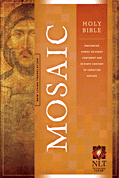
I agreed to write a "review" of the new Mosaic Bible, a new formatting of the Protestant Scriptures published this Fall by Tyndale Publishers. The publisher provided me a deluxe, imitation leather version. Joining Tyndale's campaign afforded an opportunity for me to look take a closer look at some of the sociological aspects of Bible marketing today.

Walk into any local bookstore, and you will find dozens of choices for bibles today. The production and distribution of market-savvy bibles may surprise some, but it is one of the most interesting developments in modern Christianity.

Crafting Editions of The Word of God

This Gutenberg Bible is displayed by the Unite...Image via Wikipedia

We can look back and see how the printing press certainly enabled a more ambitious structuring of the Protestant scriptures. The Geneva Bible first printed in 1560 was the first Bible to add numbered verses to make referencing passages easier. In addition, every chapter included extensive marginal notes and references making the Geneva Bible the first English "Study Bible." Between Between 1560 and 1644 at least 144 editions of this Bible were published.

Yet the initial effort to craft these bibles was considerable. It took scores of hours to typeset new bibles, and innovative systems of notations, illustrations, and footnotes created enormous difficulties. Take a glance through any edition of the Thompson Chain Reference Bible to gain an appreciation for the tremendous hours of work required to craft these books as ultimate "Bible Study Tools" intended to take personal reading of the scripture to unprecedented layering of hermeneutic possibilities.

Furthermore, the structuring of "notes" became the occasion to self-consciously promote whole theological systems. Consider the successive editions of the Scofield Reference Bible for its quite specific (and to many people peculiar) discussion of world history, the relationship between Israel and Christianity, and anticipations of eschatological happenings.

Now, the rise of digital typeset and new print techniques (including the ability to print color pages cheaply) have greatly expanded the possibilities for bible formats. Production houses have become increasingly creative in the formation of new types of bibles. While the "text" of the bible (the translation formats) may often be the same, the formatting, illustrations, and notations accompanying the text are what make a new product.

Bibles Proclaim a Brand of Faith

Moreover, bibles are not only intended to provide exhaustive notations but also reorientation toward the faith. In other words, while it may initially seem that "a bible is a bible is a bible," it is important to note that the crafting of a bible is equivalent to forming a strategic presentation of the Christian faith. In short, any carefully designed bible proclaims a brand of faith.

Enter Holy Bible: Mosaic NLT.

The Mosaic Bible strives to make a book primarily meant for meditation and prayer. It claims to be "a new genre of Bible—a weekly meditation Bible." In comparison with the large, white bible that occupied the living room table of my home growing up, the Mosaic Bible is portable and durable. But more than its portability, what makes the bible intentionally geared to personal reflection is that nearly the first half of the whole book is a series of weekly "installments," a set of scripture readings, prayers, reflections, and empty lines (for writing) accompanied by religious artwork. The weeks are aligned with church seasons. (For those who don't know which season it is, a website can be consulted; this is the 26th week of Pentecost ("Righteous Judgment"), pg m314.

The readings and prayers are intended to be diverse, affirming Christianity as a historic and global religion. There are readings from ancient to contemporary authors from every continent and every century. Of course, these excerpts are all highly orthodox and contain the presentation of Christian concepts and virtues to those generally accepted by more conservative Protestant Christians.

There is also a notable striving to affirm of the use of art in religious devotion. Full-color artwork, hymns, and poems are included.

The New Living Translation provides the base scriptural text, a newer, freer English version that allows for contemporary and colloquial speech constructed by a team of (mostly Evangelical) biblical scholars.

So, what is the branding of Christianity that comes through this particular bible?

I would suggest several dominant themes:
  • A bible can be aesthetically pleasing, yet should still evoke a pious consideration of the "sacredness" of the book as traditionally understood.
  • The bible is to be a personal, devotional tool such that the notations in "your" bible will not be the same as those in "my" bible.
  • However, the bible is not meant to be read "individualistically," but in the context of a broader community of believers through history.
  • The bible is to be read regularly and systematically.
  • The bible is most profitably read accompanied by prayer and focused reflection on themes.
  • Although structured devotions are useful, individuals should take corporate themes as launchpoints for personal reflections and commitments.
  • Bible study tools including cross-references, dictionary, maps, and concordances, are now "assumed" as essential in personal bibles.
  • The use of contemporary translations means that there is a recognition that the spiritual value of the bible is not found in traditional words or phrasing but rather in the meaning of those words to the extent they can be accurately conveyed.
  • And the aggressive marketing of a bible is appropriate in that the goal is not self-promotion as much as the distribution of a tool that gets people to read the scriptures for themselves.
My participation in the "blog tour" of the Mosaic Bible certainly indicates that bible publishers are attempting to work with a crowded marketplace. There are already many bibles on the market; the attempt to craft a message to highlight the uniqueness and devotional utility of any new bible presents a considerable challenge. To these ends, Tyndale has a dedicated website, a blog, a twitter account, and a listing of other blog reviews available.

Finally, as part of the marketing blitz for the product, Tyndale is giving away a few copies of this new book. If you are still reading this and are interested in one, the first person to email me with a request will receive a certificate from Tyndale that can be redeemed for your own personal copy.

Thursday, July 23, 2009

Is Obama the Antichrist? Well, Of Course He Is...

The American Religion Historian Matthew Avery Sutton wields a sharp pen. His book connecting American politics and the ministry of Aimee Semple McPherson is fascinating and important. Now in a post on Religion Dispatches this week, Matt takes aim at evangelicals and their relationship to President Obama, especially in their all-too-frequent obsession over decoding biblical prophecy. While Matt may not slay the beast, I think he hits pretty close to the heart.

(Thanks again to Paul Harvey for his posting at the Religion and American History blog.
)

Historian Matt Sutton doesn't hold back. He combines careful scholarship with sharp opinion. As a writer, we might say Matt has a "point of view." Even more, Matt is a scholar willing to tell people what he really thinks. Uncommon for an untenured professor.

In this post, Matt shows how it is inevitable that Obama's serene "Angel of Light" manner will be interpreted as yet another indication of the coming Antichrist.

Matt points out that "the vast majority of American evangelicals interpret the most obscure books of the Bible (Daniel, Ezekiel, and Revelation) in a very narrow and particular way. They believe that when these three books are read in conjunction with one another and overlaid with a few of Jesus’ statements, a hidden 'plan of the ages' emerges." And he's right. This is a holdover from the grip of dispensationalism (found in places like Scofield's Study Bible, bestselling Christian books both scholarly and popular, and frequent Sunday sermons) that has held evangelicals for most of the 20th Century.

He continues, "During the last 100 years, evangelicals have witnessed more and more evidence of these prophecies being fulfilled..." and shows how the Antichrist was predicted in the rise of leaders and various policies that emerged in this eventful time.
"So what does this mean for the Obama administration? Nothing very promising. Despite the president’s desire to find common ground with evangelicals, he is unlikely to be able to penetrate the apocalyptic fears that have characterized the evangelical movement since the Great Depression."
The flexibility of biblical interpretation and the considerable history of connecting the actions of political leaders with violent acts and natural disasters of all kinds leads these beleivers to connecting the dots of Obama's life to the determinative flow of spiritual history.

6: bible nerdImage by jamelah via Flickr

In other words, if you look for the Antichrist, you will find him.

Matt throws up his hands and concludes:
So what can we do? Pray for the rapture. If evangelicals vanish, the rest of us might finally get better medical care, a healthier environment, a more just international community, and full civil rights for gays and lesbians. But short of this miracle, we can at least begin to understand that before Obama is able to penetrate the evangelical heart, evangelicals themselves will need to do some serious soul-searching. Rick Warren and Joel Osteen’s shallow, positive-thinking, feel-good sermonizing is not going to help them do this. Instead, it is up to the younger evangelicals to engage in serious intellectual debate and a rigorous rethinking of the theology at the root of their politics. Anything less and the doomsayers will turn fears of Obama-as-Antichrist into big business. But hell, maybe that’s just the spark the economy needs.
Here Matt tips his hand on his own politics. Nevertheless, I think Matt is right that the old-school, end-times prophetic orientation of evangelicals will keep them from ever seeing politicians who fail to live up to a conservative social agenda as being less than an agent of prophecy, accelerating the apocalyptic consummation of history.

And he raises an important question. What are the resources available for re-thinking the theology at the root of evangelical politics? Is there something that needs to be recovered from the past, perhaps Walter Rauchenbush? Reinhold Niebuhr? Is there something to be found more recently in Martin Luther King, Jr.? Or is Jim Wallis and the Sojourner's group a fruitful direction?

Thursday, May 7, 2009

The Cultural Practice of Self-Critique among Evangelicals

After recently reading several Christian books and posts, I want to draw attention to the pervasive practice of self-critique among contemporary evangelicals.


Evangelical Self-Critique as Cultural Practice

I suspect most people don't see just how much Evangelicals continually criticize themselves. Whether the tone is sincere or smug, the practice of speaking critically about the shortcomings of their faith community is bound to come up in any serious discussion among Evangelicals.

Jesus Army evangelismImage via Wikipedia


For Evangelicals, this is obvious and mundane (Dude, tell me something I don't already know). But for those outside the movement, it highlights aspects of this religious orientation that are both critical and complimentary. So, here's my take on it.

Another way to characterize this is that contemporary Evangelicals continually look in the mirror and are not quite satisfied with what they see. So, they turn to each other and talk about the practice of their faith.

I consider such critique to be "insider talk" with "insider language" about "insider dynamics." It makes it as compelling as gossip for those who are inside. It can also sound like gibberish to those outside.

text... ask if u dont understand!Image by Coach O. via Flickr


Because there are so many Evangelicals in the U.S., the conversation can be sustained at a national level through Christian publishing houses, individual blogsites, and constant twitter updates. It's not just local church fellowships (although it happens there), its also readily available at national conferences. The back-and-forth discussion in these settings easily turns to bantering and can become a screeching match. For anyone who cares to pay attention, the public nature of this conversation makes it accessible for study.


Evolving Critique and the Future of American Religion

Why bother paying attention? Because the evolving critique that happens among Evangelicals tells you a whole lot not only about Evangelicalism but also the near future of religion in America.

2004 LIFE Phoenix CD (34)Image by Don Orrell via Flickr

Take the sharp rise of Fundamentalism in the early 20th Century (George Marsden's book is an excellent source.) In that case, severe critique of what became characterized as "modernism" and "liberalism" redefined Evangelicals into the "Bible church orientation" we are all so familiar with today -- the primacy of exegetical preaching, the focus on Bible as Word of God, the salvation focus driving bullet-point evangelism, and the requirement of church membership affirmed by checking-off a series of doctrinal affirmations.


Since the dawn of the Evangelical movement, it might be said that Evangelicalism functions as an ongoing process of critique in the practice of religion. (See a my recent posts on Charles Finney's remarkable ministry.) Indeed, Christian maturity in some circles is measured -- not by how much you pray or know the Bible but -- by how incisive you can talk about Evangelicals.


Example of Evangelical Self-Critique

As excellent example of Evangelical Self-Critique just came out this week. Read a post by Scot McKnight who recently wrote this fascinating piece on "Spiritual Eroticism."

Spiritual Eroticism:

Are we really in love with Jesus, or with the experience of loving Jesus?

by Scot McKnight

A peculiar development occurred in the medieval age regarding love. Behind closed doors and in the rush of brief encounters, there developed what has been called “courtly love” or “romantic love.” Married men found themselves emotionally carried away with either another married woman or a single woman. This courtly love, so we are told, remained at the emotional and non-physical level.
credo.jpg

Romeo and Juliet in the famous balcony scene.Image via Wikipedia

The interpretation of many is that the Lover, because of the emotion it generated, preferred the nearly intolerable absence of the Beloved over the presence of the Beloved. The Lover preferred the titillation of fantasy over the toughness of fidelity. The essence of courtly love was to become intoxicated with love, to fall in love with love. It was to prefer the fire of love over the Beloved and delight in the experience of love over the presence of the Beloved. Think Tristan and Isolde. Perhaps even Romeo and Juliet.

Friends of mine today worry about consumerization or commoditization in the church. I offer a slightly different analysis of what might be the same thing: for many, Sunday services have become the experience of courtly love. Some folks love church, and what they mean by "loving church" is that they love the experience they get when they go to church. They prefer to attend churches that foster the titillation of courtly-love worship and courtly-love fellowship and courtly-love feelings.

They say they love worship, and by this they mean they love the courtly-love-like songs that extol the experience of loving Jesus or the experience of adoring God or the experience of a concert-like praise team that can generate the sound of worship intensely enough to vibrate the very soul of the worshiper.

Such folks might like sermons that create powerful contrasts between God’s wrath and human sinfulness or between our sinfulness and God’s gracious love; or they might like stories told so well as to usher them into the depths of human loves and hates and tragedies and comedies. What they like is the freshness of discovery or the flush of shame or the intoxicating sense of learning something new. They may create such a stir of silence in expectation of some great preacher or some great leader that the sheer presence of that person makes their soul swoon.

But this does not describe worship.

My contention is rather simple: the shaping of a Sunday service or a worship event or a concert in order to generate a profound experience might emerge from a courtly-love sense of worship. The expectation of such an experience on the part of the worshiper might also emerge from a courtly sense of worship. The opening of the Bible to read in search of an experience, or the entrance into a prayer time in order to rediscover some powerful emotion might also emerge from the intrusion of courtly love into how many today understand spirituality.

Let’s call this was it is: spiritual eroticism. And those who are good at it can be called spiritual erotics.

Cover of Cover of The Four Loves

So, what can be done? The same thing that good critics of courtly love, like C.S. Lewis, did about that distortion of love. Love, proper love—the love of God and, by extension, the love of others that both Moses and Jesus reveal—is to focus on God as the Sole Beloved worthy of our entire heart. Eros, Lewis argued in The Four Loves, wants to be a god, wants to be an idol. Eros left to itself, will not lead us to Charity. Eros needs to be tamed by Charity. When Eros is tamed by Charity, what happens?

Charity always leads us to the Beloved. Charity skips over the intoxication that comes with the experience of love and leads us straight to the face of the Beloved—Father, Son, Spirit. Those who know the Beloved and desire nothing but the glory of that Beloved may well know the experience, but they are so enthralled with the Face of the Beloved they forget where they are and dwell in the presence of God with but one thought: God deserves praise, God is worthy of praise.

There is a big difference between saying “You are worthy of our praise” and saying “I love praising God.” The second, I am suggesting, is courtly love. It is in love with loving God; but it is the first that is in love with God.

McKnight is the Karl A. Olsson Professor in Religious Studies at North Park University. His books have been well-received among Evangelicals of all types.


Characteristics of Evangelical Self-Critique

In my recent reading, I think the best Evangelical self-critique today draws on aspects of Christian history as a point of comparison or apply a sensitizing concept to draw out subtle aspects of contemporary practices.

LUPA PREACHING WORKImage by who.log.why via Flickr


Scot McKnight's writing here is a good example of what can be found almost everywhere once you start looking. See books by Erwin McManus or Doug Pagitt or Tony Jones or Tony Campolo. See articles in Christianity Today or Relevance magazine. See online material like blog posts and podcasts at emergentvillage.com.

If I began some attempt to formalize it, I would begin with these characteristics of Evangelical Self-Critique:
  1. Modern Christianity is off-point on several (most?) aspects of "True" Christianity.
  2. The word "Christians" is generalized, although it often means only other Evangelicals.
  3. Observation of common practices resonates with the experience of other "Christians" (see point #2).
  4. Some type of experience -- intrapersonal experience (what happened to me), interpersonal experience (what happened to us together) or extra-personal experience (what happened to my friend, neighbor, brother) -- is weaved into the narrative to root the observation in "reality."
  5. Finally, the use of Bible verses is far less important than the application of a biblical theology - that is, applying an interpretive concept of "Christian" living is what is required to drive the point home.
This is only a beginning.

At the core, I think it's important to know that Evangelicals continually have discussions -- intense discussions -- on nearly every aspect of "normal" Christian life. Such discussion can lead to endless spinning of ideas, but others further stimulate the practical decisions being made by church leaders and church attenders (as well as non-profit organizations and broad organizational networks) about practices and priorities that fuels further developments.

Tuesday, December 30, 2008

Bestselling Eco-Bible - The Green Bible Again Recycles the Word of God

Walk into any Borders or Barnes & Noble and you will find a Bible section filled with specialty Bibles for every age, gender, and lifestyle. Now we have

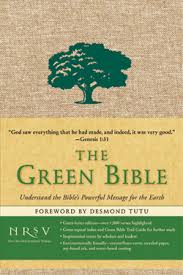
The Green Bible (NRSV)
A Study Bible for the Green Movement


an ecologically-friendly book,
  • 1440 pages
  • printed on recycled paper
  • uses soy-based ink
  • cotton and linen cover
  • over 1,000 verses printed in green ink
(I love that they've played played on the tradition of printing Jesus's words in red to highlight the "green scriptures" throughout the Bible. A picture of a page from the Psalms is on the left.)

Apparently the first 25,000 copies sold within a few weeks.

Bibles are more than just carriers of Scripture. Bibles are proud badges of identity. We choose Bibles that resonate with us (like the Catholic Study Bible, Teen Study Bible, and the African Heritage Study Bible). We want our Bibles to reflect on what is most important to us.
If you have ever taken time to purchase your own Bible, which one did you choose? What does that Bible say about you?

Even more, we look at other people's Bibles as indicators of who they are. Having the right Bible has often been a test of orthodoxy. NKJV/NASB versions of the Ryrie, Scofield, and the Thompson Chain Reference Bible scream conservative, while the NRSV version of the Annotated Oxford Bible is solidly mainline.

The first green-letter Bible shouts "Green!" And by including writers from a broad spectrum, it tries to side-step theological dogma in order to promote caring for the earth as a spiritual lifestyle. The Green Bible includes essays from N. T. Wright, Barbara Brown Taylor, Brian McLaren, Matthew Sleeth, Pope John Paul II, and Wendell Berry. The Green Bible is supported by groups like the Sierra Club, The Humane Society, and the Eco-Justice Program of the National Council of Churches.

Notice how these Bibles are "Study" Bibles? Although the word-translations among these Bibles (whether NIV, ESV, TLB, etc.) is similar. What distinguishes these Bibles are the notes, commentaries, and arrangement of materials inserted throughout the text to reinforce the overall thrust of the book. Editors of these Bibles become the most significant shapers of content. From a cynical perspective, Bible publishers catch trends and associate special edition Bibles with the name of a major personality.

From a more generous perspectives, we know biblical texts are used as launchpoints to discussing different aspect of Christian discipleship. These Bibles become tools for individuals and groups to emphasize various aspects of the faith for various interest and demographic groups.

A bit more on The Green Bible is available from the publisher's website here.