Showing posts with label megachurches. Show all posts

Tuesday, October 20, 2009

New Approaches to New Evangelicalism - Special Session in Denver

Here's a shout out for a session I organized for this weekend at SSSR in Denver, Colorado, on contemporary Evangelicalism in the US and abroad.

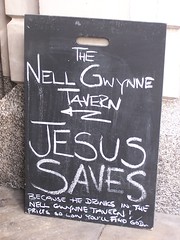
Jesus SavesImage by Andwar via Flickr


Competition among sessions this year at SSSR is fierce!

So many great sessions in each slot, but you just can't miss the session on New Approaches to New Evangelicalism. Our session brims with brilliance through the work of excellent scholars doing fascinating research. You can count on this being a stimulating time with plenty to chew on.

New Approaches to New Evangelicalism
Westin Tabor Center
Room: Teller

Organizer: Gerardo Marti, Davidson College
One Way Out: Examining the ‘Evangelical Exit Clause’ for Central America
Robert Brenneman, University of Notre Dame (rbrennem@nd.edu)

Exporters of Religion: Evangelicals in Global South Impact Other Countries with the Gospel
Stephen Offutt, Boston University (soffutt@bu.edu)

Reconstructing Social Space at Willow Creek Community Church
Peter Mundey, University of Notre Dame (pmundey@nd.edu)

The Emotional and Aesthetic Dimensions of the Local Church Rock Scene
Kevin McElmurry, University of Missouri (Klm143@mizzou.edu)

Plan on meeting us Saturday October 24 @ 3:45pm-5:15pm.

Monday, August 31, 2009

Inside Look: Andy Stanley's North Point Church Describes Creative Process

Quick post: The media department of Andy Stanley's North Point church in the Atlanta area posted a blog today walking through their creative process for a new sermon series.

North Point in Atlanta is a large, multi-site church that invests time strategizing their communication process.

This is more than just "making sermons interesting." The ambitious effort to craft ideas based at the heart of Christian concerns that connect to a mainstream audience is routinely performed.

Here's one video that came through this particular process.

Of course, North Point is not alone in their concern to craft image-saturated, symbolically-rich content. In my own research I've described Mosaic in Los Angeles and Oasis in Hollywood at length (yes, yes, "read my book...").

Nevertheless, it is important to realize the degree to which religious creativity is channeled through the construction of mission-driven religious content.

Sunday, June 14, 2009

Smartphone Spirituality - Terrible? or The New Normal?

A Twin Cities newspaper reports on the use of social networking and new technology by congregations -- not just Christian ones -- who appear to advocate a "shallow consumerism" for religion.


An article by Jeff Strickler from the Star Tribune features a now-familiar article about the incorporation of technology and the targeting of younger attenders among congregations. It seems that some of the fastest-growing congregations in Minnesota -- suburban, mostly evangelical Christian megachurches -- embraced marketing from the start. Their success has caused more-traditional congregations with dwindling memberships to take notice.

The article begins with one congregation --

This church, called Substance (they tend to have radical names,) is one of the most-successful in the Twin Cities, drawing several hundred worshippers each Sunday. They reach out to young people by cutting back on the ritual of traditional churches. There's also a rock band and multi-media.

Nice commentary on the church's name -- I guess "Substance" could be considered a radical name if you take the substance being referred to in a more ambiguous way...

Anyhow, the key to the article is how it's not just Christian churches getting into the act. The article quotes Rabbi Hayim Herring who stressed in a seminar to "fellow clergy that they should spend an hour a day on Facebook, MySpace and Twitter" and that "blogging should be considered mandatory." Rabbi Herring also recommends using video clips from YouTube in the service.
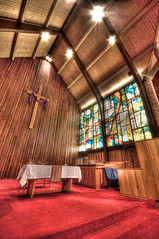
Central Presbyterian Church, AustinImage by David A G Wilson via Flickr


"They used to look at me as if I'd just said a four-letter word," said Herring, the former senior rabbi at Beth El Synagogue in St. Louis Park and now the executive director of STAR (Synagogues: Transformation and Renewal). But in its seven years, the organization has seen more converts to what many call one of the dirtiest words in religion: marketing.

According to the article, it's younger people's "reliance" on electronic social networks that leaves religious leaders "no choice." As Rabbi Herring states, "If you're not out there, there's no chance of your message being heard."

Even Hindus are becoming technologically astute. Rajan Zed, president of the Universal Society of Hinduism, urged his religious organizations to use "smart-phones with BlackBerry, iPhone and Symbian." While they were at it, he suggested, they should check out Flickr, Habbo, hi5, Skyrock, Tagged, Bebo, Netlog, MyHeritage, Odnoklassniki, Sonico and VKontakte.

Overall, the article stirs up controversy by echoing reactions from alarmists concerend about "salesmanship tools" and "commercialism." It's the marketplace of religion (so they say), and quotes Greg Smith, a research fellow for the Pew Research Center's Forum on Religion & Public Life, who says, "Whether they like it or not, religions are being forced to compete for members."
Sacred Heart Church - Notre DameImage by timjeby via Flickr


The article then goes for the jugular - it's a religions "market" because congregations need to sustain streams of financial contributions to their ministry.

Bottom line: follow the money --

More than just bragging rights are at stake. Maintaining membership is critical for church finances, especially at a time of economic distress when contributions are dropping and endowment funds have taken a beating in the stock market. If belt-tightening members drop less money in the collection plate, the congregation needs to pack more people into the pews to make up the difference.

In my view, pointing to money as a core dynamic is just too crass. Religious leaders are sincerely wrestling with attempts to meet and minister to people about the things they really care about - bringing them into a closer relationship to the divine. And yet there is a struggle to define the role for new technology.

Rev. John Mayer who is executive director of City Vision, a Minneapolis organization that tracks religious demographics, said it well, saying,

"People see it as too worldly or gimmicky for the church to be marketing itself," he said. "But most of the same people who say it is sacrilegious also expect their church to have a website, a listing in the phone book or an ad in the phone book. To me, this is marketing."

In fact, he said, one of religion's classic icons could be considered a marketing tool: the church steeple.

"Yes, it's there for artistic reasons and to symbolize pointing to God," he said. "But it's also like a big sign to people saying: 'We are here. Come and check us out.'"


Steeples as marketing tool. Nice point.

The Rev. Scott Anderson at Eagle Brook Church, also tempers the discussion by saying that tailoring the delivery of the message to its intended audience is nothing new.

"We have to reach people through the culture we find ourselves in," he said. "If we want people to hear our message, we have to get them through the doors first."


What's even more interesting are the range of comments on the story. One comment from SMBowner3 writes,

"A church is a business and a religion is a brand, so they are smart to use technology to market themselves and their brand. You can learn about God in a bible - churches and religions are 'value add' services."

Old church’s sanctuary/Chorraum der alten KircheImage via Wikipedia


Another from kevinstirtz writes,

"The leaders who are moving (dragging?) their churches (and synagogues) into the 21st century by using social media tools and other technology are just plain smart. It's called meeting your customers where they are and it works. I applaud these pastors, ministers and rabbis who are simply trying harder to meet the needs of their people."

The whole article is interesting to me.

Looks like it will be awhile before the image of "traditional church" gets shifted far enough for these developments to not be considered so outlandish.

Monday, April 27, 2009

Christianity Today Editor Suggests "Church Shrink" Conferences

A senior managing editor of Christianity Today, suggests evangelical churches need to become more demanding and that conferences on "How to Shrink Your Church" should be promoted.

Mark Galli says, "I'm not kidding."

What churches need to do is "introduce the harder edges of the gospel" and preach in such a way that attenders actually leave "because they see, finally, what Jesus is asking of them."

That necessitates creating new church conferences to show leaders how to manage decline as pastors demand more from their members.

Yes, welcome to the Church Shrink Conference with special workshops on "Exit Ministries" and answering the question "My Church is Growing, What Did I Do Wrong?"

For Galli, evangelicals may appear successful, but actually they have "succumbed" to "an emotionally and spiritually shallow culture."

He finds his evidence in a new book Holy Mavericks: Evangelical Innovators and the Spiritual Marketplace.

Co-authors Shayne Lee and Phillip Luke Sinitiere argue that the growing ministries profiled in their book are not strict in doctrine or strict in behavior. Instead, their ministry growth is the result of crafting slick marketing, sympathizing with felt-needs, and appealing to local culture.

Galli is not convinced such growth is the kind of "growth" Christianity needs.

Citing older -- and highly controversial -- research found in Dean Kelly's 1972 Why Conservative Churches are Growing and Laurence R. Iannaccone's influential 1994 essay, "Why Strict Churches Are Strong," Galli claims much of evangelicalism's past success has been due to the demands of doctrine and behavior placed by these churches on their attenders.

The underlying argument of this research is that strict churches draw people into greater participation in their churches, greater solidarity with other believers, and a greater sense of purpose in living to a harder-edged gospel -- especially in comparison with liberal, mainline churches.

Jesus Army Baptism ~ NorthamptonshireImage by cromacom via Flickr


Strict churches, therefore, grow more and faster than looser, low-commitment congregations.

Galli admits (I'm sure reluctantly) that "Many churches are growing because they preach a God of second and third and fourth chances, and a faith that gives palpable hope, joy, and acceptance. What's not to like?" 

He concedes that the "gracious aspects of the faith" are attractive.

Yet, Galli goes against the strict church research to argue that strict Christian groups are small. "The more strictly you adhere to the teachings of Jesus, the smaller the church will 'grow.'" 

What is his core belief? Galli believes that theologically better churches with strict moral standards may be numerically small, but they are spiritually superior despite less attendance. "These theologically conservative and morally strict communities are not winning converts by the tens of thousands." 

Of course, Galli is conveniently ignoring that most morally "non-strict" communities aren't growing either.  Galli is also dismissing that 1) few churches are large (like 1,000+ attenders), and 2) the "accommodation to culture" has been happening even among "strict" evangelicals since they began. 

(See my recent posts on the ministry of Charles Finney.) 

Never mind all that.  There is a clear vision in Galli's mind of what churches should be like, and this new book really irks conservatives like him who hope that the future of American religion does not follow any of these various developments.

Instead, Galli believers pastors and leaders in "superficially successful" churches need to introduce the difficult demands of the gospel. And this introduces us to the tricky notion of how to measure any congregation's "success."

Ukrainian Pastor Sunday Adelaja (in 2007)Image via Wikipedia


Perhaps Galli would object less to the ministries of Mosaic or Oasis as I describe them. While these are certainly not conservative churches in his mold, they do call people to high standards while simultaneously accommodating to a changing culture. I don't quite know.

I'm confident strict churches will survive well into the 21st Century, but I am not so sure that the development of evangelicalism as a whole will follow this path ignoring an accommodation to the life circumstances of people's contemporary situations.

Saturday, April 18, 2009

Revival and Relevance in the Sticks (towns 75k or less...)

Interesting new conference -- "The Sticks" -- takes a southern and mid-western sensibility to initiating contemporary, mission-driven ministry to the small towns of the United States.


With a website complete with videos of t-shirt and wireless-mike wearing pastors, The Sticks conference is designed to inspire smaller town pastors to go for innovative ministry styled on the successful models of larger churches around the country.


The conference is an interesting example of the extent of influence from successful, evangelical megachurches in America, the pervasive use of technology in American religion, and the continued concern for attracting young adults in church ministry. Here you will find a mission-driven form of accommodation, acculturation, and experimentation in response to social change.

Stimulating ambition for churches outside Metro areas, The Sticks makes leadership philosophy and a reflection of contemporary practices accessible to smaller towns. Its stated mission --
Do you live out in the sticks? [small cities and towns of 75K or less]

Divernon IL - First Baptist Church (10 of 14)Image by myoldpostcards via Flickr


Do you want to make a big impact?
Tired of small towns being left out of the conversation?

Have you bought into the lies...
'we can't do that' or 'we don't have the funds to pull that off'?

the sticks is a gathering where revival meets relevance. It is a gathering to inspire and equip pastors in small to medium towns to make a big impact for the Kingdom!

Break out sessions over two days in three different sites work through youth ministry, outrreach, the use of social networking sites, multi-site ministry, and leadership developments.

The speakers are native to each area, successful pastors who have grown vibrant ministries in these areas like Perry Noble, founding and senior pastor of NewSpring Church in Anderson and Greenville, South Carolina.

Tuesday, March 24, 2009

Pastor Rob Bell - "Geeky, Affable, and Energized"

A new article in The Christian Century profiles the provocative author and megachurch pastor Rob Bell.

I met Rob Bell and his core team just a few weeks after his phenomenally successful church Mars Hill Bible Church was launched in 1999. Educated, earnest, and entertaining, Rob brings to his pastorate a consummate skill of consistently speaking a clear and compelling message every time he stands up.

Mars Hill was born in a defunk-urban-mall-turned-big-box-megaspace in Grandville, Michigan, just outside of Grand Rapids. This is Rob's home base. It's one of the ugliest church buildings that also happens to be one of the most active and innovative in the country.

From the article:
After nine years Mars Hill now has 11,000 worshipers, but it still meets in the shopping mall where Bell began holding worship services in 1999. Everything inside and outside the building has a warehouse functionality; it's practical, spacious and ugly.

[Bell's] geeky, affable presence and energized speaking style warm up the room quickly and signal a seasoned performer. After you hear Bell speak, it's not surprising to learn that his childhood hero was David Letterman

He says Letterman isn't a bad example for pastors, since he's been on television every night for 20 years, engaging the culture. "What's my job again?" says Bell. "To engage our culture!"

His NOOMA videos [many available on YouTube] have sold 1.2 million copies in 80 countries (NOOMA is a phonetic spelling of the Greek pneuma, or "spirit"). In 2007-2008 he visited 22 cities as part of "The Gods Aren't Angry" tour.


What is Bell doing to earn so much attention? For one thing, he can preach. As Bell warms up a congregation or audience to hear "the truth of the text," he drops jokes based on pop music, references to favorite cheap wines or the quirks of cell phone technology, a mainstay of the 20-somethings among his listeners. In his sermons, he prepares the congregation by announcing that he'll be teaching for 80 minutes. (Some of the visitors thought that he must be kidding. He wasn't.)

On the Sunday I visited, the 80-minute teaching sermon provided a base for on-the-ground ministry. Bell included a strong critique of Christians who, he said, proselytized in Rwanda, saved souls and then took off. These missionaries were wrong to tell people that "if they were saved they'd go to heaven when they died," he said, for it led to a devaluation of life on earth and possibly smoothed the path for the country's genocide of 1994. A Left Behind theology is an "evacuation theology," warned Bell. It is lethal to believe that one can live apart from the world in some kind of "spiritual neverland."

Nice pocket tee.Image by el clinto via Flickr

Bell's video audience, like the people who come to hear him at Mars Hill, tend to have been raised in evangelical churches, and many are graduates of evangelical colleges. They are restless with the Christianity they've inherited and come to Mars Hill eager to hear someone who knows their tradition and claims core truths of the faith, yet challenges other givens.

Bell challenges those who insist on a literal approach to scripture and believes people can get caught up in the details of the text instead of plumbing the meaning of a passage. When he thinks aloud with his listeners, he carefully paraphrases some passages and avoids technical words and doctrinal terms. Sermon topics often focus on the basics of outreach: how to be a neighbor; how to be a church.

The church clearly expects members to get involved in ministry. Here are words from the mission statement: "We have the opportunity to make a difference. That's why we leverage both our resources and our selves in pursuit of tangible results."

Monday, February 9, 2009

Video Profile of Influential Pastor Mark Driscoll and Mars Hill Seattle

Mark Driscoll, a contemporary pastor recently profiled in The New York Times, was interviewed on Nightline. 


I wrote last month about Pastor Mark Driscoll of Mars Hill, Seattle, as an example of one brand of contemporary evangelicalism.  Driscoll was recently a highlighted speaker last week at Leadership Network's Innovation 3 Gathering.  

For those interested in things like what Driscoll looks like and the ambience of his church, here's a brief video on his ministry. 


Monday, January 26, 2009

The Three People in Every Megachurch

Reporting from the Innovation3 Gathering in Dallas, Texas -- I just finished giving a presentation that breaks down the members of every megachurch. "There are only 3 people in your church," I told them.


The best and most recent information on megachurches available was collected by Warren Bird (Leadership Network) and Scott Thumma (Hartford Seminary). They invited me and a small group of other scholars to look through their data. Here's a small sample.

I used focus group transcripts to look at the process of joining a megachurch. I call it "The Three People in Your Church":


The powerpoint is presented here as a "movie". Enjoy!

Also, you can read more on megachurches here.

Sunday, January 25, 2009

Innovation 3 Gathering


I'm traveling today to Dallas for a pre-conference consultation with megachurch leaders at the Innovation3 Gathering, organized by Leadership Network. It seems about 1,000 people are registered for the conference.City of DallasDallas, TX, Image via Wikipedia

This gathering is a new type of conference, one that focuses less on plenary speakers and more on face-to-face dialogue.

The website says,

Innovation3 is a chance for you to do some real networking. You won't just be adding "Facebook friends", but you'll be interacting one-on-one with peers that will help you sharpen your views and collaborate to help change the world.

Parachurch organizations like Leadership Network interested in spreading and stimulating innovation really love these kind of conferences. It's a chance to see people you've heard of, get "behind the scene" details on how things actually work, and hear directly from some of the biggest names in pop-Christianity today. The list of presenters and churches is quite impressive -- evidence of how Leadership Network continues to maintain its credibility of providing worthwhile programming. Scroll over the "Featured Innovators" on the front webpage to learn more.

Anyways... if I hear anything interesting I'll let you know.

I leave early from the conference. From Dallas I'll head to Berkeley, California, to speak at the Earl Lectures at the Pacific School of Religion. If you're there, come say hello.

Thursday, January 22, 2009

What We Know about Megachurches

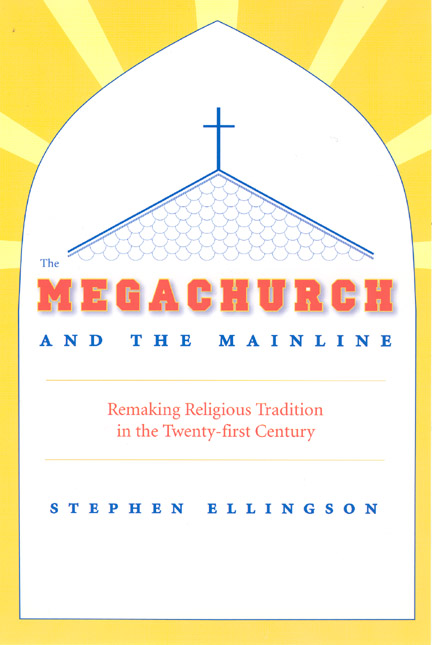
An excellent review of research on megachurches is now available in the December 2008 issue of the journal Sociology Compass. Here's a preview. A great book on megachurches is also now available.


The State of the Megachurch

A new article comes from the award winning author of


which won the annual best book award from the Society for the Scientific Study of Religion.

Here's the article:

Review Article by Stephen Ellingson
Department of Sociology, Hamilton College

A brief overview of the article says,
Megachurches represent an emerging and powerful force within American Religion. These large, Protestant churches that average at least 2,000 attendees per week are reshaping religion locally, regionally, and nationally as well as at the denominational and congregational levels.

Megachurch leaders have been leaders in religious innovation since the 1970s, ushering in major changes in church architecture, ritual practices, polity, and marketing. In this essay, I review the nascent literature on megachurches.

First, I discuss the major descriptive findings from several surveys and case studies of megachurches. Second, I examine scholars' efforts to explain how and why megachurches have emerged and grown over the past forty years. Finally, I suggest several lines of future inquiry that may allow sociologists of religion to extend or refine existing cultural and market based theories of religious change and church-sect theory."

Highlights on the American Megachurch

The article is a tightly-packed summary of what we know about megachurches today.

For example, Ellingson tells us the growth of megachurches really began in the 1970s:

(expand browser for full image)

Ellingson also tells us most megachurches are denominational, but one-third are non-denominational (mostly evangelical and conservative Protestant):


And Ellingson also includes a section about how megachurches are restructuring American religion:


This is just a brief sample. The full article can be found here (sorry, subscription required).


Best Book on Megachurches Available Today

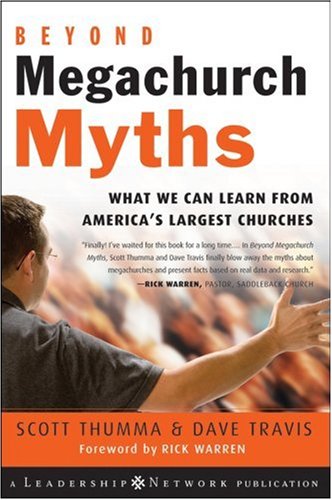
Beyond Megachurch Myths:
What We Can Learn from America's Largest Churches

(Jossey-Bass Leadership Network Series)
by Scott Thumma and Dave Travis


The book includes a forward by Rick Warren.

My own published review of this book appears in Reviews in Religion & Theology
Volume 15 Issue 3, Pages 336 - 338.

Other quick reviews:
"In this groundbreaking book, Scott Thumma and Dave Travis share their keen insight and unique understanding of the megachurch phenomena in one accessible volume. This book is a significant addition to the literature and knowledge of megachurch studies."
—Ed Stetzer, Ph.D., senior director and missiologist, Center for Missional Research, North American Mission Board

"Megachurches are here to stay and will attract continuing interest. Thumma and Travis have done us all a great service by setting the record straight."
—Robert Wuthnow, Gerhard R. Andlinger Professor of Social Sciences and director, Center for the Study of Religion, Princeton University

"This is the most thorough, insightful, and helpful book ever written on megachurches."
—Mark Driscoll, pastor, Mars Hill Church, Seattle, Washington

Saturday, January 17, 2009

Cool Pastor Steven Furtick Draws Fire for Fashion

Steven Furtick, 28-year-old pastor of Elevation Church, is founder of one of Charlotte's newest megachurches and used to getting attention. After three years and over 4,000 attenders, Elevation is considered one of the fastest-growing evangelical churches in America. Now, his sense of style has been the source of some local comment.


The Charlotte Observer characterizes the pastor of Elevation: "Part spiritual athlete, part rock star preacher, Furtick is the talk these days in Charlotte religious circles." True enough. Now the talk has turned to his sense fashion.


Focus on Fashion

Last week in a quirky interview, the Observer decided to run a "style" question-and-answer piece focused on Furtick and his fashion sense. Here's a sample:

Q: Do you wear designer clothing?

I like certain lines. I love Monarchy, mainly the shirts. I like Antik Denim jeans.

Q: Do you have a favorite brand of jeans?

I like Rock and Republic Jeans. We buy a lot of jeans from Jordano's. We also like to Shop at Saks Off Fifth at Concord Mills. I like to go to Pure Denim in South Park.

(On a personal note, I don't understand most of what Furtick is talking about. No one's asking me, but I wear Docker's and 501's from Kohl's. Anyways...)

In the interview Furtick is both revealing and practical in covering:
Q: What piece of clothing can't you live without?
Q: Do you have any fashion role models?
Q: What fashion advice can you give to other ministers?
I found that Furtick's wife Holly supplements her husband's interview by making one thing clear: "The preacher's wife is responsible for his look."

(See the interview and some pictures with Steven Furtick.)


Fashion Draws Fire

But that's not the end. What's interesting is that some readers apparently balked at church donations supporting the young pastor's wardrobe.

The columnist, Dannye Romine Powell, called them "a bunch of pious fuddy-duddies."

Powell makes the point that the hubbub is "more about culture than religion." And she's right. There's no surprise to most that styles of fashion have changed for pastors. As culture changes, style changes.

But more importantly clothing worn by leaders on the platform signals the culture and identity of the church. Whether pastors wear torn jeans, Hawaiian shirts, or some sort of liturgical vestments (I've seen them all and more), visitors draw cues about the priorities of the congregation.

In the fashion interview, Furtick says, "You will see a person with a piercing, and a person with a suit, and the person with the suit is probably a guest, and the person with the piercing is probably a staff member." Elevation is not a suit-and-tie church.

Savvy pastors are more aware of their public profiles -- just like any other person who is dependent on first impressions for their livelihood. They come to understand which markers are important and how they come to be defined by people. Identifying fashion trends and becoming intelligent on matters of personal style is an important source of credibility.

Even further, dressing "in style" among evangelicals like Furtick is another way of communicating the contemporary relevancy of religion. The message and morality of this Southern Baptist Church is still quite conservative, but the earnest attempt by church leaders like Furtick (and Mark Driscoll at Mars Hill and Erwin McManus at Mosaic and Phil & Holly Wagner at Oasis and Naeem Fazal at Mosaic Charlotte) is to translate this orientation in a way that navigates immersion in today's urban/suburban lifetstyle with a vital Christian commitment.


More on Elevation


Wednesday, January 14, 2009

Ted Haggard HBO Documentary Will Discomfort Evangelicals

On Jan. 29th, HBO will air a documentary, "The Trials of Ted Haggard." Haggard, who fell in 2006 amid a gay sex scandal, was exiled from the New Life mega-church he founded and told by church leaders to leave Colorado after admitting "sexual immorality" and buying methamphetamines from a male prostitute.


A new HBO documentary covers Ted Haggard's year in exile, his struggle with his sexuality in the face of his past condemnation of gays, and his attempts to make a living outside the church. During his exile, he told documentary maker Alexandra Pelosi (the daughter of U.S. House of Representatives Speaker Nancy Pelosi), that he continued to "struggle from time to time with same-sex attraction."

"Even though I'm a sinner, even though I'm weak," he told Pelosi, "God's best plan for human beings is for men and women to unite together." He also said this difficult year "strengthened my faith. I do wish others had been more forgiving toward me. But I think those who hate me and judge me had a reason. I deserved it."

Haggard's documentary (about which he had no control of editing) will likely complicate rather than comfort evangelicals. It seems his sexuality is more complicated than he thought. According to the Reuters article:

Three weeks after church elders told Haggard to leave and ordered him to undergo "spiritual restoration," they announced that after counseling he was "completely heterosexual."

Haggard smiled wryly at the statement, saying he fits into neither the gay nor the evangelical community.

"My therapist says I am a heterosexual with complications. I don't say that because it is more complex. I love my relationship with my wife."

To the extent Haggard's sexual "complications" are played up in the film, conservatives will continue to dissassociate from him, even if Haggard still supports traditional marriage.

Look for further backstage revelations on the process of his dismissal and restoration (like "he smiled wryly at the statement" following his elders' assurance that their former leader is "completely homosexual"). As the public absorbs the complex process of navigating between fallen pastors and shocked congregations, such revelations will complicate other high-profile scandals that will inevitably occur in the future.


Tuesday, January 13, 2009

Mark Driscoll is American Evangelicalism’s Bête Noire


Don't miss the extended article on
Mark Driscoll, the "cussing pastor" of Seattle's Mars Hill Church in the New York Times. (FYI: Bête Noire is french for dark beast and is used to refer to an object or abstract idea that causes fear or has the potential to cause large harm.)


For those of you who may have missed it, The New York Times this week features a concise profile of one slice of contemporary evangelicalism that resonates with my own published research on both Mosaic and Oasis.

The profile of Mark Driscoll and the Seattle's Mars Hill -- a church with 7,600 attenders -- is compelling and throws more light on how religion is continuing to shift in America.  Longer and well-written, it's a treat to read.

Bottom line: This ain't your grandma's church:
Driscoll represents a movement to revamp the style and substance of evangelicalism. With his taste for vintage baseball caps and omnipresence on Facebook and iTunes, Driscoll, who is 38, is on the cutting edge of American pop culture. Yet his message seems radically unfashionable, even un-American: you are not captain of your soul or master of your fate but a depraved worm whose hard work and good deeds will get you nowhere, because God marked you for heaven or condemned you to hell before the beginning of time.

Yet a significant number of young people in Seattle — and nationwide — say this is exactly what they want to hear. Calvinism has somehow become cool, and just as startling, this generally bookish creed has fused with a macho ethos. At Mars Hill, members say their favorite movie isn’t “Amazing Grace” or “The Chronicles of Narnia” — it’s “Fight Club.”

In little more than a decade, his ministry has grown from a living-room Bible study to a megachurch that draws about 7,600 visitors to seven campuses around Seattle each Sunday, and his books, blogs and podcasts have made him one of the most admired — and reviled — figures among evangelicals nationwide.


The “modern evangelical machine” is a product of the 1970s and ’80s, when a new generation of business-savvy pastors developed strategies to reach unbelievers turned off by traditional worship and evangelization. Their approach was “seeker sensitive”: upon learning that many people didn’t go in for stained glass and steeples, these pastors made their churches look like shopping malls. Complex theology intimidated the curious, and talk of damnation alienated potential converts — so they played down doctrine in favor of upbeat, practical teachings on the Christian life.

Driscoll disdains the prohibitions of traditional evangelical Christianity. Taboos on alcohol, smoking, swearing and violent movies have done much to shape American Protestant culture — a culture that he has called the domain of “chicks and some chickified dudes with limp wrists.”

Moreover, the Bible tells him that to seek salvation by self-righteous clean living is to behave like a Pharisee. Unlike fundamentalists who isolate themselves, creating “a separate culture where you live in a Christian cul-de-sac,” as one spiky-haired member named Andrew Pack puts it, Mars Hillians pride themselves on friendships with non-Christians. They tend to be cultural activists who play in rock bands and care about the arts, living out a long Reformed tradition that asserts Christ’s mandate over every corner of creation.

God called Driscoll to preach to men — particularly young men — to save them from an American Protestantism that has emasculated Christ and driven men from church pews with praise music that sounds more like boy-band ballads crooned to Jesus than “Onward Christian Soldiers.” What bothers Driscoll — and the growing number of evangelical pastors who agree with him — is not the trope of Jesus-as-lover. After all, St. Paul tells us that the Church is the bride of Christ. What really grates is the portrayal of Jesus as a wimp, or worse.

(Picture via Jim Bryant / P-I.)

This reaction to the “feminization” of the church is not new. “The Lord save us,” declared the evangelist Billy Sunday in 1916, “from off-handed, flabby-cheeked . . . effeminate, ossified, three-carat Christianity.” In 1990 a group of pastors founded the Promise Keepers ministry dedicated to “igniting and uniting men” who were failing their families and abandoning the church. In recent years, mainstream megachurches — the mammoth pacesetters of American evangelicalism that package Christianity for mass consumption — have been criticized for replacing hard-edged Gospel with feminized pablum.

Mars Hill — with its conservative social teachings embedded in guitar solos and drum riffs, its megachurch presence in the heart of bohemian skepticism — thrives on paradox. Critics on the left and right alike predict that this delicate balance of opposites cannot last. Some are skeptical of a church so bent on staying perpetually “hip”: members have only recently begun to marry and have children, but surely those children will grow up, grow too cool for their cool church and rebel. Others say that Driscoll’s ego and taste for controversy will be Mars Hill’s Achilles’ heel.
Cover of Cover via Amazon
Driscoll is author of the bestelling book:

The Radical Reformission:
Reaching Out without Selling Out


UPDATE: For one response to the NYT's piece, see the Hot Air blog.

Here's also a brief blog post justaposing Driscoll with another "influential" pastor.

Sesame Street and the Seeker Sensitive Church

A radio interview with the author of a new book on Sesame Street (you know Oscar, Grover, Big Bird, Bert & Ernie, and others who made Jim Henson and the Muppets stars), got me thinking about media. Seems like the philosophy behind innovative productions like Sesame Street paved the way for changes captured in today's "contemporary" church services. How's that?


One Day in Charlotte...

Driving around Charlotte this morning, I caught an interesting interview on the Diane Rehm Show with Michael Davis who wrote an interesting new book,


Like you, I grew up watching Sesame Street singing"Sunny days, Every thing's A-Ok...." I enjoyed hearing about how the show got started.

Most interesting to me is how the show's producers had an astounding confidence in the ability of preschoolers to learn.


The Philosophy of Sesame Street

The idea started at a dinner party when someone asked if it was possible to do more than simply entertain children through television. Can we expect more from tv?

Apparently, Sesame Street came along at a watershed moment. Until that point, young children were seen as passive and could only be kept busy until they could mature enough to properly learn.

Young children were suddenly seen as able to do more than just be distracted. People started to believe toddlers could absorb concepts and ideas.

Sesame Street took up the challenge, using a mix of people and puppets to promote a new form of sharing ideas -- even ideas as complex as the notion of death when the show dealt with the death of Mr. Hooper.


Reaching a "Bi-Modal" Audience

Even more, the show wasn't satisfied with a children's audience. Believing that learning was accelerated when parents and children watched together, Sesame Street wanted to reach a "bi-modal audience," two age groups, with scenes that were funny to parents as they taught their children.

Let's teach and keep it fun.

It began just after Head Start and embraced the growing concerns for raising the educational level of impoverished children. The show accommodated both entertainment and pedagogy. The producers of the show kept the "fun" while saturating the content with educational material -- sponsored by celebrities like the letter P and the number 3.


Entertainment and Church Ministry

The philosophies of Sesame Street and Seeker Churches connect in the ministries of churches like Willow Creek. Why? Because church leaders like Bill Hybels who jump-started the move toward "contemporary" Bill HybelsImage via Wikipediachurch services have no problem with entertainment.

Religious programming (if you will) took a turn toward a "bi-modal audience" -- services sustain the faithful while capturing the attention of the uncommitted. Keeping things interesting is important -- even a religious duty -- especially when there is a missional imperative to draw in those not interested in religion at all.

I remember an interview with a staff member when doing my research at Mosaic. I asked him if the use of videos, dances, and dramas at the church was a gimmick. He said,

We believe it is entertainment; entertainment is getting people's attention. We use that tool--we use that gimmick--to gain their attention. And it's ok.

In short, perhaps the transformation of children's programming, especially in resolving the tension between entertainment and teaching, was one of the first resolve the tension of "frilly" goals like entertainment and intertwining them with the noble goals of "education" and "personal development."

It's not too far to go from there to find justification for re-packaging liturgical services into outlets that combine entertainment with spiritual development.


More on the Interview

Here's another audio file of the show.