Monday, September 12, 2011

Falling Back to My Stack of Books

With the start of the school year, I re-gain a few hours in the quiet of my office to sift through my ever-growing stack of books.

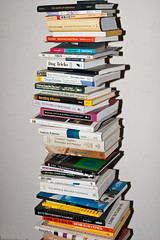
Visitors to my office have a common experience. They say hello to me, but soon their eyes drift around to the walls, desks, and floors of my office to absorb the umpteen volumes of books I have in all manner of organization and disarray.  Polite guests try to ignore the stuffed shelves and precarious towers, but the less inhibited quickly ask, "Have you READ all these books?"

SML Books / 20090903.10D.52433 / SMLImage by See-ming Lee 李思明 SML via Flickr
Well, yes and no.  I love to learn, and I find reading to be an efficient avenue for learning. My curiosity ranges within the social sciences, and then add history, philosophy, theology, and literature and my interests leave me constantly sorting through books old and new. Classic sources are valued alongside the most recently published monographs.

The local thrift store is just as important as our closest Barnes and Noble. You wouldn't believe the fantastic sources I've lugged home for a handful of quarters.

As I look through different sources I find surprises all the time. Serendipity is my best companion. "Why didn't I know about this?" is one of my own frequent questions. The must-read lists of other scholars I respect quickly become absorbed into my own must-read list. NYT book reviews is a great source, but so is twitter and conference book tables and tv interviews. My own amazon wish list has multiplied many times -- I've encountered a limit of some sort along the way.

Sometimes books show up in my mailbox unannounced. Really good things. I'm grateful for those.

So, I'm making another attempt to move quickly through the books I've accumulated. Some stacks have grown stale (so sad), and my current list is a fairly large bag with nine different volumes that must weigh around 30 pounds. On my hot list?
And there's more. Believe me, a LOT more. I have several new literary novels sitting on our dining room table (sorry, honey), a few recent philosophy texts, and a range of biographies and ethnographies that are calling for my attention.

So, as I wait for the proof sheets for my latest book coming this January, I'm falling back to my stack of books this month. Hope you find a quiet corner to get through your own stack as well.
Enhanced by Zemanta

Saturday, August 13, 2011

Worship across the Racial Divide: Order Your Exam Copy Now!

Colleagues,

My new book Worship across the Racial Divide is now listed at the Oxford University Press site. At the right side is a blue link to "Request Examination Copy" ~ 


I invite all instructors, college professors, seminary professors, and periodical reviewers to click on that link and request their copy today!

Best,

Gerardo

Monday, August 8, 2011

Finish and Rest - Taking a Breath in August

The summer has been consuming, so the past couple of weeks have been a combination of finishing final edits on my book with Oxford University Press, taking care of loose-ends, and then taking a moment to breathe.  Besides spending time with my family, I've been taking a leisurely look through a stack of Bibles I've collected around the house.

Since coming back from Michigan, by far the most important thing I've worked on is completing the final set of revisions for my book, Worship across the Racial Divide, coming out early 2012 with Oxford University Press.  These are the "copyedited" files from Oxford that are worked through before being sent to the typesetter for producing the "proof sheets."

What's critical about the copyedited files is that this becomes the LAST CHANCE to make any substantive changes in the document.  And I ended up making quite a few.

Medieval illustration of a Christian scribe wr...Image via Wikipedia
Making Last Changes to Manuscript before Printing?
The last stages of writing a book manuscript for me is a combination of relief and panic.  Relief that this is a critical stage before having an actual printed book in hand, a copy that I will send to my parents, and a copy I will carry around with me to show anyone who'll listen (at the gym, the grocery store, the gas station... you get the picture). But -- Panic that this is the final push before sending off to press, a final opportunity to craft what I'm going to say.

So the past two weeks have been an effort to further weave together the core narrative, accentuating key points, highlighting the main contribution. New thoughts, new arguments keep coming up as I re-read the book, like the relationship of musical taste to church music. I keep finding insights that relate to my book. For example, I read an interesting article saying that as the level of education increases, "musical tolerance" also increases. Yet the same research also shows that genres whose fans have the least education (gospel, country, rap, heavy metal) are most rejected by these “musically tolerant” people.

In contrast to such “taste-based” findings, I find situational dynamics in multiracial churches encourage all members (regardless of race, regardless of education) to strongly favor gospel music. The musical tastes members bring to their churches are not nearly as important as the situational dynamics of race/music/worship within their church. Individual musical taste is subdued in relation to value for highlighting notions of race-based diversity in multiracial churches.  Even more, a person's overall musical preference is subdued in relation to desire for people to connect with others in apart from specific genre(s) of church music.

Also on re-reading the book, the most surprising thread of argument is how important the notion of African American musicality is. All people have profound notions of how "black people" relate to music. It is an incredibly persistent theme.

African Americans bear the weight of diversity in multiracial churches in so many ways, even when few or no blacks attend the church. I can tell you that Chapter 3 on African Americans singing gospel music as the icon of "true worship" will be worth the price of the whole book. Add Chapter 7 on the importance of "gospel choirs" for multiracial worship, and I think it will be an interesting, surprising set of insights. I hope you all enjoy it!

Besides working through the copyedits for my book, I've seen a few movies, caught up on sleep, went swimming and bowling with my family. There's always quite a bit of mail (physical) and email to catch up on, and some new writing projects I'm working through.  Plenty to do.

Title page of The Holy Bible, King James versi...Image via Wikipedia
The Marvel of the "Study Bible"
Perhaps most surprisingly, I found myself reviewing a dozen or so Bibles I have around the house.  Perhaps finishing my own "tome" has got me thinking about others lying around the house....

Some of the Bibles are new (New Oxford Annotated NRSV 4th Edition, MacArthur Study NASB Updated, NIV 2011) but most are quite old (Newberry Reference Bible Portable Edition 1893, Original Scofield 1917 edition, Revised Scofield 1967 edition, Dickson's New Analytical Indexed 1950, Dake's Annotated 1963 alongside the 2006 revised version). These various study editions, nearly all in the King James Version, represent aggressive attempts to systematize the scriptures, lending helps and reference points before, after, and throughout the text.

In a time before computers, the work of notation and typesetting in these "study bibles" would have been fantastically demanding. It is hard for us to imagine the amount of time and passion that went into the construction of these books.  We may be too casual in seeing how these "mini-libraries" seem widely available today. Yet, I find that holding these books in my hand and working through the 1000+ pages of notations, I am overwhelmed with the amount of thinking and striving for coherence and accuracy represented in these works.

Given the 400th anniversary of the King James Version, it seems relevant that most of my looking through bibles has involved this version.  I have a replica of the first edition of the KJV published this year by Oxford (a truly giant book) and one of the most interesting things about it is how much "study" material is included in this book.  Modern translations have not been soley about "text," but nearly always about helping ordinary people make sense of the text, with generous help from translators and editors.

For me, the most intriguing places to look in these bibles is Genesis and Exodus, then Matthew and Revelation. Here are the places where the notes go crazy, with long footnotes, bulging cross-references, and fascinating sub-headings. I'm just today going through the building of the Tabernacle and the equipping of the High Priest (Exodus 23-28). Fascinating in any one of these bibles; supremely interesting when comparing several of them.

I'll round out the summer with attending the American Sociological Association Meetings, and the Association for the Sociology of Religion Meetings, both held in Las Vegas toward the end of August.  If you're there, maybe I'll see you at the buffet line!

Enhanced by Zemanta

Sunday, July 17, 2011

Seminar in Grand Rapids

I've been directing a seminar on "Congregations and Social Change" this month through a program for scholars at Calvin College.

A wonderful, interdisciplinary group has gathered this month:

Kendra Barber (University of Maryland)
Walt Bower (University of Kentucky)
Lloyd Chia (University of Missouri)
Ryon Cobb (Florida State University)
Lisa DeBoer (Westmont College)
Janine Giordano Drake (University of Illinois at Urbana-Champaign)
Lincoln Mullen (Brandeis University)
Paul Olson (Briar Cliff University)
Peter Schuurman (University of Waterloo)
Christine Sheikh (University of Denver)
Phillip Sinitiere (Sam Houston State University)
Kevin Taylor (Boston University)

Together, these scholars represent a tremendous range of knowledge and skills, drawn from the humanities and social sciences, who pursue a broad scope of ambitious questions in the study of religion. Race, work, technology, "the market," identity, women's leadership, incorporation of the arts, and the question of whether "congregations" matter or not, have all been part of rich and not-easily-resolved conversations happening in both classroom and lunchroom.

We read and think a lot together, but I think we all agree we've ate a lot together, too! Food for thought has been more than adequately matched by food for our collective stomachs.

The first three weeks we explored a range of concepts and methodologies and experienced several congregations on visits as individuals and as a group.  Although we are all fascinated by the phenomena of the megachurch (a memorable visit), a stand-out visit for me was the opportunity to meet with the Imam and several lay leaders of a newly built mosque here in the city -- the most multi-ethnic, multi-cultural congregation we encountered.

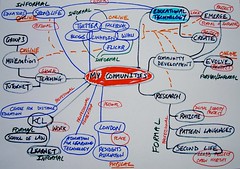
My communitiesImage by steven w via Flickr
This week, participants will share from their own work, something I am really looking forward to hearing.  For me, this is the part where we get to hear ideas in development, articles being born, books being written.  The application of genius to crafting a narrative takes shape before us, further connecting us all into our collective development as scholars.

These are brilliant people, and I am learning from them. Be prepared for more work on the Black megachurch, the emerging church movement, pastor Joel Osteen, conversion narratives between Christians and Jews (both directions), parents raising atheists, second generation mosque leaders in America, congregations and the labor movement in New York, arts and worship, and more.

Special thanks to Penny Edgell (University of Minnesota), Jim Wellman (University of Washington) and Bill McKinney (recent emeritus president of Pacific School of Religion) who each spent time with us and shared their advice and expertise.  Joel Carpenter here at Calvin deserves great thanks for hospitality and his own insightful "footnotes" as well as a nice set of casual conversations with visiting scholars for other programs here in Grand Rapids.

Finally, thanks to all my colleagues in the seminar!  It's a privilege to pursue our questions in scholarship.  It's a gift to do it in community.
Enhanced by Zemanta

Saturday, July 2, 2011

Worship across the Racial Divide: Religious Music and the Multiracial Church

Here's a draft blurb for my forthcoming book (Oxford University Press, 2012):


Worship across the Racial Divide:
Religious Music and the Multiracial Church

Oxford University Press. In press, expected 2012.

"This book will surprise many readers." -- From the Introduction


Church leaders believe worship is key to congregational diversity, and the demand for music that appeals across racial and ethnic cultures has prompted great speculation.

But misguided worship practices based on faulty racial assumptions accentuate rather than relieve the pervasive racial tensions.

Through stories and vignettes from a wide variety of Protestant multiracial churches and interviews with over 170 of their members – including church leaders, church musicians, and regular attendees – Marti's book moves away from assumption and speculation to examine how music and worship actually ‘works’ in diverse congregations.

The book provides an intriguing lens for how race continues to affect religion, even when religion attempts to overcome it.

http://www.oup.com/us/

Friday, June 17, 2011

Conversation, Congregations, and the Cape

Just returned from a fruitful meeting as part of the Congregational Studies Team including Steve Warner, Nancy Ammerman, Bill McKinney, Larry Mamiya, and Jim Nieman, with fellows Orit Avishai, Lynne Gerber, and Tricia Bruce, and special guest scholar John Bartkowski.  What a fine group! 

Having known some of this group for about 10 years (and nearly everyone since beginning my professorate at Davidson), I see a difference in the relationships among this group.

Building at 614 Main Street, Hyannis, Massachu...Image via Wikipedia
I arrived at Cape Cod on Sunday and came home Thursday -- nearly four days of fourteen-plus hours of conversation each day on religion and congregational life in the US and abroad.  We met informally around breakfast, kicked up conversations at our conference site next to the coast morning and afternoon, taking breaks to have lunch and dinner in Hyannis.  Visits to sites, including a large, Brazilian Pentecostal Church and their charismatic pastor. More informal meetings late into the night.

Such immersive conversation gives opportunity to think about the nature of "conversation" among scholars.  And how rare it really is.  While long-time relationships happen among some scholars, given the discussions of this week I can be fairly confident in saying that most scholars don't have opportunity for warm, relational, and consistently constructive encounters with others in their field.

Conversation among scholars is generally a polite affair, accomplished at receptions or before or after conference sessions.  Usually short, amiable, and generally quite distant.  Scholars have a nice way of getting along with each other (for the most part) even if they radically disagree.  But a "distant respect" is quite different from a "caring respect" that genuinely imbues the interactions among the people I was around this past week.

Not that disagreements or even outright arguments don't happen--they do.  And not that this team exists as some form of romanticized utopia.  That's not my view, and not my point.  Instead, my observation from these past few days is that there is a different level of scholarship that occurs among active researchers who respect and trust each other.

Meaningful Conversations?Image by tonyhall via Flickr
The people I was around this week are all very strong people, brilliant in ways I cannot properly specify, yet quite human in ways that can be so disarming.  We tease and play, at the same time reveal aspect of each others thoughts and published work not commonly recognized. Most importantly, our interactions reveal sides of each other's scholarship that are both formed and unformed, with "set" ideas alongside ideas that are continuing to be reshaped.  Here is a group in which uncertainty is welcome as each of us find our way through the difficulty of thinking that is still so very fluid.

As scholars, so often we work alone, careful of who we tell about our ideas.  Direction for many of our projects is not quite there.  It can be unsettling to be so unsure of ourselves today when we can look at our cv's and have such solid evidence of quality publications from our past.  Can we complete more good work? Can we get the help we need as we find our way? And will people still respect us when we admit we just might not be so clear on what we're doing?

Yet admitting uncertainty among those who respect both us as a person and the messy process of research is perhaps the most productive activity to be found in scholarship.  I'm glad to have a group that allows this to happen for myself.  And I hope I can be that person for others because the future of good scholarship can only be found if we avoid overconfidence and accept the feedback of others before we become only distantly caring and rigidly brilliant.


Enhanced by Zemanta

Saturday, June 4, 2011

Second Biennial Conference on Religion and American Culture

Just a brief note that I am now in my second day of an immersive, interdisciplinary conference on religion and American culture sponsored by the Center for the Study of Religion and American Culture and by Religion & American Culture: A Journal of Interpretation. Bringing a striking diversity of voices together, this gathering is a privileged opportunity for a broad ranging discussion at the cutting edges of working through the complexities and continuing richness of religion, drawing out perspectives from the humanities and social sciences.

Thinking RFIDImage by @boetter via Flickr
Yesterday I spoke from one aspect of my research--on approaching the study of racial and ethnic dynamics--while other sessions of the conference bring intense focus on varied and multiform topics I am also deeply invested in working through: overarching paradigms in the study of religion, competing conceptual frameworks, scholarly assumptions on sweeps of history, considerations of personal experience and identity, points of disagreement and correction, amidst a marvelous mix, sometimes clash, of personalities. For those not invested in these issues, it may seem very heady yet what stands out to me so clearly in these two days is the remarkable passion evident with the eager, critical thinkers in the room with me.

Proceedings from the conference will be available online eventually, and others will post more descriptive blog entries soon. Nothing quite substitutes for being in the room right now and seeing the vibrant compression of scholarship that I find so enriching.
Enhanced by Zemanta

Monday, May 2, 2011

Death of Osama Bin Laden

President Obama has just confirmed the killing of Osama Bin Laden, mastermind of 9/11 and founder of Al Quaeda. 


This marks the end of a decade of radical change -- changed air travel habits, increased security awareness, renegotiation of the meaning of Islam worldwide, wars, economic shifts, concerns about oil, concerns about indiscriminate terror, and a more recent surge in democratic movements across the Middle East.  News organizations are proudly and persistently reporting well after midnight this Sunday night, promising the beginning of a busy week of analysis and commentary.  People have gathered outside the White House cheering "USA! USA!" You can almost feel the rumblings in the political, economic, and journalistic realms as twitter feeds light up and facebook statuses are updated.  Some cities are shooting fireworks.  Celebrations have started.  They're singing "God Bless America" at the site of the World Trade Center at Ground Zero. Cheers and beers are being shared well into the start of a new week.

The announcement comes with the end of a school year, and creates a new endpoint to the first decade of the 2000s.  It dissipates a specter of fear from the mountainous regions of a Pakastani/Afghan desert that most have never seen yet most can imagine.  A new future appears to be establishing itself.  And surely even stronger calls to end the wars overseas will occur.

Yet perhaps the fragmentation of terrorist cells and less noticed areas of terrorist planning will find new opportunities to assert themselves.  We have danger points, old ones, and surely new ones to to come.  Still, the death of Bin Laden brings with it the last innocent thought that there is a singular, unified direction to various efforts to violently disrupt the US and other parts of the Western world.

I suggest one of the most important consequences of the death of Bin Laden is a greater contextualization of the issues of the Middle East.  We would all benefit from greater attention to what is occurring among particular people with particular issues in particular places.  We need more careful attention in all regions and at various levels of discussion and analysis to appreciate the nuanced conflicts that will still exist long after Bin Laden is gone.  We need to stop thinking in grand terms ("fundamentalism" "Islamofascism" "terrorists") and bring sensitive approaches that allow us to see the true danger points away from mere ideology, religious orientation, ethnicity, or even citizenship.  Where shall we focus? What armed and diplomatic efforts yield the best outcome? What kind of intelligence is needed to be trained now?

Even more: What future are we more free to imagine now?  Now that Osama Bin Laden is dead, what can we now see as the collective life we most wish to live?

Saturday, April 30, 2011

2nd Bi-Annual Religion in American Culture Conference

This is an ultra-fast, very quick post while I'm busy with my family this weekend.

I'm thrilled to be part of the Second Bi-Annual Conference on Religion in American Culture at the beginning of June sponsored by the Center for the Study of Religion and Culture at IUPUI and by Religion & American Culture: A Journal of Interpretation. This is a rare gathering of very fine scholars of religion across the disciplines. 

The extensive series of conversations combines insights of those working from different perspectives to stimulate new and better understandings of religion’s role in American life.

The first Conference on Religion and American Culture, held in Indianapolis June 4-7, 2009, laid the foundation for the series, with a focus on recognizing disciplinary boundaries and exploring how scholars within those disciplines might learn from each other. Proceedings of those first sessions are available online (PDF file download here).  Also -- Linford Fisher blogged his highlights, and I blogged several posts myself here, here, and here, here, and here, here, here, and even here  at this site.

This is a major conference for hearing and interacting with notable scholars.  Full information on the this affordable conference is front-page news at the RAAC website.  I thoroughly enjoyed the first one and expect much insight and passion throughout our coming days together.

Hope to see you there!